Ten years ago, I would have turned my nose up at the idea that we already understood how to get machines to think (…) it seemed absurd to me that a mere next-word predictor could ever truly understand new concepts
I was wrong.
The one writing those sentences is Blaise Agüera y Arcas —a leading voice at the intersection of machine learning and cognitive science—in a brief paper1 published in Nature in November 2025, on the occasion of the publication of his book, What is Intelligence?
In 2025, we find ourselves in the rather comical situation of expecting such large language models to respond fluently, intelligently, responsibly and accurately to all sorts of esoteric questions and demands that humans would fail to answer.
And here comes the twist:
After months of intense, recurrent debate regarding the mathematical results churned out by new AI tools—such as the fierce controversies surrounding the Navier-Stokes theorem—the list of mathematical discoveries by artificial intelligence began expanding at a dizzying pace. But that was only a prelude.
On the evening of October 6, 2026, some of the world’s leading mathematicians gathered in Princeton, New Jersey, to mark the opening of a new academic year at the Institute for Advanced Study’s (IAS) School of Mathematics. For weeks, rumors had buzzed through the halls that OpenAI was close to dropping scores of solutions to advanced, unresolved math problems. But the reality left the gathered mathematicians agape: OpenAI had quietly dumped an unprecedented mass of 722 preprints covering 372 distinct results onto the web.
As Science magazine reported, the move changed mathematical research overnight. Through OpenAI’s official announcement and the corresponding GitHub repository (openai/math), the AI lab revealed a broad range of mathematical manuscripts and supporting proof artifacts produced entirely by an internal frontier model.
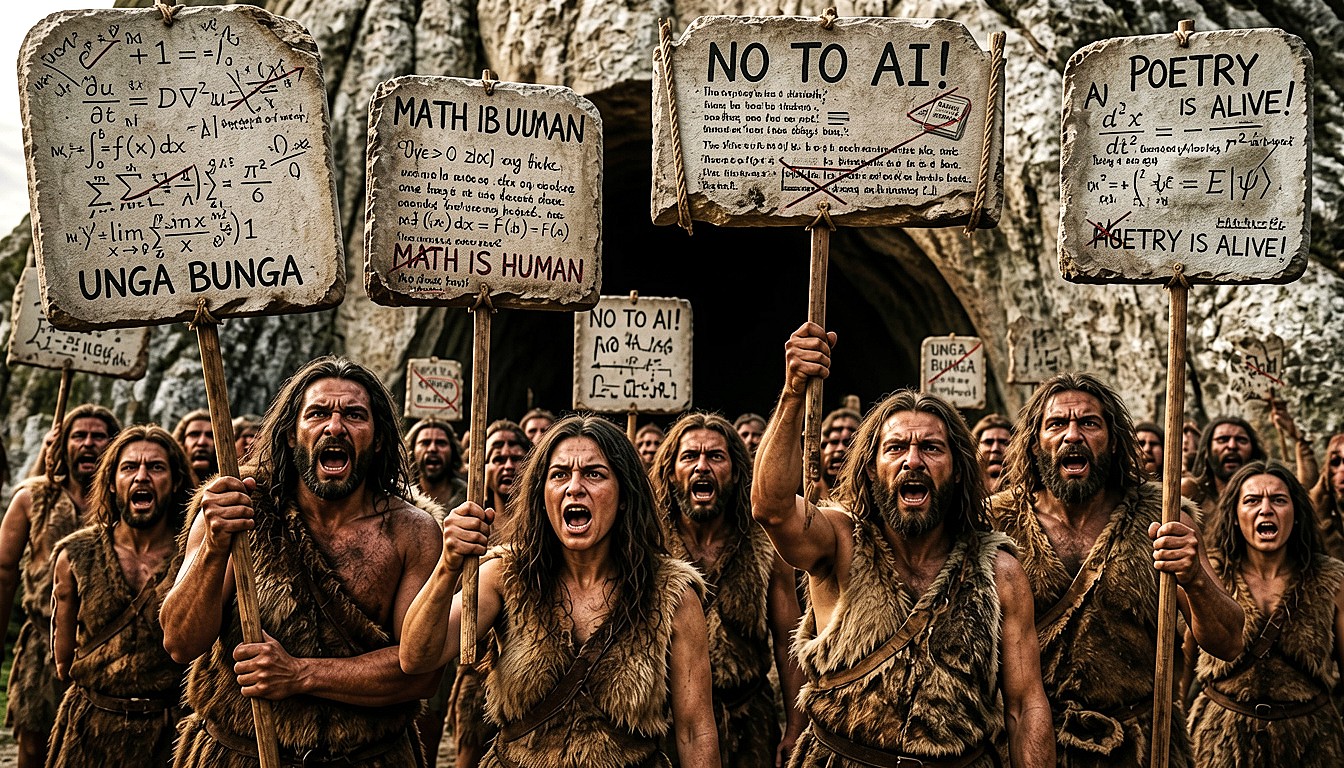
It is no big surprise that right now some mathematicians are in the process of becoming a brand-new Luddite movement, digging in their heels with the solemn conviction that “[a]rtificial intelligence tools pose a fundamental threat to scientific practice and mathematical understanding”—a defensive line now being etched into formal membership commitments at places like the Association for Human Mathematics.
The shockwaves are rippling across the entire discipline. As Stephen Wolfram —the computational physicist, founder of Wolfram Research, and creator of Mathematica—mapped out in his late-September reflection on the future of pure math research, and as Quanta Magazine reported just as these tensions boiled over, the establishment is facing this sudden shift with grief, anger, and a desperate scramble for fresh ideas. After all, as one stark warning puts it, “If we don’t adapt, there’s just no more math in 50 years”.
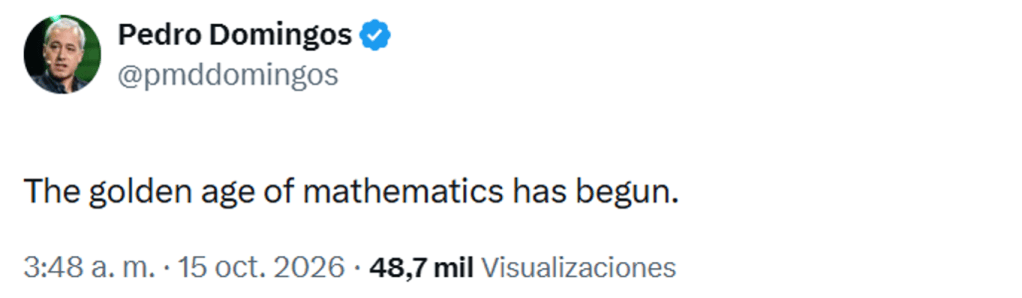
Or are we entering the golden age of mathematics? As Pedro Domingos——University of Washington computer science professor, author of The Master Algorithm, and never one to shy away from bold claims—declared with his customary sobriety:
Stepping back from both the panic and the hype, Terence Tao—the Fields Medalist at UCLA, widely regarded as the finest mathematician of his generation—explores the question with calm, in a balanced reflection published last weekend (very much worth a full read):
What do we know today about the mathematical abilities of LLMs? Theoretical and empirical insights both support the conclusion that LLMs are extraordinary at recombining existing intellectual structures and discovering unobserved connections among distant parts of the scientific literature. What is more, LLMs do this at a scale that is inaccessible to individual researchers. Whether their uncanny effectiveness at proving theorems can be entirely explained as hyper-sophisticated linguistic recombination, or whether it involves other forms of synthetic reasoning that are yet to be described and understood, is today an open scientific question.
(We may even be in a situation where there is a mathematics of humans and a mathematics of LLMs. This is maybe true not only at a linguistic level, but also in a deeper sense, although it is just too early to say.)
My reading? Very likely, yes: we are entering a new era, and mathematics as we know it will end—not because it is dying—quite the contrary—, but because we are finally forced to face an old, fundamental question: What is mathematics, after all?
As Reuben Hersh famously argued in What Is Mathematics, Really?3, if we step away from Platonist ideals:
mathematics must be understood as a human activity, a social phenomenon, and a deeply embedded part of human culture—historically evolved and intelligible only within a social context.
This “humanist” viewpoint reveals that math is fundamentally a language and a cultural artifact. Hersh builds on the breaking ideas of the anthropologist Leslie White, whose work he cites in the aforementioned piece and whose seminal piece The Locus of Mathematical Reality4 is included in 18 Unconventional Essays on the Nature of Mathematics5:
Mathematics did not originate with Euclid and Pythagoras—or even with the thinkers of ancient Egypt and Mesopotamia. Mathematics is a development of thought that had its beginning with the origin of man and culture a million years or so ago. Had it not been for the human ability to give these ideas overt expression in symbolic form and to communicate them to one another so that new combinations would be formed… the human species would have made no mathematical progress beyond its initial stage.
For all of us who have loved and enjoyed math—and who have spent years facing the skepticism of those resistant to abstract thinking—this moment is both a shock and an illumination.
What if mathematics is not what we thought it was? Back to Agüera y Arcas:
If we accept that intelligence is essentially computational—the view held by most computational neuroscientists—we must accept that a working simulation of intelligence is intelligence. And if scaling up computation yields artificial intelligence, could the kind of reasoning shown by living organisms, humans included, also be the result of computational scaling?
AI, biological intelligence, and indeed life itself, might all have emerged from the exact same process.
You can only guess what’s coming6.
The most touching thing of all is that it seems AI might finally bring about the reconciliation of the ‘Two Cultures’—the famous divide described by C. P. Snow.
Mathematicians and literary minds, united at last: UNGA BUNGA!”
____________________
(1) Agüera y Arcas, Blaise. ‘What Is the Future of Intelligence? The Answer Could Lie in the Story of Its Evolution’. Nature 647, no. 8091 (2025): 846–50. https://doi.org/10.1038/d41586-025-03857-0.
(2) Arcas, Blaise Agüera y. What Is Intelligence?: Lessons from AI About Evolution, Computing, and Minds. Antikythera, edited by Benjamin H. Bratton. MIT Press, 2025. https://mitpress.mit.edu/9780262049955/what-is-intelligence/.
(3) Hersh, Reuben. What Is Mathematics Really? Oxford University Press. London, 1997.
(4) White, Leslie A. ‘The Locus of Mathematical Reality: An Anthropological Footnote’. Philosophy of Science 14, no. 4 (1947): 289–303.
(5) Hersh, Reuben. Ed. 18 Unconventional Essays on the Nature of Mathematics. New York, 2006.
(6) What Blaise Agüera y Arcas describes is much the same as what I explored in my recent essay on Experimental Cities, and it has been touched upon in this blog in several contexts. Yet, what each of us anticipates from this major evolutionary transition is (very likely) different. The contours of the future are always hard to grasp.

