
Why freedom isn’t just a value — it’s evolution’s winning strategy.
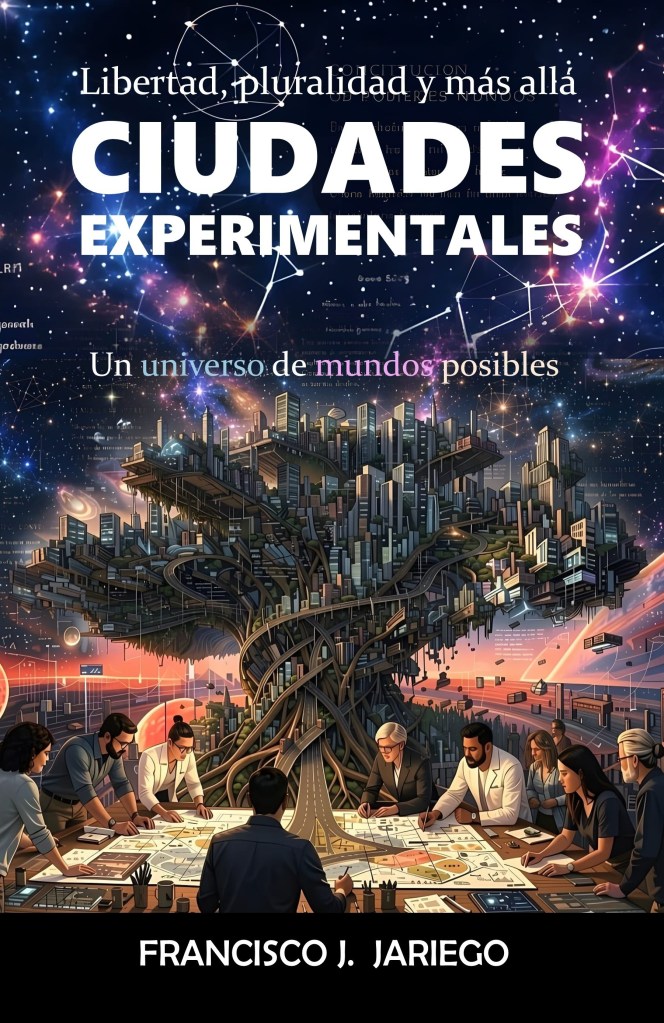
Experimental Cities: Freedom, Plurality, and Beyond begins with an uncomfortable question: why does humanity not apply to governance the same method that has transformed science and technological innovation?
Nation-states —in particular, modern democracies— lack the systematic mechanisms to trial, validate, and improve models of social organisation. Faced with a Great Transition that multiple authors — from vastly different fields and ideological positions — anticipate for the twenty-first century, we explore the Experimental City as an institutional laboratory: a voluntary community with an explicit social contract, its own governance, and an evaluation framework that turns experiment into cumulative knowledge.
Exploration and experimentation are not modern inventions. They are the oldest human instinct — and the one most consistently rewarded by history:
Is not the capacity to experiment with different forms of social organization itself a quintessential part of what makes us human? That is, beings with the capacity for self-creation, even freedom? (Dave Graeber)
In a world that has run out of terra incognita, Experimental Cities might be the new caravels that will allow us to navigate the immense ocean of ideas, opening new routes towards the countless possible and desirable futures that are yet to be discovered.
The essay reviews the history and current state of charter cities, free private cities, startup societies, network states, and more, and argues that diversity and competition between governance systems is not merely a liberal principle: it is the most intelligent evolutionary bet in the face of uncertainty.
Liberty is essential in order to leave room for the unforeseeable and unpredictable… All institutions of freedom are adaptations to this fundamental fact of ignorance, adapted to deal with chances and probabilities, not certainty. (Friedrich Hayek)
Experimental Cities is published with two main purposes:
- The first is dissemination: to bring the concept of the Experimental City — with rigour and narrative ambition — to the Spanish-speaking world, where these ideas are almost unknown.
- The second is connection: to build bridges with individuals and institutions who defend freedom and believe, as the author does, that a plurality of models of coexistence is a necessary condition for the human species to face what is coming.
In short, a pro-freedom manifesto. And an invitation to act!
You can read it — for free — today. But this is just the beginning.


[…] To wrap up my own quixotic excursion, let’s look at a recent piece from another AI Illuminati that hits much closer to my personal obsession about individual freedom: […]