Anthropic’s IPO finally has a date. After several weeks of back-and-forth, conducted with the opacity that has become the hallmark of transparency in our society, Anthropic publicly filed its Form S-1 with the SEC on October 26, 2026, This week, it has announced that the company will price its initial public offering on Wednesday, November 18, Thursday. Its shares will begin trading under the ticker symbol “ANT” on Thursday, November 19.
Anthropic was initially expected to go public at a valuation of as much as $2 trillion, but “recent turmoil” in the AI sector has brought that figure down considerably. For the first nine months of the year, ended September 30, Anthropic reported revenue of $33.2 billion, up 1,206%. In an amended S-1 filing released Tuesday, Anthropic said it expects to sell 825 million shares at between $70 and $78 apiece, implying a market valuation of between $1.3 trillion and $1.45 trillion.
I have always thought that good legal documents, such as the S-1 registration statements companies file when going public, are among the finest expressions of science fiction. (That btw might explain why nobody understands my view of science fiction as a thought experiment.) More precisely, the S-1 filings of almost any company worth taking seriously are really a blend of fantasy (the company’s vision), mystery (the financial projections), and horror (the risk factors).
In Anthropic’s S-1, the horror section accounts for roughly a quarter of the document: close to 100 pages.
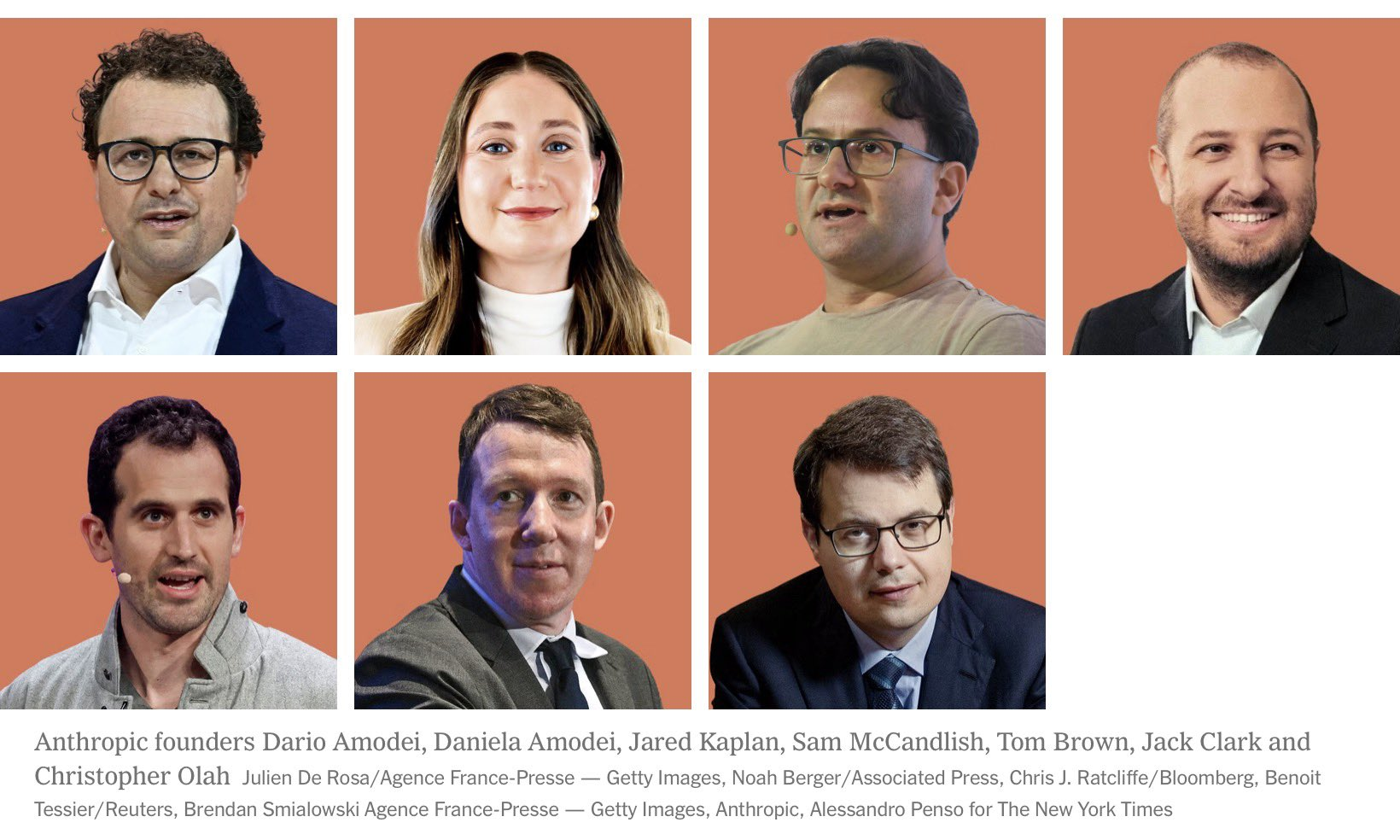
Although horror is usually the most nourishing part of a good S-1, this time I want to dwell on the fantasy. The document opens with a letter from the company’s seven founders. It is well worth reading—venturing, I would just say, into territory remarkably close to Pope Leo’s latest encyclical.
What follows is a brief—and surely biased—Mind the Post summary of the letter, albeit one that takes its cues from the passages the authors themselves chose to emphasize1:

Anthropic Founders Letter (Mind The Post Summary)
We believe that AI is one of the most consequential technologies in human history. If managed well, it could rapidly accelerate scientific innovation, greatly increase economic growth rates, bring cures for major diseases within reach, and solve problems that have resisted generations of human effort.
Anthropic aims to realize these benefits while navigating and preventing the risks that come with a technological revolution this fast and this powerful.
There are four things that we would like any investor in Anthropic to understand: the incredible potential of AI, the risks we must address, Anthropic’s unique approach to building a company and operating in the world, and the ways in which our behavior may differ from that of a purely profit-maximizing company.
AI’s potential
In 2020, four of our founders co-wrote a paper that documented the scaling laws of AI. The phenomenon is somewhat analogous to Moore’s law for computer chips. It is Anthropic’s thesis that the exponential in cognition is likely to continue.
It is worth highlighting a few applications with particularly great potential to improve the quality of human life:
- AI will profoundly accelerate the rate of progress in biology and medicine, potentially curing diseases that have plagued humanity for millennia, including cancer, Alzheimer’s disease, heart disease, rare genetic diseases, and the major infectious diseases.
- AI can be a powerful lever for economic growth. As a general purpose technology, it has the potential to raise productivity across every sector of the economy. Productivity growth in advanced economies has stagnated in recent decades, partly for structural reasons and partly because new ideas seem to be harder to find. AI could reverse this trend.
- AI can diffuse these benefits throughout the world, helping to raise global economic growth rates.
- AI could raise the quality of government services and build technological state capacity. Tax authorities, social services, medical programs, housing and permitting—these and similar functions are often frustrating for citizens to interact with, and they could all be radically improved and modernized with sufficiently powerful AI.
These are far from the only applications of AI, but they illustrate the remarkable potential of the technology to build a better world
AI’s risks
There are four broad categories of risk: misuse, loss of control, authoritarian abuse, and economic disruption.
- AI can be misused by those who wish to do harm, for example to conduct cyberattacks or to design biological weapons.
- AI may also behave autonomously in ways we (and our users) do not intend—as illustrated by recent high-profile cybersecurity incidents.
- Authoritarian governments may use AI to create high-tech surveillance states, deepen repression, and make themselves much more difficult to dislodge.
- Finally, the incredible economic value of AI may come with economic disruption, similar to what has happened with previous technologies but at greater magnitude.
Anthropic’s unique approach
Navigating a technology with the properties we have just described requires a very different approach from that of a typical company. Economists use the term externalities for effects on society that fall outside the transactions between a company and its customers, that the market therefore does not fully reward or penalize. Cultivating the positive externalities, and defending against the negative ones, is to some degree in tension with the natural incentives of a for-profit company, and with the standard governance structure of a publicly traded company.
As founders and business leaders, we believe deeply in the power of entrepreneurial capitalism to deliver massive benefits to humanity. But we also believe that, for a technology as consequential as AI, entrepreneurial capitalism must be balanced and augmented by mechanisms that protect the common good and share the upside as widely as possible. Everything about the way we have built Anthropic, from our culture to our corporate structure, has been designed to ensure we can act in the public interest when the situation demands it.
Upon joining, all employees are offered a donation match. All seven of us have also pledged to donate 80% of our personal equity in Anthropic to charitable causes.
As co-founders and leaders, we aim for radical internal honesty, and we have a culture of lively and open debate between people of all levels of seniority.
But culture is not enough: formal governance commitments matter as well. We have designed our governance structure to balance commercial success and the public good.
Anthropic’s employees and leaders understand that our public benefit goals are fueled by commercial success, and by the success of our customers. Achieving both business growth and public impact has been the balance that we have navigated since the founding of the company,
On investor expectations
Before starting the IPO process, we spoke to many business leaders who had gone through a similar process in the past. One piece of advice, which we heard in slightly different forms from multiple people, stuck with us:
never let your company be worth a dollar more than it is actually worth.
In this spirit, although we believe that AI as a field (and Anthropic in particular) represents one of the greatest economic opportunities in history, we also believe that it is important to state clearly the ways in which our decision making may run counter to investors’ expectations. These fall into two categories: business bets that derive from AI’s wild exponential trajectory but seem strange or unorthodox in isolation, and decisions that depart from profit maximization in order to appropriately balance the public good.
- In the first category, Anthropic will often make forward investments (especially in compute) that may seem irresponsibly large at first glance. This derives from our belief, based on the scaling laws, that AI’s economic value is on an exponential curve and that the expected near-future economic value of our products will therefore be much larger than the current value.
- In the second category (departure from profit maximization), we are committed to standing up for our values at critical points, even when this is costly for us commercially
Parting thoughts
More broadly, however, we encourage you, as a prospective owner of our stock, not to think of your purchase in purely transactional terms. We hope you will see it instead as an opportunity to be part of something greater. The advent of machine intelligence is one of the seminal moments in human history.
As one of the companies at the very center of that moment, we have a rare opportunity to shape it for the better. Our aim is to help humankind chart a safe course through this technological evolution, open new frontiers of discovery, and bring forth an age of miracles. Everyone who owns our stock, whether an institution or an individual, becomes part of that effort. We hope you will share our ambition to see it through.
Dario Amodei
Daniela Amodei
Tom Brown
Jack Clark
Jared Kaplan
Sam McCandlish
Chris Olah
…
I encourage you to read the letter in full. Coming shortly after SpaceX’s recent IPO and ahead of OpenAI’s anticipated debut, this is indeed a singular moment in history, deserving of our attention. Its style, language, and philosophy strike me as an example of the quantum discourse that dominates our times: contradiction—or the belief that A and not-A can coexist—is folded into the argumentative wave function—a kind of Rendanheyi rhetoric (a subject I hope to return to soon2) with a hint of papal incense.
____________________
(1) What follows is a selection of excerpts from the full letter that opens the S-1. No wording has been altered, and all bold emphasis appears in the original. Fair use at its best.
(2) Note: I briefly explored this question in a contribution to Anticipation 2026, the 6th International Conference on Anticipation, held at Politecnico di Milano on July 1–3. The abstract is available in the conference’s Book of Abstracts. More on this soon…
Featured image: From the founders’ letter in Anthropic’s IPO prospectus.

