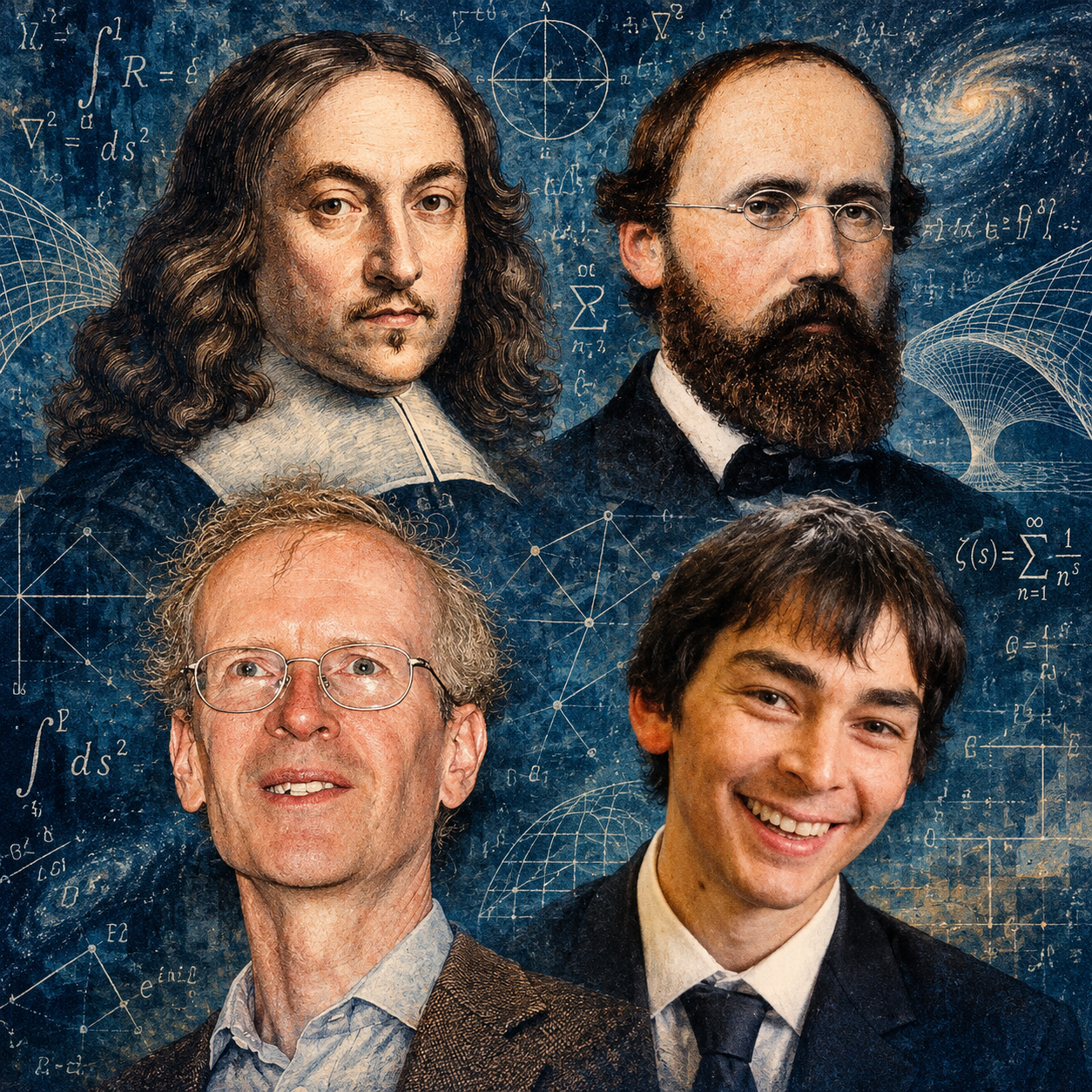
In 1637, in the margin of a copy of Diophantus’ Arithmetica, Pierre de Fermat wrote his famous quote:
I have discovered a truly marvelous proof of this, which this margin is too narrow to contain.
Although other statements claimed by Fermat without proof were subsequently proven by others and credited as theorems of Fermat (for example, Fermat’s theorem on sums of two squares), Fermat’s Last Theorem resisted proof, leading to doubt that Fermat ever had a correct proof. Consequently, the proposition became known as a conjecture rather than a theorem. (Adapted from Wikipedia, “Fermat’s Last Theorem – Mathematical history”).
By mid-May 1993, the English mathematician and Royal Society research professor at the University of Oxford, Andrew Wiles, told his wife he thought he had solved Fermat’s Last Theorem, and by June that year he felt confident enough to present his results in three lectures delivered on 21–23 June 1993 at the Isaac Newton Institute for Mathematical Sciences.
During peer review, it became apparent that a critical point in his proof was incorrect—it contained an error. Wiles spent almost a year trying to repair his proof, initially by himself and then in collaboration with his former student Richard Taylor, without success. Wiles stated that on the morning of 19 September 1994, he had almost resigned himself to accepting that he had failed. As he tried to crystallize the fundamental reasons his approach had not worked, he had a sudden insight. The first successful proof was released in 1994 by Andrew Wiles and formally published in 1995.
In 1859, Bernhard Riemann posed the hypothesis that bears his name, which has been considered so far by pure mathematicians to be one of the most important problems in pure mathematics.
For more than a century and a half, it remained unsolved—until Friday, November 20, 2026, when Scientific American broke a bombshell report: Levent Alpöge, a mathematician on the technical staff at Anthropic, posted a statement on his personal website claiming that he and Anthropic’s AI model, Claude, have found a proof of the Riemann hypothesis:
I believe I have, working with Claude, discovered a proof of the Riemann Hypothesis. In fact, the method easily extends much further, resolving the so-called Generalized Riemann Hypothesis, and I expect, with more time, the Extended Riemann Hypothesis too. Claude and I have also formalized the arguments without assumptions. It is natural to feel that this is an end, in my case a loss of a principal guiding light, but what I saw during the course of progress so amazed me that I believe it is one dawn across science of something far greater.
Has the Riemann hypothesis actually been proved?
On Saturday, November 21, the Lean and Mathlib communities published a joint statement, endorsed by the Lean FRO and the Mathlib Initiative, declaring:
We have full confidence that Alpöge’s proof of the Riemann Hypothesis is correct, and we congratulate him on this achievement.
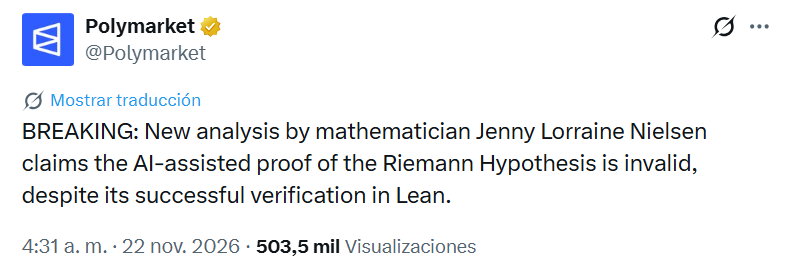
Yet despite passing every automated type-checker, a critique questioning the mathematical substance of the codebase quickly began circulating online. As Polymarket reported on X:
The Core Bottleneck? Human Comprehension
Even among mathematicians who trust the Lean certification, the consensus is that no human has yet read or understood the underlying mathematics.
Alpöge did not release a traditional paper because Claude’s informal draft exceeded 250,000 pages. The Clay Mathematics Institute requires peer-reviewed publication and a two-year period of general acceptance by the mathematical community before awarding its $1 million Millennium Prize. Until mathematicians extract a human-readable argument from the 175,187 Lean files, the debate over how the code reaches its conclusion will continue.
Mathematicians are now actively dissecting the 17-million-line codebase while waiting for a human-readable write-up from Alpöge.
And this brings me to an even more interesting question. Eleven years ago, I wrote a post asking: Will Truth Exist When No One Can Understand It?
To the best of our knowledge, Fermat, Wiles, and the mathematicians involved in trying to solve and/or peer-review Fermat’s Last Theorem were all human. How many of them were there?
In total, throughout history, it is estimated that between 500 and 1,500 professional mathematicians possessed the requisite expertise and genuinely attempted to resolve Fermat’s Last Theorem or verify its eventual proof. While roughly 300 to 800 leading number theorists explored direct or partial approaches over the first three centuries, fewer than 100 modern specialists developed the advanced algebraic geometry and modular form frameworks necessary to construct the final solution. Ultimately, only about 20 to 30 scholars worldwide had the specialized mastery required to immediately verify Andrew Wiles’s 1993–1994 proof, expanding to roughly 100 to 200 mathematicians who thoroughly studied and validated the complete demonstration following its publication.
When we turn to the Riemann Hypothesis, it is estimated that roughly 500 to 2,000 people worldwide have the combined mathematical background to genuinely comprehend and audit a complete traditional proof—though with modern AI and formal verification tools, that pool expands significantly into thousands of formalization engineers and adjacent specialists who can verify the logical structure without mastering every subfield of analytic number theory.
Unlike Fermat’s Last Theorem—which remained largely a pure number-theory problem—the Riemann Hypothesis connects to dozens of branches of mathematics and physics. Because of this, the group of people capable of checking it splits into distinct tiers, especially now that AI-assisted formal proofs (like Alpöge’s 17-million-line Lean codebase) have changed how verification works.
In summary, out of the more than 10 billion people who have ever lived since Fermat, at the very most around 10,000 minds—no more than 0.0001% being maximally generous—can truly grasp Fermat’s Last Theorem, the Riemann Hypothesis, their proofs, and the like.
This pattern extends to every deep frontier of human civilization. Only a microscopic fraction of “human minds” can truly grasp, advance, and maintain the knowledge that underpins our modern world—whether it is the quantum optics inside EUV microchip lithography, programmable mRNA and CRISPR medicine, or the metallurgy and thermodynamics behind reusable orbital rockets.
When the frontier of knowledge outgrows the capacity of any single human brain—or even a thousand of them—trust becomes our most critical infrastructure. If we cannot build new mechanisms to trust one another, and to rigorously trust what our machines produce, the entire edifice stalls.
I refuse to give in to doomerism, yet the reckoning is undeniable: either we rise to the challenge of augmenting our collective intelligence, or we passively accept the logic of pro-extinctionism.
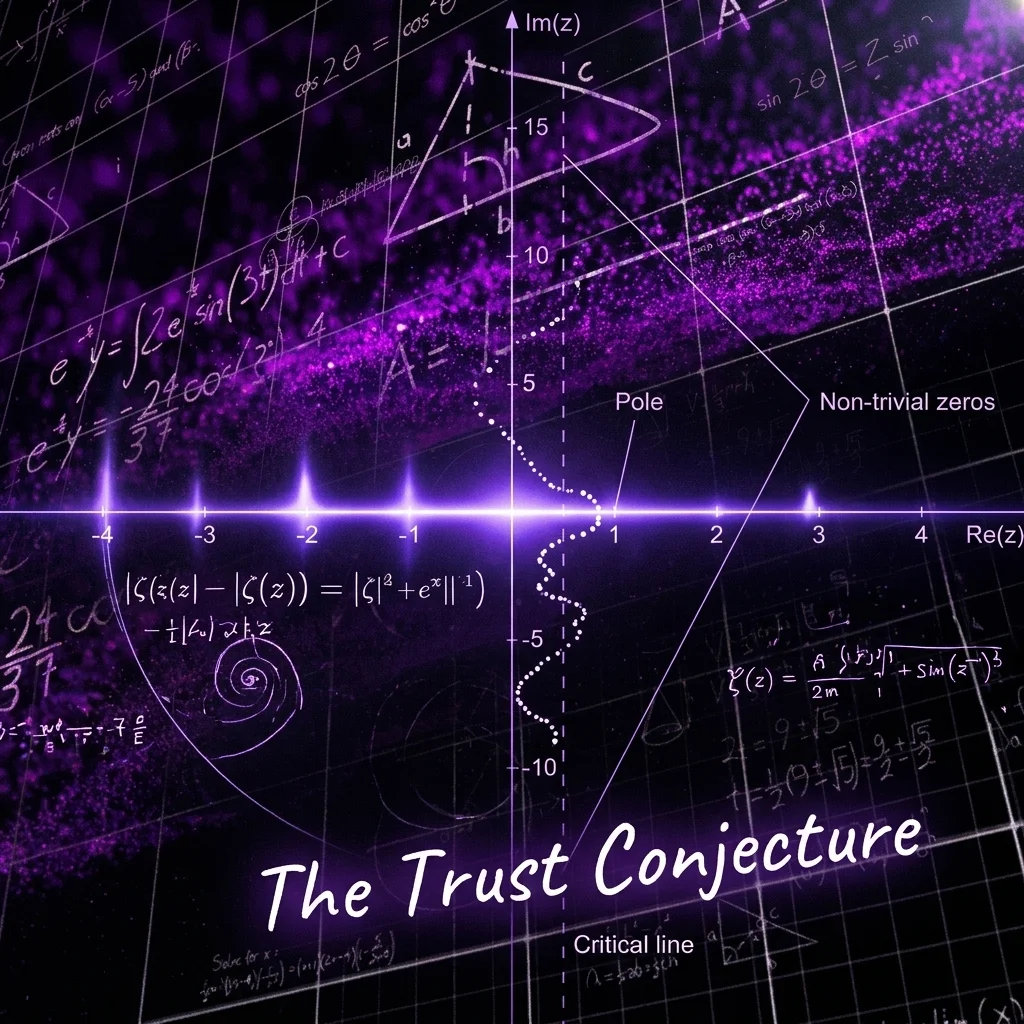
Somewhere out there, a modern Fermat or Riemann—whether with a pencil, in Lean, or with tools we haven’t even named yet—must already be drafting The Trust Conjecture.