
The World Intellectual Property Organization (WIPO) has just published The Global Innovation Index (GII) 20261.
The Global Innovation Index 2026 reveals an innovation landscape in transition, where technological progress continues, investment patterns are shifting and deep science ventures are working to translate frontier research into scalable industries.
Key takeaways
1. In 2025, innovation investments largely positive again after the 2023 downturn, but growth mostly below trend
- Scientific publications hit a new global record: Global research output surpassed 2.4 million articles last year, growing 6.9 percent above its long-run trend.
- Global R&D growth solid, China edges ahead of the United States:
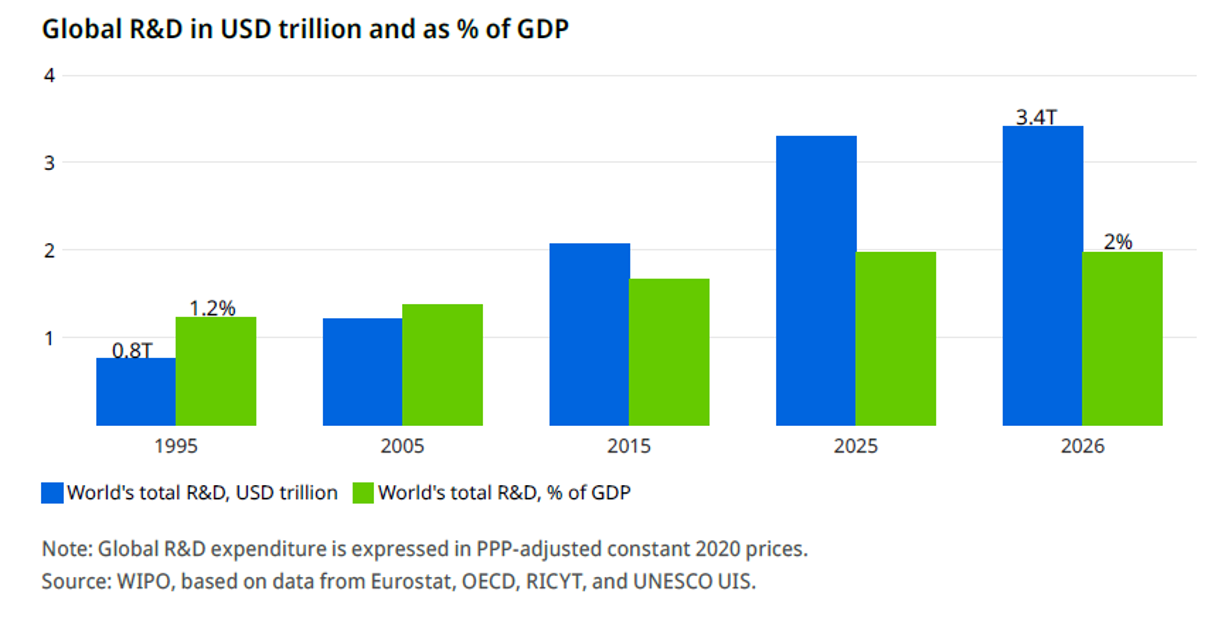
- Corporate R&D hits a record: USD 1.5 trillion last year, growing 5.8 percent in real terms from 2024. Expansion is increasingly driven by software and artificial intelligence (AI)-intensive firms, though aerospace and defense R&D rose sharply as well.
- Venture capital (VC) values recover, but activity narrows:
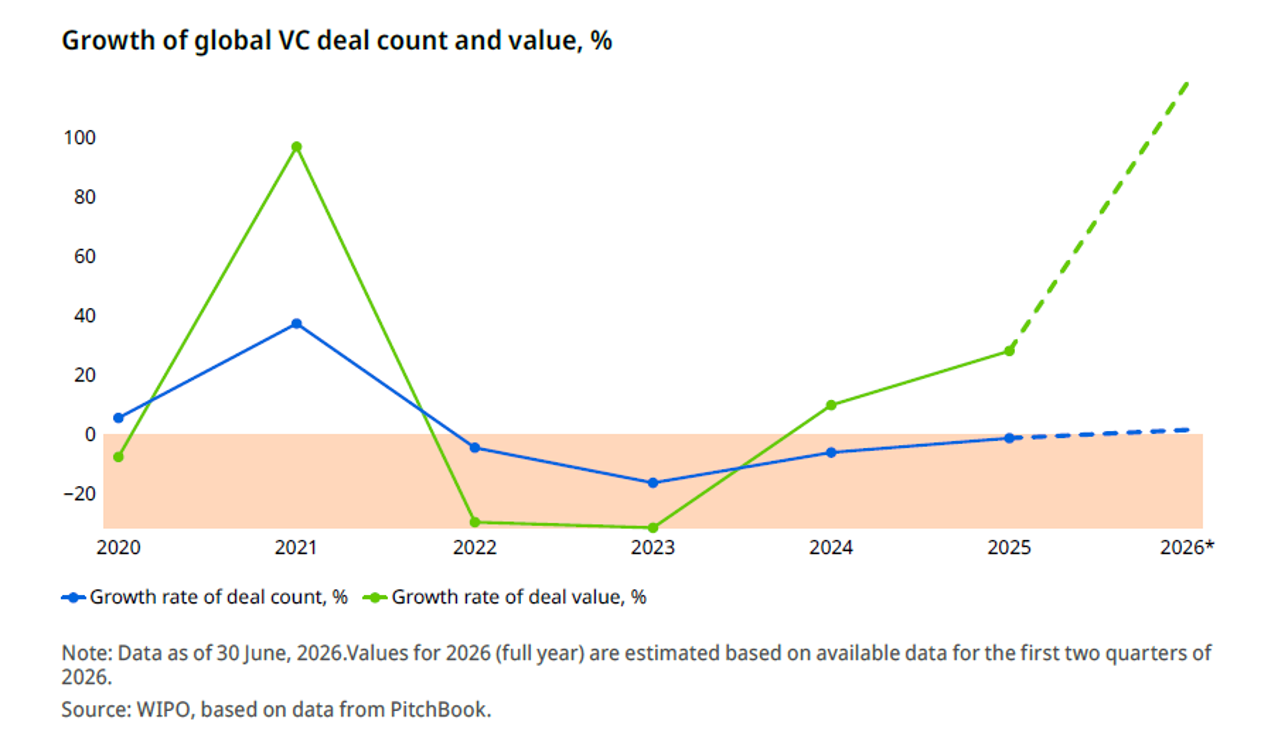
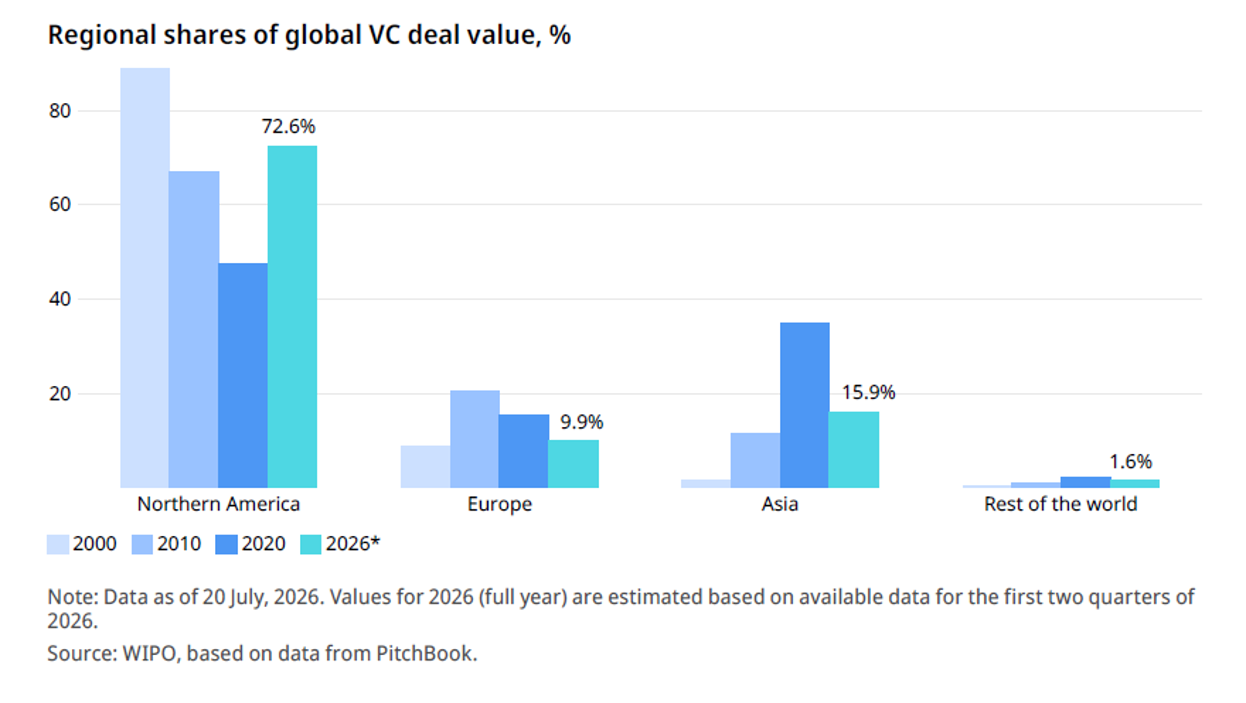
- International patent filings continue to expand, but below trend:
2. Technological progress: continued advances at a slower pace
3. Technology adoption: wider diffusion with uneven access
4. Socioeconomic impact: social gains continue, climate pressures persist
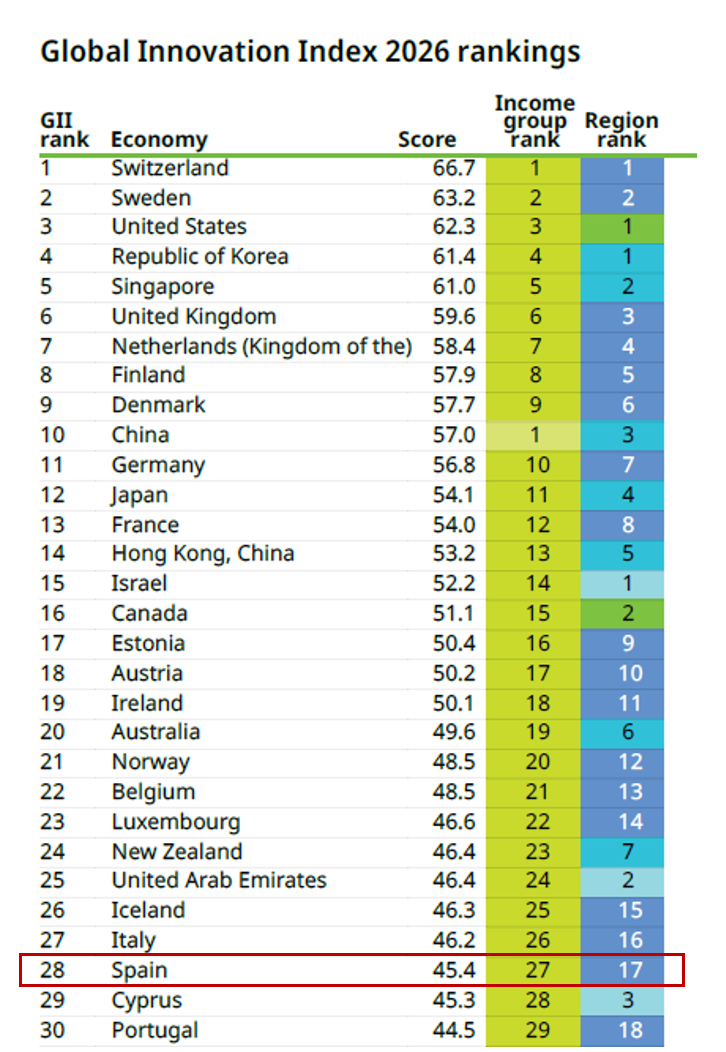
5. In a turbulent year, the innovation frontier holds: Switzerland, Sweden and the United States lead again
6. A few other economies reach key milestones including Portugal, Latvia, Kuwait and Costa Rica; Bhutan joins the GII
7. Middle-income economies keep climbing, but an innovation glass ceiling is becoming more apparent
- China (10th), India (38th), Viet Nam (43rd), Türkiye (45th), the Philippines (52nd), Morocco (54th) and Indonesia (55th) have advanced most among middle-income economies since 2013. Morocco reaches its best rank ever; Viet Nam returns to its pre-pandemic level.
8. Since 2019, a newer wave of climbers has gathered pace, powered by investment, digital transformation and services
9. Who converts inputs into outputs?
- China is the most prominent outlier
- Several middle-income economies do more with less: Morocco ranks 76th in inputs, but 46th in outputs, with the Islamic Republic of Iran, Mexico, Tunisia, Türkiye and Viet Nam showing similar patterns, and Madagascar, Nigeria, Pakistan and Zimbabwe also producing more than their inputs would suggest.
- Qatar, Saudi Arabia and the United Arab Emirates show the reverse: strong institutional, infrastructure and investment foundations, with conversion into results the necessary next step.
10. Switzerland, China, India and Rwanda lead their income groups; momentum in Africa
- Sub-Saharan Africa shows some of the year’s most encouraging momentum
11. New green-field R&D and high-tech FDI indicator: investment is highly concentrated, but middle-income magnets emerge
12. Twenty-one economies innovate above their level of development, led by India and Viet Nam for a 16th year
13. The world’s top innovation clusters span six out of the seven continents, with Shenzhen–Hong Kong–Guangzhou leading globally for a second year
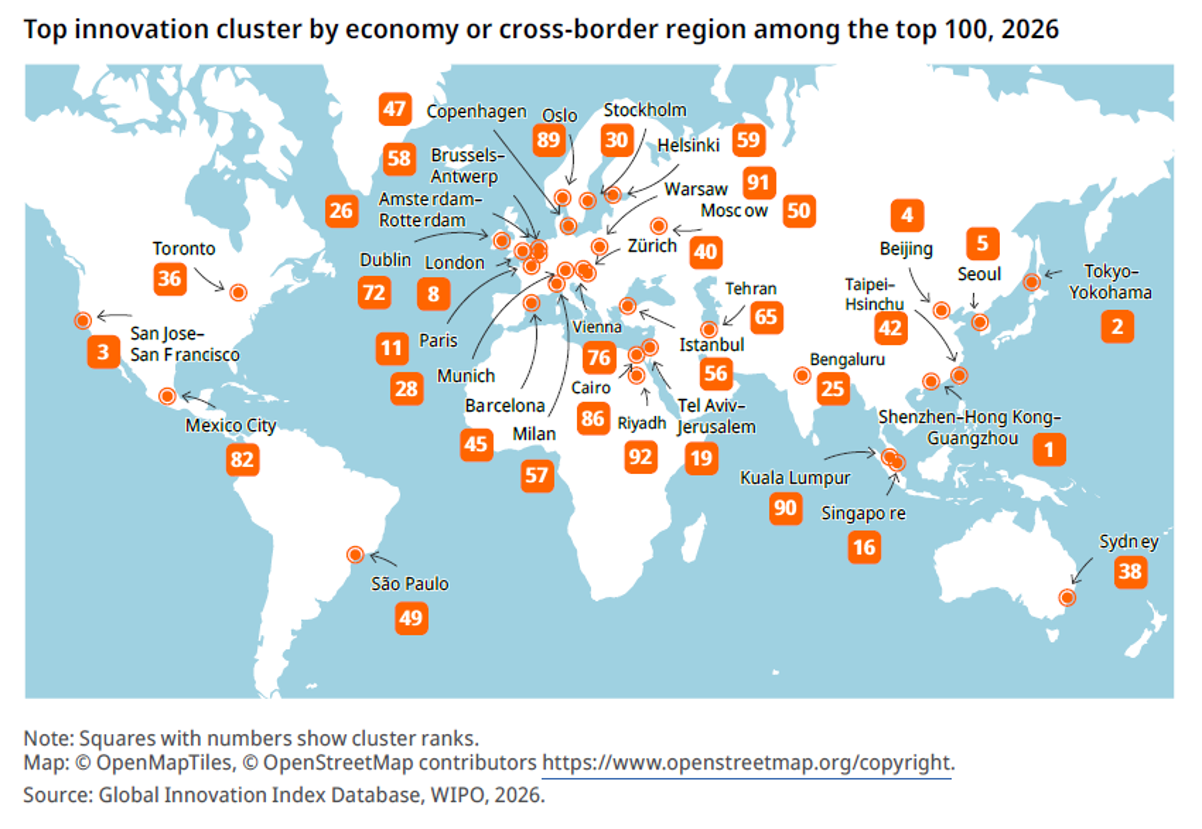
14. San Jose–San Francisco and Cambridge are the most innovation-intensive clusters, with several smaller hubs close behind
A “deep” dive on science-powered entrepreneurship
This year’s special GII theme looks to the future of science-powered entrepreneurship:
15. A deep science wave: more than 30,000 startups since 2000, now worth USD 7.6 trillion
16. Patents anchor deep science ventures, and their use widens with maturity
17. Deep science takes root beyond leading hubs, but ventures stall at predictable transitions
18. Policy priorities: finance the full translation stack and activate demand
Spain

WIPO GII 2026 places Spain at 28th globally —17th (out of 39) in its region (Europe)— with:
- Top Innovation Clusters: Barcelona holds strong at 45th, and Madrid stands at 48th (−1) among the world’s top clusters.
- Science-Powered Entrepreneurship: Aligned with this year’s GII special theme on deep science, Spain boasts 557 deep science startups and spinouts, proving the raw potential of its research ecosystem.
However, context matters: With a Nominal GDP ranking of 14th in the world ($2.09 trillion) and a GDP (PPP) ranking of 15th ($2.98 trillion), Spain’s innovation performance remains clearly below its level of economic development.
The main reason? Business and Regulation!
According to WIPO’s institutional framework, the main bottleneck lies within Pillar 1.3: Business Environment:
- 1.3 Business environment: Score 28.4 | Rank 102
- 1.3.1 Policy stability for doing business†: Score 30.0 | Rank 100
- 1.3.2 Entrepreneurship policies and culture†: Score 26.7 | Rank 63
To bridge the gap between economic weight and innovation output, Spain’s next priority must be clear: cutting regulatory friction, boosting policy stability, and strengthening the framework for science-driven entrepreneurship.
Will Spain ever be a country for the future??
____________________
(1) World Intellectual Property Organization. (2026). Global Innovation Index 2026: Powering entrepreneurs at the frontier of science (19th ed.). Geneva: WIPO.https://doi.org/10.34667/tind.59194
All charts and indicators presented are extracted from the official WIPO publication: Global Innovation Index 2026. WIPO operates under a Creative Commons Attribution (CC BY 4.0) policy for its official publications. Cover art © WIPO / Getty Images / Unsplash (used under editorial reference): a visual metaphor for Deep Science Entrepreneurship.

