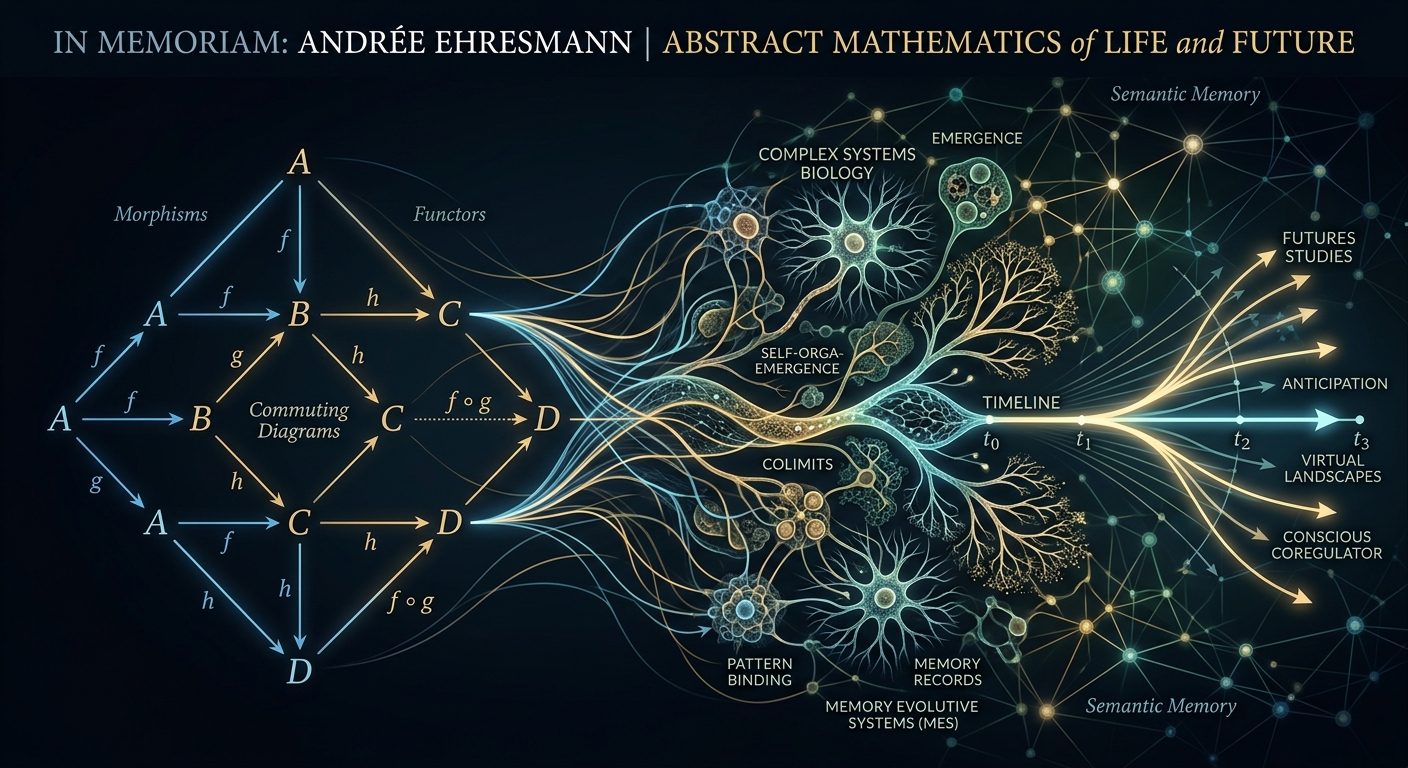
Andrée Ehresmann was a French mathematician who who specialised and pioneered applications of category theory. She passed away on 21 August 2026 at the age of 91.
Category theory is a general theory of mathematical structures and their relations. It was introduced by Samuel Eilenberg and Saunders Mac Lane in the mid-20th century in their foundational work on algebraic topology. It reaches such high levels of abstraction that even some of its own pioneers affectionately dubbed it “abstract nonsense.”1
Yet, surprisingly—or perhaps inevitably—it was this very form of ‘abstract nonsense’ that Robert Rosen chose to tackle the ultimate question of biology: What is life?”
From “Abstract Nonsense” to Relational Biology
In the late 1950s, theoretical biologist Robert Rosen recognized that traditional physics and reductionist mathematics were fundamentally ill-equipped to explain living systems. Newtonian paradigms reduce systems to state-space trajectories governed by uniform physical laws, treating context and interaction as “extraneous details.”
He introduced the language of categories in Biology as soon as ’582 and several authors followed his lead
Rosen’s research was concerned with the most fundamental aspects of biology, specifically the questions “What is life?” and “Why are living organisms alive?”.
A few of the major themes in his work were:
- Developing a specific definition of complexity based on category theoretic models of autonomous living organisms
- Developing Complex Systems Biology from the point of view of Relational Biology as well as Quantum Genetics
- Developing a rigorous theoretical foundation for living organisms as “anticipatory systems”
He developed a highly original approach for investigating those complex questions3:
Arguing by analogy with Aristotle’s four distinct categories of causation (material, formal, efficient and final), this paper argues that there are correspondingly distinct categories of information, and that the same mathematical language cannot be used to describe each of them. This fact leads to the conclusion that our mathematical language is somehow deficient, and that it must be supplemented by new structures. These considerations lead to a formalization of the ideas of a complex system and anticipatory control.
And in particular, Life Itself.4 As Judith Rosen later noted regarding her father’s work5:
relational information is far too often relegated in science to the category of preconditions, “extraneous details,” or “contextual information.”
Memory Evolutive Systems: The Algebra of Complex Life
Andrée Ehresmann developed, together with Jean-Paul Vanbremeersch a model of Memory Evolutive Systems (MES)6, which proposes a mathematical model for ‘living’ systems with a hierarchy of complex components with multiple temporalities, such as biological, neuro-cognitive, or social systems. Based on a theory of ‘dynamic’ categories, evolving memory systems can analyze complexity, emergence and self-organization:
MES use Category theory not only as a language, but also as a powerful method to uncover the main processes underlying complexity. For that, we must adapt and generalize several fine results, in particular theorems of the theory of sketches, developed by C. Ehresmann, A. Ehresmann and their research students in the seventies [], and now largely used in Computer Science.
Our basic idea is that category theory is a reflection on the fundamental laws of brain functioning such as they have been determined by natural selection during Evolution: formation of relations between objects of various types allowing for the transfer and the analysis of information, formation and recognition of patterns of coordinated objects, optimization processes. We could paraphrase for this theory what Chapline [] says about quantum mechanics:
“quantum mechanics can be regarded as a fundamental theory of distributed parallel information processing and pattern recognition… we are led to suggest that the fundamental link between mathematics and theoretical physics is the pattern recognition capabilities of the human brain”.
As Ehresmann and Vanbremeersch observed, category theory is not just a convenient language for biology; it reflects the fundamental laws of cognitive functioning forged by evolution—pattern recognition, information transfer, and multi-agent coordination. They echoed physicist George Chapline’s insight that quantum mechanics and advanced mathematics mirror the pattern-recognition capabilities of the human brain itself.
Something worth a second thought.7
A Theoretical Foundation for Futures Studies
This brings us to Ehresmann’s 2013 paper published in On the Horizon, titled “A Theoretical Frame for Future Studies.”8
While rarely cited in mainstream foresight literature—which often focuses on practical scenario tools—her paper provides a mathematical grounding for the entire discipline:
Purpose – Future studies can be given several interpretations. The purpose of this paper is to develop a methodology for anticipation in a well delimited frame, that of multi-scale complex systems with a dynamic directed by the cooperation/competition between a net of agents, the ‘‘co-regulators’’, each operating with its own rhythm and logic, with the help of a central memory. These systems include social systems of different sizes from small social groups, to large societies, and also living or artificial cognitive systems.
Design/methodology/approach – The study is conducted in the frame of the Memory Evolutive
Systems, a model for such systems, which the author has developed with Jean-Paul Vanbremeersch in a series of publications since 1987; this model is based on a ‘‘dynamic’’ category theory.
Rather than treating time as a passive sequence of reactive events, Ehresmann shows how complex systems actively construct their own futures through conscious coregulators…
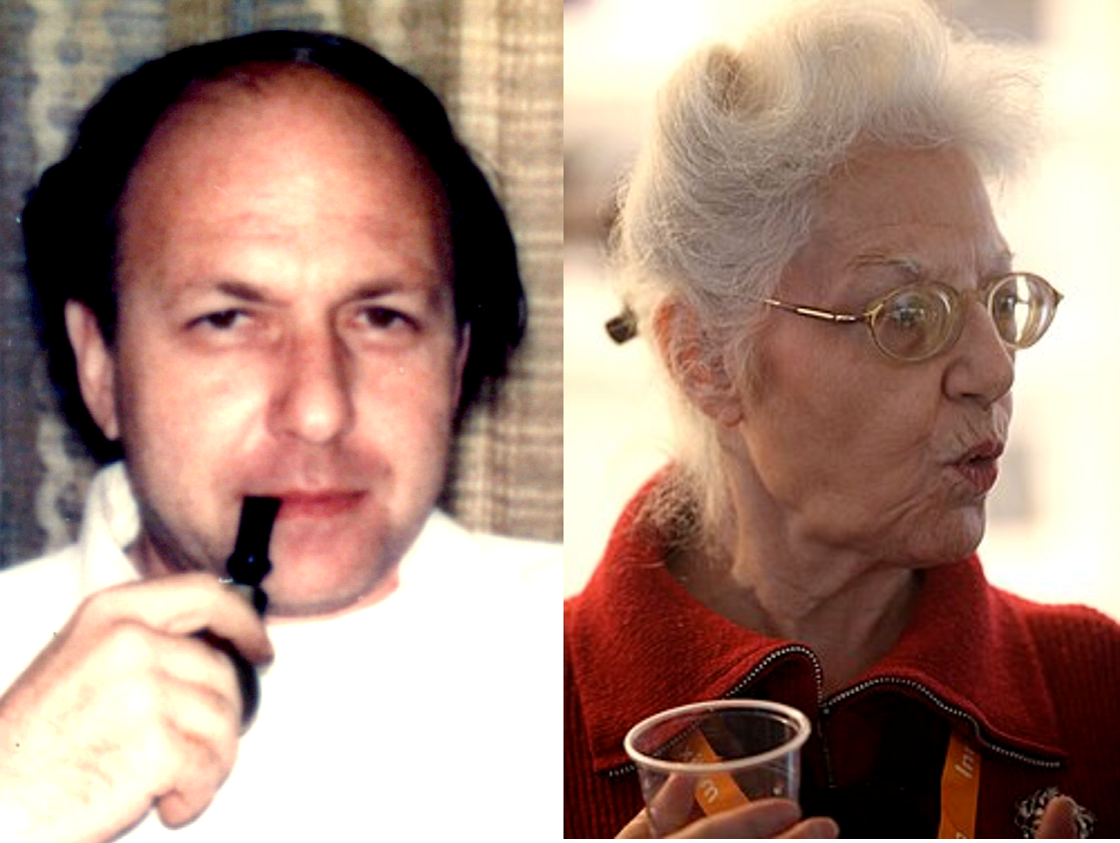
Andrée Ehresmann (9 July 1935 – 21 August 2026)
Andrée Ehresmann tried to offer us the mathematical tools to formalize what Robert Rosen boldly envisioned: that complex systems—whether a single living cell, a human brain, or a social institution—are inherently relational, historical, and anticipatory.
Whether category theory will ultimately fulfill that grand promise remains an open quest for future generations. But together, Ehresmann and Rosen dared to bridge the highest realms of abstract mathematics with the deep organizational reality of life and foresight.
And that’s the reason why Andrée Ehresmann is now here, in Mind the Post! While sparked by Andrée’s recent goodbye, this tribute is ultimately dedicated to both her and Rosen—pioneers who showed us where to look if we ever hope to understand complex life.
In memoriam!
____________________
(1) Siekmann, Ivo. ‘An Applied Mathematician’s Perspective on Rosennean Complexity’. Ecological Complexity 35 (2018): 28–38.
(2) Rosen, Robert. ‘The Representation of Biological Systems from the Standpoint of the Theory of Categories’. The Bulletin of Mathematical Biophysics 20, no. 4 (1958): 317–41. https://doi.org/10.1007/BF02477890.
(3) Rosen, Robert. ‘On Information and Complexity’. In Complexity, Language, and Life: Mathematical Approaches, edited by S. A. Levin, vol. 16, edited by John L. Casti and Anders Karlqvist. Biomathematics. Springer Berlin Heidelberg, 1986. https://doi.org/10.1007/978-3-642-70953-1_7.
(4) Rosen, Robert. Life Itself: A Comprehensive Inquiry into the Nature, Origin, and Fabrication of Life. Columbia University Press, 1991.
(5) Rosen, Judith. ‘Robert Rosen’s Anticipatory Systems Theory: The Art and Science of Thinking Ahead’. Proceedings of the 53rd Annual Meeting of the ISSS-2009, Brisbane, Australia, 2009. https://journals.isss.org/index.php/proceedings53rd/article/view/1249.
(6) Ehresmann, Andrée C., and Jean-Paul Vanbremeersch. “Memory Evolutive Systems.” Preprint, October 1999. Cogprints.https://web-archive.southampton.ac.uk/cogprints.org/921/1/auef.htm.
(7) Jariego, Francisco J. “Quantum Strategic Foresight – Navigating an Inherently Probabilistic Universe.” Book of Abstracts, 5th International Conference on Anticipation, Milan, 1 July 2026, p. 70. Available on SlideShare.
(8) Ehresmann, Andrée C. ‘A Theoretical Frame for Future Studies’. On the Horizon 21, no. 1 (2013): 46–53.
(9) Rosen, Robert. ‘Anticipatory Systems’. In Anticipatory Systems: Philosophical, Mathematical, and Methodological Foundations, edited by Robert Rosen. Springer, 2012. https://doi.org/10.1007/978-1-4614-1269-4_6.

