Just another paper on one of the key foundational questions in this blog: Science, innovation and the challenges we face to find new ideas. In this case, ageing.
Scientific careers today are marked by growing polarization: A small number of scientists now remain active and influential for longer than ever, whereas many others pass through research as temporary workers. Lengthened training periods, the elimination of mandatory retirement, and funding systems that reward experience have concentrated resources among senior scientists. As science becomes increasingly dependent on its aging core, a central question arises: How does academic age influence creativity? The answer has long divided scholars. Analyzing more than 12.5 million scientists who published between 1960 and 2020, we find that novelty—the linking of previously unconnected ideas—increases with academic age, whereas disruption—the replacement of established ideas with new ones—declines. These and other findings invite reflection on potential implications for policy, such as funding, tenure, and promotion systems; immigration and mobility; workforce development; and incentives for (and barriers to) collaboration and innovation.
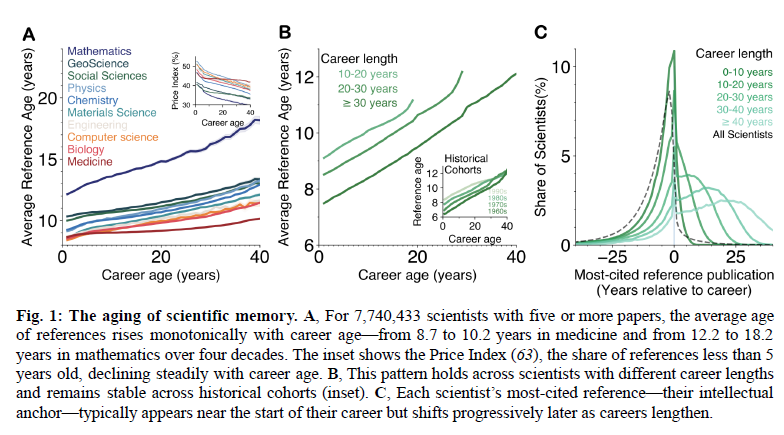
It seems inescapable: the older the population, the older the ideas…
____________________
(1) Cui, Haochuan, Yiling Lin, Lingfei Wu, and James A. Evans. ‘Aging and the Narrowing of Scientific Innovation’. Science 392, no. 6798 (2026): 588–91. https://doi.org/10.1126/science.ady8732.
Image: Fig 1. is from the preprint, originally published in Arxiv in 2022, updated Dec. 2025: Cui, Haochuan, Yiling Lin, Lingfei Wu, and James A. Evans. ‘Aging and the Narrowing of Scientific Innovation’. arXiv:2202.04044. Preprint, arXiv, 4 December 2025. https://doi.org/10.48550/arXiv.2202.04044.

