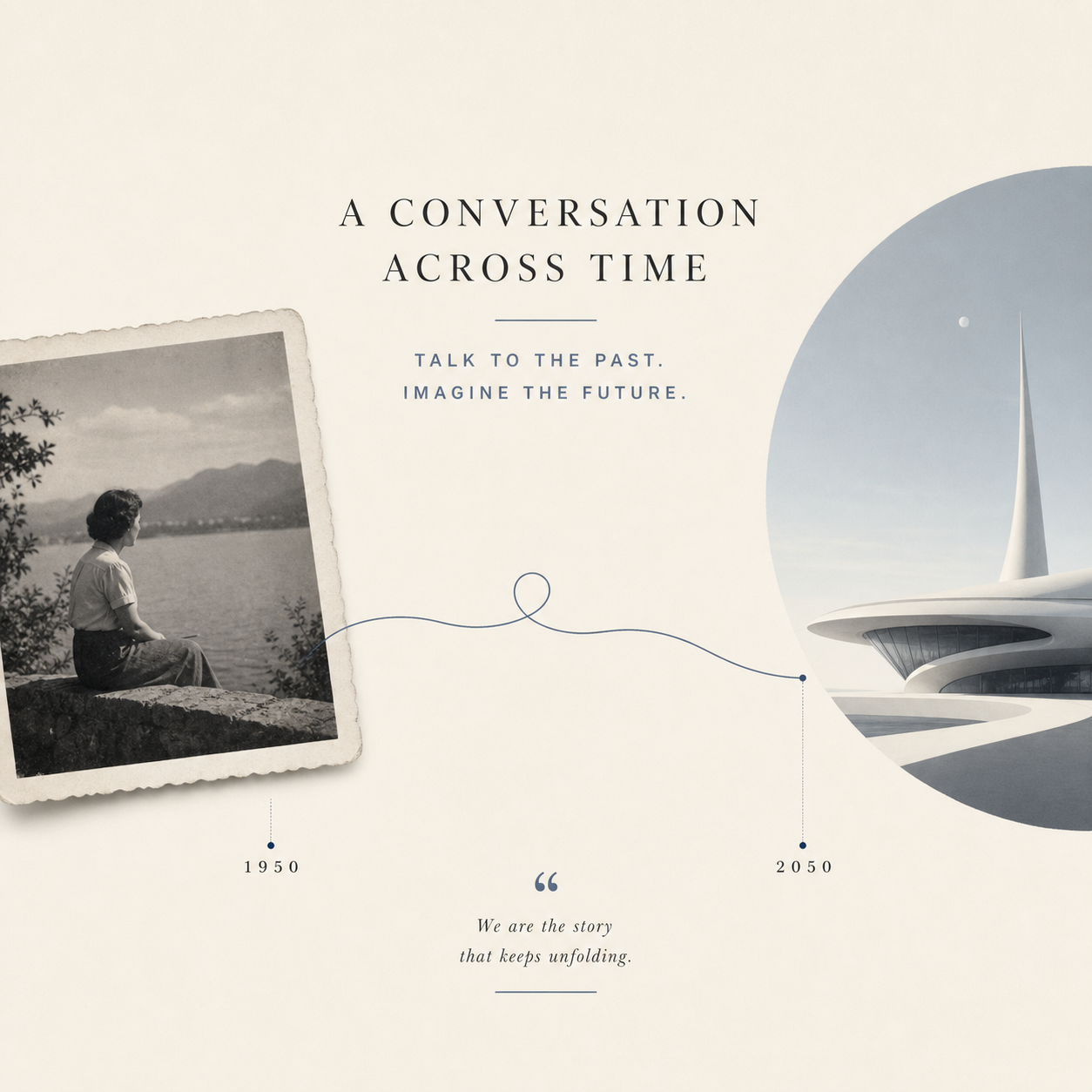
Have you ever daydreamed about talking to someone from the past?
Yes, I have. It’s in fact, something with plenty of potential yet to explore.
What would you ask someone with no knowledge of the modern world? What would they ask you? While we don’t have time machines yet, we can simulate this experience.
How can we do it? By training, Vintage Language Models: LMs trained only on historical text.
A vintage LLM is a large language model trained on texts and potentially images or other multimodal data up to a particular date. The date could be 2019, so it’s trained only on data until 2019 – that’s the easier case. It could be up until 1900 or even up until 200 AD, and these historical cases are much more challenging.
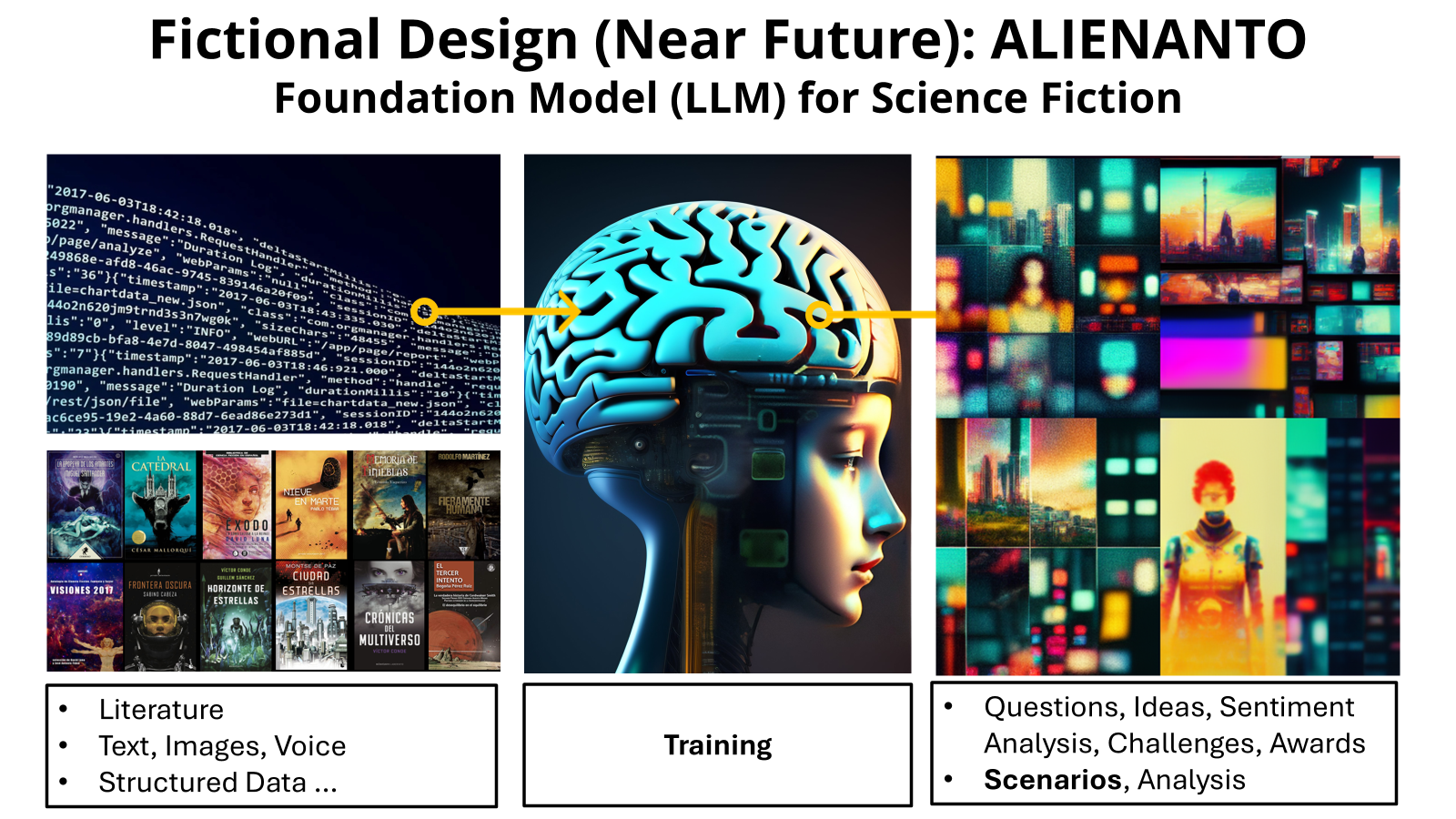
Three years ago, we asked basically those same questions talking about the possibilities to use LLM models in worldbuilding, building —redundancy intended— on the speculative and science fiction literature of different epochs, and cultures. It was at the First International Congress of Latin American and Spanish Science Fiction (2010–2020), Reimagining Futures (7–9 June 2023, University of Alcalá), where we presented ALIENANTO.
Why this matters?
We wanted to talk about the future of Spain, but let’s have a look at this recent call for contributions: Futures4Europe Conference 2026:
Europe and the world are living through times of profound change, marked by discontinuities, systemic crises, and far-reaching transitions. These challenges can also be understood as products of inherited and increasingly inadequate imaginaries. Such conditions urgently demand to re-open the future through renewed ways of probing the possible.
Foresight creates spaces where future imaginaries are produced, negotiated and contested and new relations between knowledge, values, and action can emerge. At the same time, foresight cultivates awareness of imaginative processes and supports their reflexive examination.
Current imaginaries and narratives are dominated mainly by dystopian futures (e.g. artificial intelligence doomerism) with a counterpoint of naive and illusory optimism (technology will solve all our problems, or the welfare state).
This week, Patrick Collison asked in XTwitter which are the most humane (empathetic, compassionate) Arab / Middle Eastern novels?
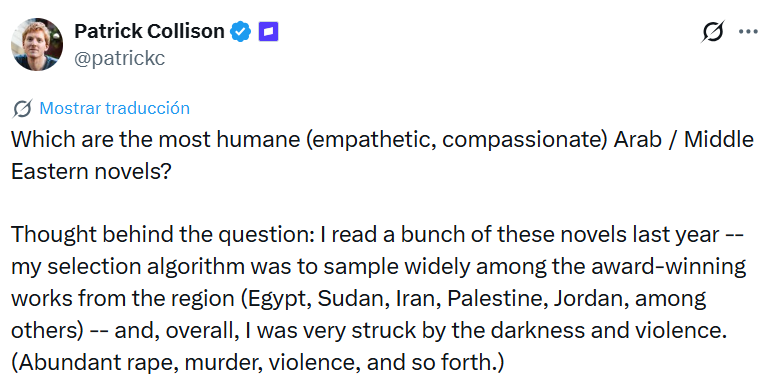
This is a question which, beyond our particular interest like readers, we should be able to answer with absolute precision, now that the entire history of world literature has been digested by LLMs.
In their presentation1 of talkie: a 13B language model trained on 260B tokens of historical pre-1931 English text, Nick Levine, David Duvenaud, Alec Radford introduce some of the possibilities, yet to be explored, of this kind of iniciatitive. For example:
- We can evaluate LMs’ ability to predict the future, and understanding how forecasting performance improves with model size and decays at longer horizons
- Evaluate LMs’ abilities to come up with new ideas by seeing if they can arrive at inventions or scientific discoveries we know would arise after their knowledge cutoffs
- Teach us about the impact of data diversity in AI development.
They think that study of the behaviors and capabilities of vintage LMs will advance our understanding of AI in general.
I basically think the same. Talking to the past may be a necessary step that allows us to better understand, and shape, the futures we imagine and want. Aren’t vintage language models what we have inside our brains, after all?
And you? What do you think?
____________________
(1) Nick Levine, David Duvenaud, and Alec Radford. ‘Introducing Talkie: A 13B Vintage Language Model from 1930’. April 2026. https://talkie-lm.com/introducing-talkie.

