
“Data centers have become the new frontlines of global power.” It’s the title of a new report published by GIS expert Henrique Schneider in which he argues that data centers have moved from digital infrastructure to contested strategic assets.
The IDCA’s 2026 Global Data Center Report maps the current landscape: global data centre capacity has reached a footprint of 67.7 GW, up 36% in two years. They now consume 2% of the world’s electricity, up from 1.7% in 2024 and 1.9% in mid-2025.
The US is by far the world’s largest data centre location, with 43% of global consumption. The world’s top five data centre consumers are:
- US — 29.2 GW, 6% of national electricity
- China — 8.5 GW, 0.8% of national electricity
- Germany — 5.5 GW, 9.5% of national electricity
- UK — 2.0 GW, 5.8% of national electricity
- Japan — 1.7 GW, 1.5% of national electricity
IDCA’s report also identifies something close to a natural law: political opposition tends to emerge once data centres cross about 5% of a grid’s consumption, hardening into an effective growth cap around 6.25%. The US, at 6%, has already crossed the first line. Germany, at 9.5%, shows what lies past the second.
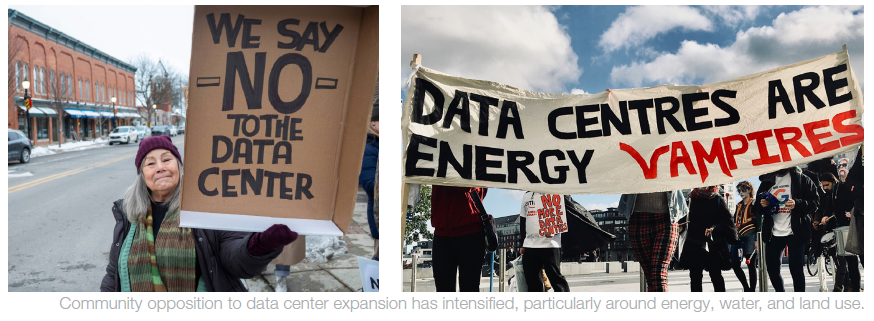
Community pushback against large new data centers has been reported over the past year in many parts of the United States.
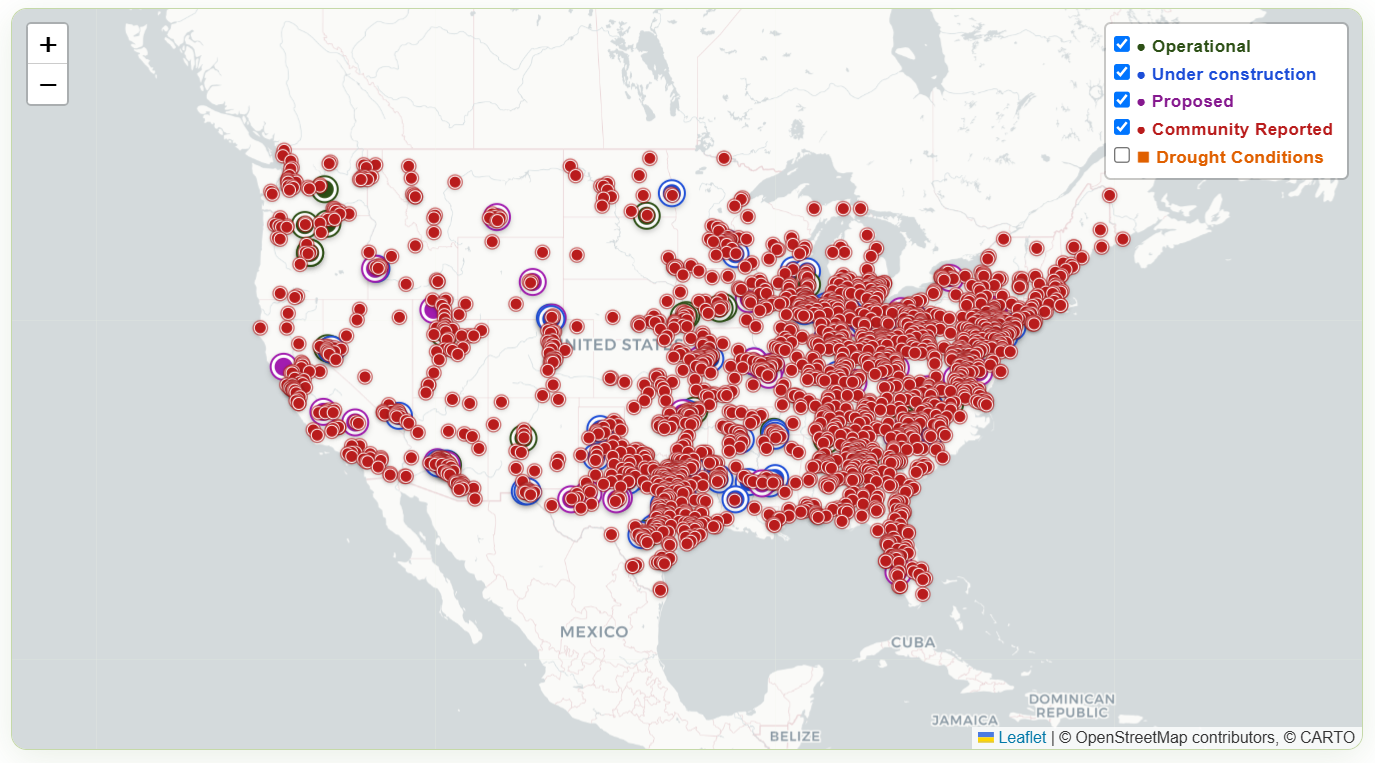
Erin Brockovich — the environmental activist behind the Oscar-winning film that bears her name — has built a crowdsourced map tracking data centres and community complaints US-wide, drawing thousands of reports within weeks of launch.
As Ben Thompson ‘Stratechery’ frames it, AI’s impact has so far been digital, where it needs no one’s permission. But AI runs on data centres, and data centres need permits. That gives ordinary citizens a veto over AI that globalization never allowed them over jobs. In 2025 alone, roughly 48 data centre projects worth $156bn were blocked or stalled by local opposition.
For Bruce Schneier and Nathan E. Sanders, the backlash isn’t just local — it’s the symptom of something bigger. AI companies, they argue, are trying to capture value created by entire industries, and that concentration of wealth and power is society’s greatest existential risk today. They frame popular opposition not just as NIMBYism, but as one of the few tangible levers citizens have against it.
The anger is real, but it isn’t the whole picture. A July 2026 report from Alethea highlights that:
Data centers are the current target, but they’re also a preview of a repeatable playbook: local opposition, hijacked and amplified by foreign state actors into a national narrative. Any industry that becomes the center of the next hyperlocal fight should expect the same tactics, which is why what’s happening to data centers right now is worth studying well beyond this one sector.
The playbook itself isn’t new. Find a raw nerve, flood it with content that echoes what people are already saying, then let the fracture widen on its own — Russia, China, and Iran have all run this pattern before around natural disasters, elections, and protests. Data centers are just the newest venue.
Zooming out: a technological civilization is a race against its own stagnation —a sprint to keep capturing more energy before hitting what might be a Universal Limit to Technological Development. Kardashev’s Type I —mastery of all the energy available on one’s own planet— still remains distant; by most estimates, we sit around 0.73. Similar scales can be used to classify information stored, population, and mass of constructions.
For years, AI’s story was told in software terms: algorithms, data, parameters, tokens, chatbots. In 2026, the story has become physical: concrete, watts, wires and — increasingly — orbits. Control of data centres now means economic and military power. They are evolving from real estate into regulated infrastructure.
AI hasn’t changed the race. It has just made it uncomfortably visible.
If states won’t grant the permits —or their citizens veto them— some will want to leave. The idea of data centres in orbit has gone from science fiction to a serious spending category. SpaceX has filed plans with the FCC for up to a million satellites acting as orbital data centres — a proposal that conveniently coincided with the company’s IPO roadshow. Google, not to be outdone, announced Project Suncatcher with Planet, aiming to launch two satellites carrying Google TPU AI chips by early 2027. Jeff Bezos, meanwhile, wants to relocate “polluting industries” off-Earth entirely.
However, as IEEE Spectrum put it: “Orbital Data Centers Are Harder Than Silicon Valley Thinks:”
Proponents tout the many wonders of computing in space: abundant solar energy, free cooling, and freedom from Earth-based disturbances like earthquakes, floods, and protesters. But a sober look at the physics of space-based computing paints a much more nuanced picture.
OpenAI CEO Sam Altman said placing data centres in space isn’t feasible right now. He called the idea “ridiculous” during an event in New Delhi this past February. Nature’s diagnoses is a bit more precise:
For these projects to succeed, several engineering obstacles need to be overcome. One is ensuring that the satellites’ electronics cool properly. (…) Another obstacle is the effect of harsh space radiation on AI chips. (…) If the number of satellites in low Earth orbit increases by two orders of magnitude, ‘it certainly seems like a big challenge from the space-traffic management perspective.’
Fifteen years ago data became “the new oil.” Now it seems it’s compute —and this time the metaphor has teeth. Sovereign AI programmes are treating GPUs and grid capacity the way 20th-century states treated crude: as the resource around which national strategy gets built — from the UK’s £18bn Stargate UK and Saudi Arabia’s $100bn HUMAIN to the EU’s Cloud and AI Development Act, aimed at cutting reliance on US hyperscalers that still control over 70% of the European cloud market.
The bipartisan MATCH Act would force US allies to align chip-equipment export controls with Washington’s rules — squeezing ASML, the Dutch firm whose lithography tools are essential to the world’s most advanced chips and which still draws roughly a third of its revenue from China.
The IDCA report outlines the many factors that must be weighed in planning, siting, building and operating data centres — and in connecting them to electricity and communications grids.
Building data centers has implications for local environments, workforces, and the ultimate progress to which each nation can aspire.
GIS Reports closes its analysis with three scenarios for the decade ahead:
They are not mutually exclusive; elements of each will appear across geographies and segments.
- Likely: Distributed intelligence network — inference pulls capacity into small, local, fast-deployed nodes.
- Moderately likely: Sovereign compute fortress — geopolitical fragmentation accelerates following further infrastructure attacks and tighter export controls; compute is treated as critical infrastructure across all major economies.
- Less likely: Efficiency correction — chip gains simply outrun demand.
None of these three scenarios accommodates yet the two serious orbital bets described, now taking shape at SpaceX’s Boca Chica launchpad and Google’s Mountain View campus, home to Project Suncatcher.
Whether we like it — accelerationism — or not — degrowth —, climbing the Kardashev scale is barely a choice. It’s life and evolution. We’ll keep climbing until we hit one of the barriers that might explain the Great Filter.
Population is destiny, energy is destiny, and, for the time being, infrastructure is destiny. AI’s next phase won’t be won in a lab. It’ll be poured, one truckload of concrete at a time, on the ground.

