How is it that ideas, and human capabilities, become lost? And how is that new insights come to pass? If eventually the insight seems obvious, why didn’t we see it before? Or maybe we did see it before, but didn’t really know we were on to something important? Why do new insights arrive suddenly, in a kind of flood? How do new worldviews replace older ones?
And what does all of that have to do with the future of science, the future of research, and the future of economics in particular? Especially when we try to understand how the ongoing artificial intelligence revolution is going to reshape human knowledge, and the all-important question of what economists should do.
Those are the motivating questions behind the project “The Marginal Revolution: Rise and Decline, and the Pending AI Revolution,”1 by Tyler Cowen. He announced it on March 26, 2026:
I am offering a new piece of work — I do not quite call it a book — online and free. It has four chapters, is about 40,000 words, is fully written by me (not a word from the AIs), and it is attached to an AI with a dual page display, in this case Claude. Think of it as a non-fiction novella of sorts, you can access it here. You can read it on the screen, turn it into a pdf (and upload into your own AI), send it to your Kindle, or discuss it with Claude.
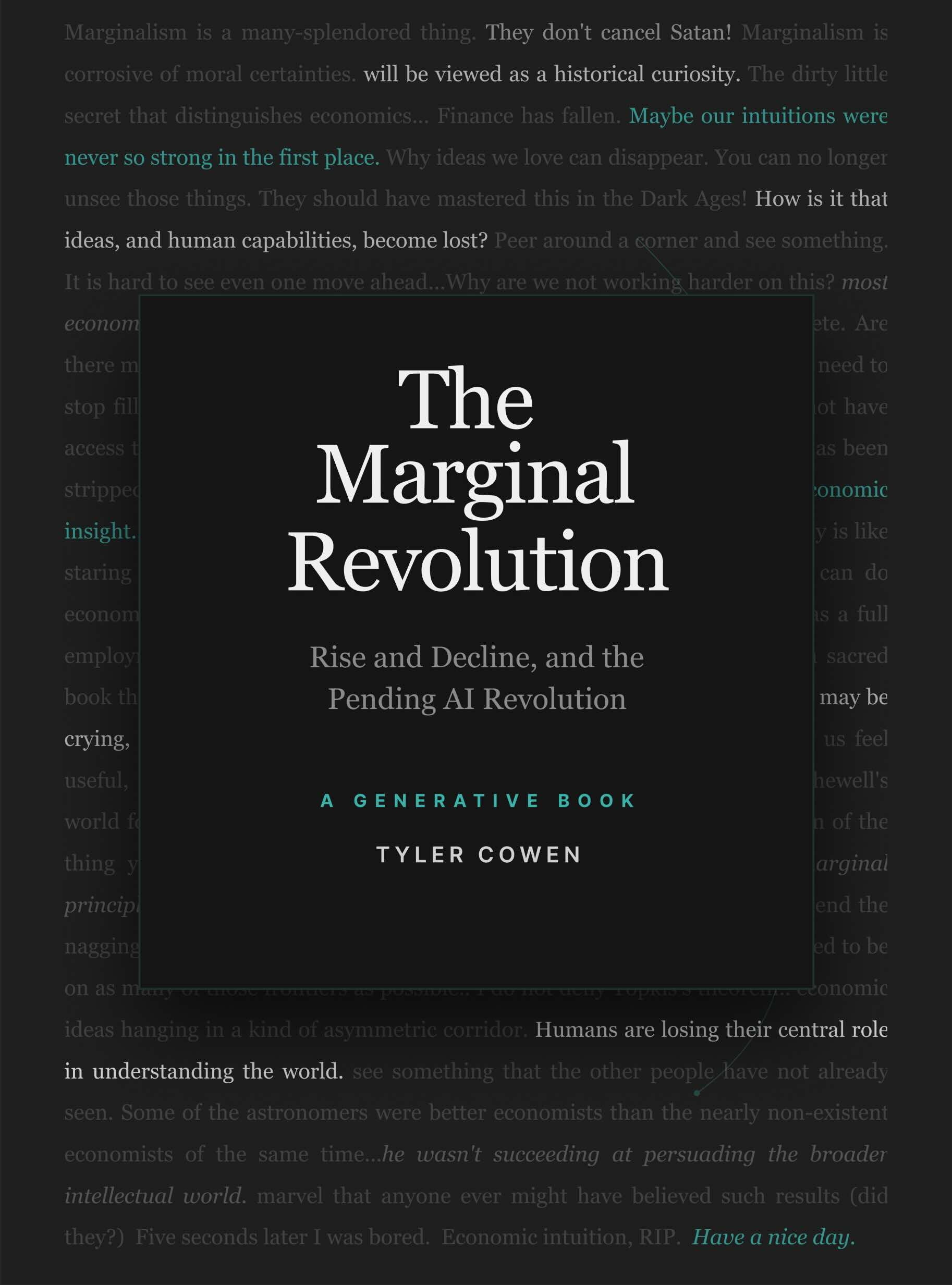
Given the questions he introduces in the very first paragraph of Chapter I (quoted above), and the new “generative” way he suggests to explore them, I just couldn’t leave it out of Mind The Post.
Let’s explore ideas.
____________________
(1) Cowen, Tyler. “The Marginal Revolution: Rise and Decline, and the Pending AI Revolution.” (2026).


El artículo es muy oportuno. Puedo aportar un ejemplo del “no ver” un par de ideas obvias. Pueden leer el libro Informe sobre la vida humana. Leyes ética y futuro entrando en Libros de la web.www. supervivenciayaltruismo.org
Gracias