Humanity has become a dominant force in shaping the face of Earth1.
Here we quantify the human-made mass, referred to as ‘anthropogenic mass’, and compare it to the overall living biomass on Earth, which currently equals approximately 1.1 teratonnes. We find that Earth is exactly at the crossover point; in the year 2020 (± 6), the anthropogenic mass, which has recently doubled roughly every 20 years, will surpass all global living biomass.
Fig 1. Elhacham et. al. Op. cit.
We want to ensure our own continuity by blending in with Earth’s continuity. How do we do that?
Here’s one suggestion: Expand how we think about infrastructure.
Capital spending on AI already rivals the mainframe era of the late 1960s and the fiber optic deployment of the late 1990s – with an estimated $175 billion in global infrastructure funds waiting to be committed. The question is not whether that funding will flow, but where. If it doesn’t flow into US-backed global infrastructure projects that advance a global AI that spreads the technology’s benefits to the most people possible, then it will flow to China-backed projects that leverage AI to cement and expand autocratic power. There is no third option.
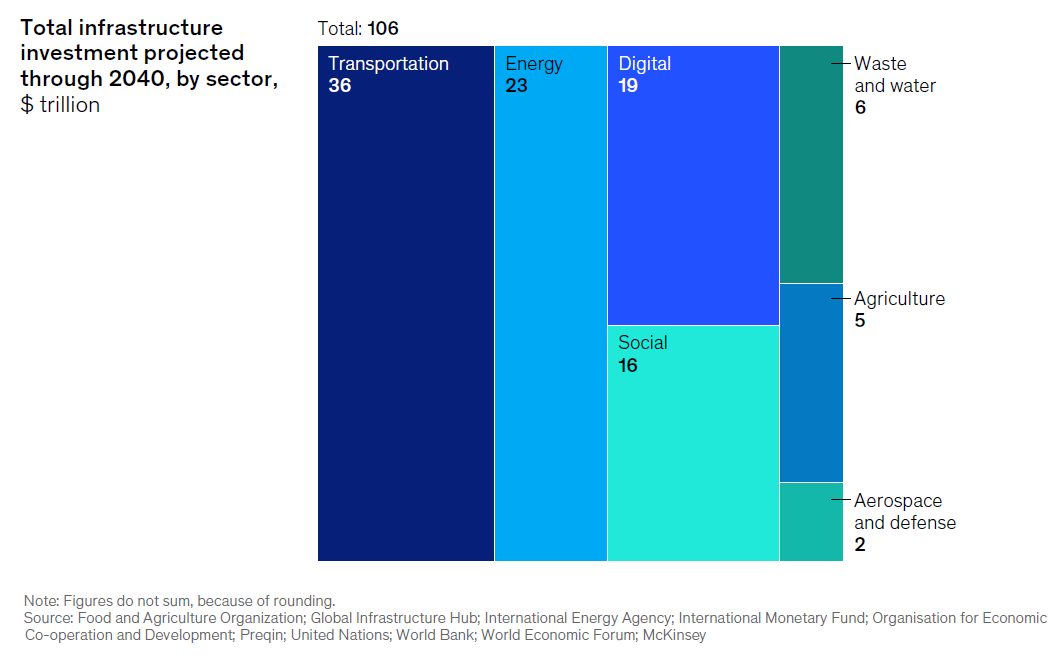
In a report published this week, McKinsey estimates that a cumulative $106 trillion in investment will be necessary through 2040 to meet the need for new and updated infrastructure. The required investment spans seven critical infrastructure verticals3:
Transport and logistics, $36 trillion)
Energy and power, $23 trillion
Digital, $19 trillion
Social, $16 trillion)
Waste and water infrastructure, $6 trillion
Agriculture, $5 trillion, and
Defense, a.k.a. War $2 trillion
Interestingly:
the boundaries between infrastructure verticals are blurring. Many of today’s most critical needs—such as infrastructure to support the deployment of artificial intelligence and the energy transition—exist at the intersections of the verticals.
The next decade will be a defining one for global infrastructure. Those who act decisively today will shape the future of connectivity, economic growth, and societal well-being for generations to come.
And the next one, the same (or even more). You can bet on it.
____________________
(1) Elhacham, Emily, Liad Ben-Uri, Jonathan Grozovski, Yinon M. Bar-On, and Ron Milo. ‘Global Human-Made Mass Exceeds All Living Biomass’. Nature 588, no. 7838 (2020): 442–44. https://doi.org/10.1038/s41586-020-3010-5. (2) Believe me. It there is something I know a little about, that’s the complexity of O+M. (3) Yes. Figures do not sum, because of rounding… A difficult matter for strategic consultants 😉
Gravel is not made by humans. They just move it from one place to other. Concrete is partially anthropogenic, I agree. but it is very similar to natural products. I have to admit the energy consumption to make it is significant.


 Mind the Post
Calling gravel (or even concrete) anthropogenic is a bit of an exaggeration.
Why do you think concrete is not anthropogenic = “of, relating to, or resulting from the influence of human beings on nature” ?
Gravel is not made by humans. They just move it from one place to other. Concrete is partially anthropogenic, I agree. but it is very similar to natural products. I have to admit the energy consumption to make it is significant.