The reports of the death of literature are greatly exaggerated. Or perhpas not… and the literature is already dead. Or is it the novel, or the book?
We’re in another round of concern about the “death of the book”, and, in particular, the claimed inability or unwillingness of young people to read full-length books. I’m not going to push too far on the argument that this complaint is ancient, but I can’t resist mentioning the response of my younger brother, who, when asked if he wanted a book for Christmas, answered “thanks, but I already have one”). That was around 50 years ago, and he went on to a very successful legal career.
But what I want to talk about right now is the Death of the Author. ¿The reason? A number of articles and academic work recently published dealing with this question.
On June, David Gunkel published “AI Signals The Death Of The Author” in Noema. He emphasizes that the meaning of a piece of writing does not depend on the identity of the author, even if the author is not human.
When a text is written or generated by a large language model like ChatGPT, Claude or DeepSeek, the view of the author becomes clouded.
Why does it even matter? Gunkel traces the emergence of the idea idea of individual authorship, following the steps of Roland Barthes and his 1967 essay “The Death of The Author.”
Barthes’ essay argues against traditional literary criticism’s practice of relying on the intentions and biography of an author to definitively explain the “ultimate meaning” of a text. Instead, the essay emphasizes the primacy of each individual reader’s interpretation of the work over any “definitive” meaning intended by the author, a process in which subtle or unnoticed characteristics may be drawn out for new insight.
Gunkel says that
LLMs may well signal the end of the author, but this isn’t a loss to be lamented. In fact, these machines can be liberating: They free both writers and readers from the authoritarian control and influence of this thing we call the “author.”
The death of the author is the birth of the critical reader.
But there’s something bigger at play here. The advent of LLM AI also brings into question the concept of meaning itself.
Large language models open an opportunity to think and write differently.
This week, Henry Farrell writes “Cultural theory was right about the death of the author. It was just a few decades early.” He reviews and comments on Leif Weatherby’s recently published book “Language Machines: Cultural AI and the End of Remainder Humanism.” In Farrell’s words: a staggeringly ambitious effort to revive cultural theory, by highlighting its applicability to a technology that is reshaping our world.
Weatherby reworks the ideas of Claude Shannon, Warren McCulloch and Walter Pitts, to provide a different theory of how language maps onto math and math maps onto language.
It is a long article, but I’m going to stress a key idea on the question of meaning:
Large language models are a concrete working example of the basic precepts of structural theory and of its relationship to cybernetics. Rather than some version of Chomsky’s generative grammar, they are based on weighted vectors that statistically summarize the relations between text tokens;
LLMs illustrate how language can operate as a system of meaning without any such grounding. For an LLM, text-tokens only refer to other text-tokens; they have no direct relationship to base reality, any more than the LLM itself does. The meaning of any sequence of words generated by an LLM refers, and can only refer to, other words and the totality of the language system. Yet the extraordinary, uncanny thing about LLMs is that without any material grounding, recognizable language emerges from them. This is all possible because of how language relates to mathematical structure, and mathematical structure relates to language. In Weatherby’s description:
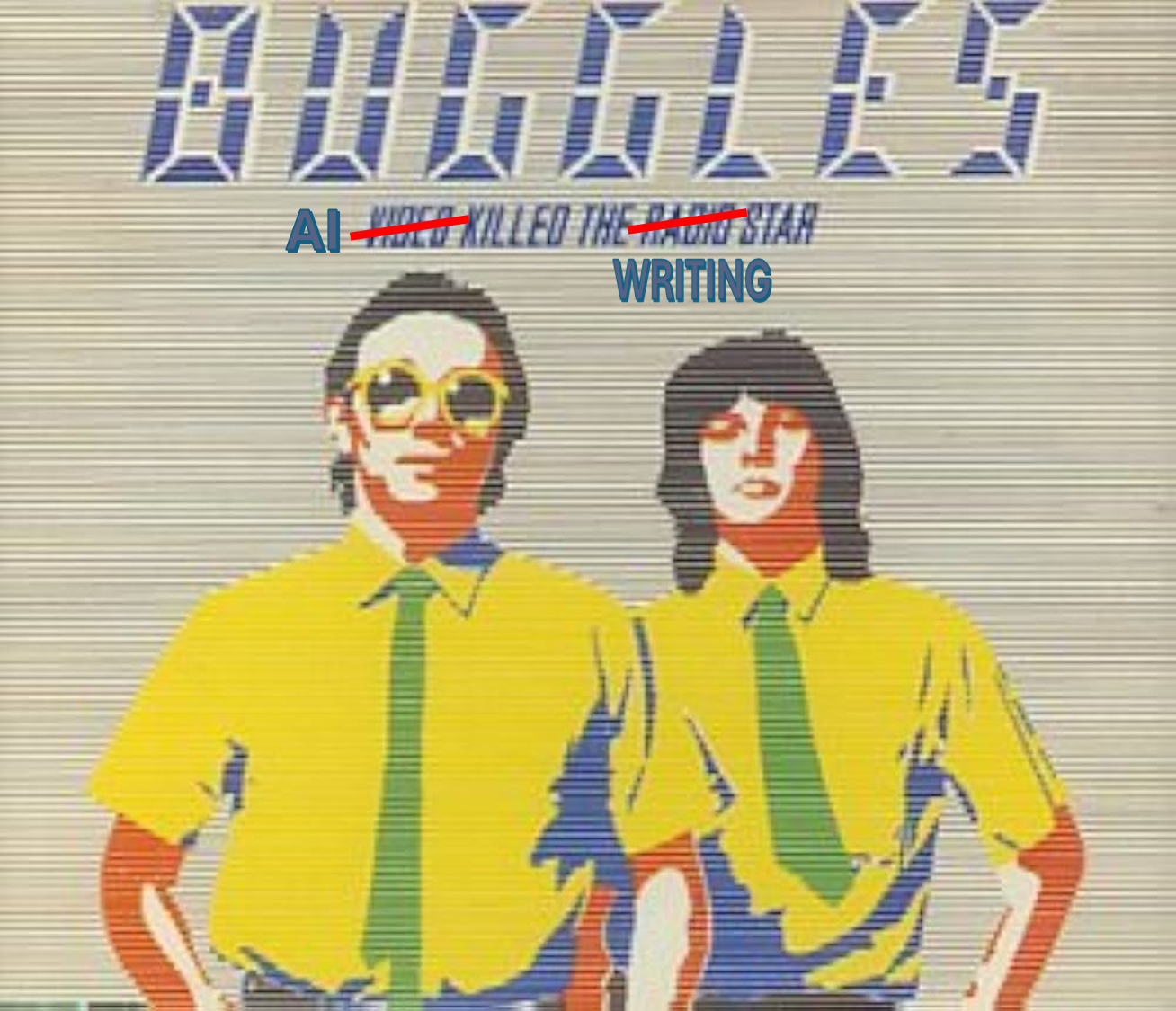
If Video Killed the Radio Star in 1979, it seems it’s time to write (oh wait!) AI Killed the Writing Star!
Now my two cents on meaning and authors.
This is a question that, for obvious reasons, I’ve had the opportunity (and the need) to think about it. I’m not going to expose my ideas in detail, because I would need a long essay, or even a novel. But I just want to stress two simple points:
- The question of meaning can be clearly abstracted and separated from the author, whoever he, she, or whatever it is. The possibilities opened by current (and future) Artificial Intelligence are incredible promising, and I do not have any doubt that they will eventually materialize in all sort of developments, both positive and negative, as it always happens with technology and innovation. But meaning is a horse of different colour than individual authors
- However, one of the most interesting features of literature (writing in general), and perhaps the single reason authors will defend themselves and will remain alive, is the memory. Literature is a means to travel back in time and have a dialogue with persons (individuals) who are not with us anymore. In a possible future perhaps not too distant, in which AIs will be able to eat and digest the world, they will have the mission to offer us a conversation with every single living being who once had something to say.
____________________
Featured Image: Cover art for Video Killed the Radio Star. (carelessly hacked 😉
 Mind the Post
Basicamente. Por la misma razón que no amaríamos los mitos de Marylin Monroe o James Dean si no fuesen mortales
[…] to another insightful post published by Kevin Munger a couple of weeks ago, as a follow up of my previous one, in order to dig deeper into the ultimate question of whether we are living the end of writing and […]