The times are changing… (Can you hear Bob Dylan’s voice in the background?). They always are. only perhaps sometimes faster. We use to talk too much about technology acceleration, but with a global population which has duplicated over the last 50 years, and quadrupled since 1940, what about society itself? Is it also accelerating? Or quite the contrary?
Anticipating possible futures is a source of concern (and opportunity) for all kind of organizations. Let me go straight to the fact and summarize six recently published (mega) trends report by different organizations with focus on society and geopolitics.
Bank of America, The world in 2030
The next five years will be the ones that will rip up the old rule book and rewrite the framework of the economic, strategic and thematic megatrends that will impact society.
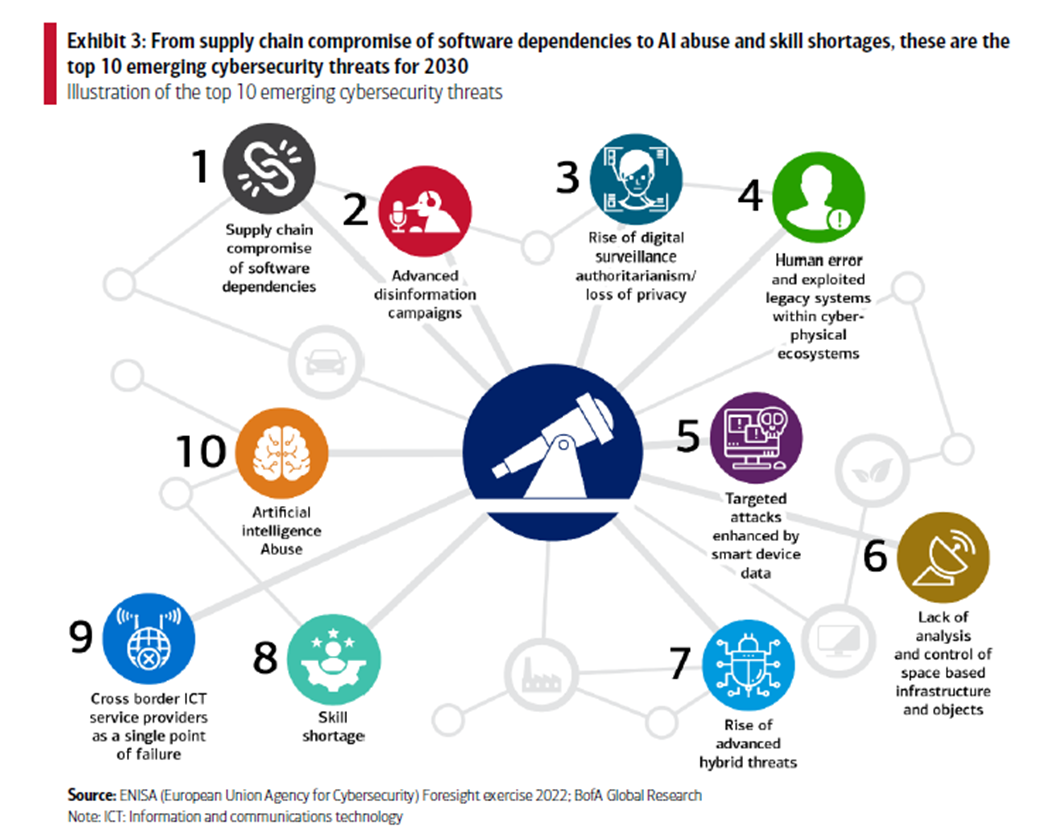
Eight themes that will shape our world in the years:
- “Technology is eating the world”
- Digital insecurity
- More of… everything!
- Rebuilding everything!
- Populism
- War and peace
- Rise of the Zoomers… and Boomers!
- Health as the new wealth

Atlantic Council, Welcome to 2035
What the world could look like in ten years, according to more than 350 experts
- Forty percent of respondents expect a world war in the next decade—one that could go nuclear and extend to space
- Tensions with China and Russia are potential vectors for major conflict
- Just under half of respondents expect China, Russia, Iran, and North Korea to be formal allies within a decade, potentially in a world featuring China- and US-aligned blocs
- The proliferation and use of nuclear weapons is agrowing risk, with nearly half of respondents expectinga nuclear weapon to be used by 2035
- The United States is still likely to be dominant militarily in 2035—but with relatively less economic, diplomatic, and soft power as it navigates a multipolar world
- Many respondents are pessimistic about the war inUkraine ending on terms favorable to Ukraine
- Respondents are much more optimistic about abreakthrough in Israeli-Saudi relations than in Israeli-Palestinian peace
- As global organizations become less capable ofsolving the world’s problems, regional groupings andthe BRICS may rise in importance
- Today’s democratic recession may deepen into ademocratic depression
- Women are more pessimistic about the global future than men are

Not all the projections were pessimistic. Fifty-eight percent of those who participated in our Global Foresight 2025 survey, for example, felt that artificial intelligence would, on balance, have a positive impact on global affairs over the next ten years—an increase of 7 percentage points fromour Global Foresight 2024 survey. Roughly half of respondents foresaw an expansion of global cooperation on climate change.
But the grimmer forecasts were in keeping with a dark global outlook overall, with 62 percent of respondents expecting the world a decade fromnow to be worse off than it is today, and only 38 percent predicting that it will be better off.
Millennium Project 2035
State of the Future — Version 20.0
- Artificial intelligence (AI) will be much different in 2050 than it is today and far more different in 2100
- Governing Artificial General Intelligence could be the most complex, difficult management problem humanity has ever faced.
- There are, roughly speaking, three kinds of AI: narrow, general, and super.
- The nuclear arms race is being aided by and in important ways being replaced by the race for AGI and advanced quantum computing among the U.S., China, European Union, Japan, Russia, and several corporations.
- Elementary quantum computing is already here and will accelerate faster than people think, but the applications will take longer to implement than people will expect.
- global temperatures continue setting records
- The COVID pandemic has caused the first global “time-out” for humanity to re-think everything.
- The COVID pandemic increased awareness of the need to use global foresight as input to national and transnational strategy, and global decision-making.
- Biologically, new growth occurs after natural and human-made disasters. Historically, innovations can follow disasters as well
- Although nuclear brinkmanship has returned to geopolitics, the vast majority of the world is living in peace
- Information warfare change the rule of the war game.
- Given trends in synthetic biology, material sciences, and AI, eventually, an individual acting alone will be able to make and deploy a weapon of mass destruction.
The State of the Future Index —SOFI— shows that if the trends among the 29 variables continue, then the human condition will be better in 2035 than it is today.

too much is invested into geopolitical zero-sum power, instead of investing in synergies among nations to turn around global warming, govern future forms of AI and synthetic biology, counter information warfare, and more seriously address other global challenges. As long as we continue to focus on geopolitical zero-sum power, rather than on creating synergies among governments and people, then conflict in one form or another will continue.
NATO 2045
Science and Technology Trends 2025-2045
The report identifies six key trends that will be important for NATO in the next 20 years:
- Evolving competition areas;
- The race for Artificial Intelligence (AI) and quantum superiority;
- Biotechnology revolution;
- Resource divide;
- Fragmenting public trust; and
- Technology integration and dependencies.


UK Ministry of Defense 2055
Global Strategic Trends: Out to 2055
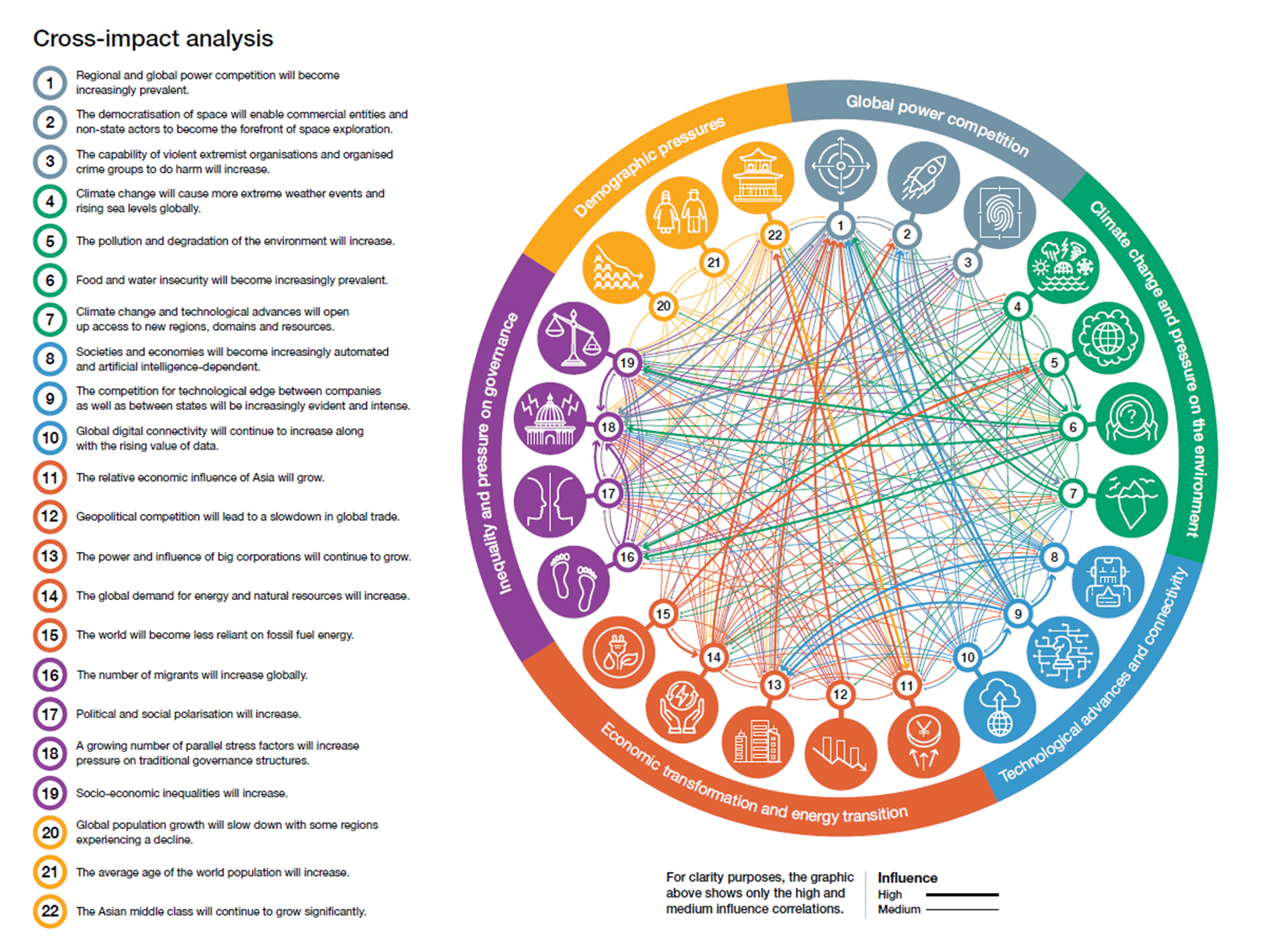
Six global drivers of change that will redefine societies, economies, governance, security and defence, as well as the natural world itself.
- Global power competition
- Demographic pressures
- Climate change and pressure on the environment,
- Technological advances and connectivity,
- Economic transformation and energy transition, and
- Inequality and pressure on governance.
Five core, interacting and dynamic contradictions, sitting alongside the six drivers:
- Increasing interconnectivity and fragmentation
- Cooperation and confrontation
- Innovation and stagnation
- Growing authoritarianism and demand for transparency
- Weakening abilities and strengthening roles of states

And 22 underlying trends:
- Regional and global power competition will become increasingly prevalent.
- The democratisation of space will enable commercial entities and non-state actors to become the forefront of space exploration.
- The capability of violent extremist organisations and organised crime groups to do harm will increase.
- Climate change will cause more extreme weather events andrising sea levels globally.
- The pollution and degradation of the environment will increase.
- Food and water insecurity will become increasingly prevalent.
- Climate change and technological advances will openup access to new regions, domains and resources.
- Societies and economies will become increasingly automated and artificial intelligence-dependent.
- The competition for technological edge between companies as well as between states will be increasingly evident and intense.
- Global digital connectivity will continue to increase alongwith the rising value of data.
- The relative economic influence of Asia will grow.
- Geopolitical competition will lead to a slowdown in global trade.
- The power and influence of big corporations will continue to grow.
- The global demand for energy and natural resources will increase.
- The world will become less reliant on fossil fuel energy.
- The number of migrants will increase globally.
- Political and social polarisation will increase.
- A growing number of parallel stress factors will increasepressure on traditional governance structures.
- Socio-economic inequalities will increase.
- Global population growth will slow down with some regions experiencing a decline.
- The average age of the world population will increase.
- The Asian middle class will continue to grow significantly.
AXA. What if… we experienced the future? Toward 2065
There are two types of organization that must constantly project themselves in the future: the military and insurance companies. Indeed, risks and uncertainties are central to our core activities, and anticipating them is pivotal for preparing and adapting to an evolving context.
To decipher the complex world we live in today and to imagine the future challenges facing the insurance industry, we employed a collaborative approach gathering insights from a diverse group of internal experts across regions and cultural backgrounds. These insights have led us to identify five key megatrends.


Five Megatrends:
- Navigating a multipolar world with uncertain alliances ahead
- Climate realities, adaptation and resilience
- Addressing the protection gap
- Challenges for intergenerational solidarity
- Balancing innovation and control
10 scenarios from 2035 to 2065 Likelihood values (plausibility) in parentheses:
What if…
- Our Water was not safe anymore? Amsterdam Netherlands 2035 (30-50%)
- The world order crumbled? 2035 New York USA (50%)
- Europe succesfully designed a post-growth operating manual? 2035 Strasbourg France (10%)
- Global Pop Culture disappeared in favor of local and hybrid cultures? 2040 Chile south America (30-40%)
- Space Debris turned off the light? 2042 Pacific Islands & Space (75%)
- Microplastic played a role in infectious cancer in animals? 2045 Kristiansand Norway (5%)
- Cafes and Bars were still a thing? 2045 Paris France (100%)
- AI warmed up the world? 2050 Riyadh, Saudi Arabia (85%)
- A tsunami hit at the Atlantic Ocean coasts? 2055 Lisbon Portugal (85%)
- Psychiatric disorder were recognized as inflammatory diseases? 2065 London UK (50%)
I can only stress the artwork illustrating the report

I leave it to your preferred AI chatbot to extract some clear cut themes you can follow through the different reports and timelines… Maybe we can’t predict the future, but we can hear it singing somewhere in the background.
 Mind the Post
Very well presented.
I personally think the major concern is an all out nuclear war (or a large one). The rest may be a problem, but manageable.
Thanks for reading… and your comment.
I would add bio to the highest potential risks. Still in the moment previous to the nuclear-1945.
[…] diese Megatrends vorbereiten müssen, um im dynamischen Markt von morgen erfolgreich zu sein. Die Zukunftsprognosen zeigen, dass die Anpassungsfähigkeit und Innovationsbereitschaft Schlüsselkompetenzen sind, um […]
[…] Life’s hard. Scott Adams entered the dubious Hall of Fame of Hideous Men1. His time was ending. The times were A-Changin’. […]