
The world is witnessing a rise in polarization, illiberalism, nationalism and a decline in trust in democratic institutions. Dissatisfaction with democracy is at an all-time high and there is a sharpening of competition and conflict between democracies and autocracies worldwide, from Russia’s invasion of Ukraine to a hardening of the rhetoric between China and the U.S.
Democracy has become a synonym in much of the world for the increasingly desperate effort to preserve rigid, outmoded, polarized, paralyzed, and increasingly illegitimate governments. Free democratic societies exist in a “narrow corridor” between social collapse and authoritarianism.
The EIU Democracy Index 2024, published this week, just confirms the trend:
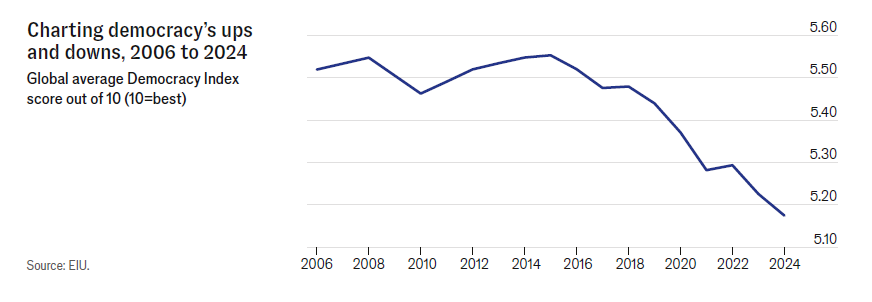
Today less than half of the world’s population live in a democracy of some sort (45%), and only 6.6% reside in a “full democracy.”

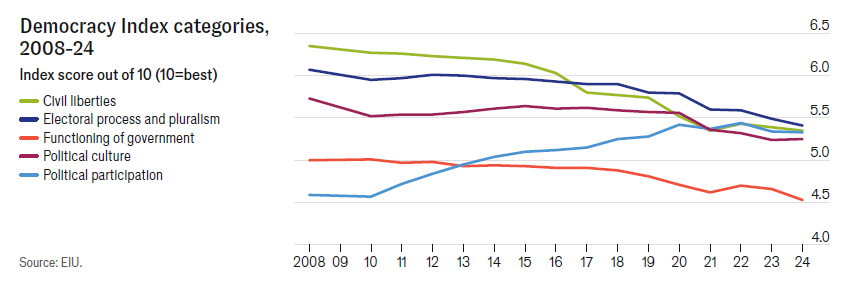
The categories that have recorded the biggest deteriorations since 2008 are civil liberties (-1.00 on a 0-10 scale) and electoral process and pluralism (-0.66), which are the building blocks of democracy. By the way, the fact that e.g. Spain is considered a full democracy (Score 8.13, Rank 21) —Thanks, Oh Lord— gives you a clear idea of what democracy actually means.
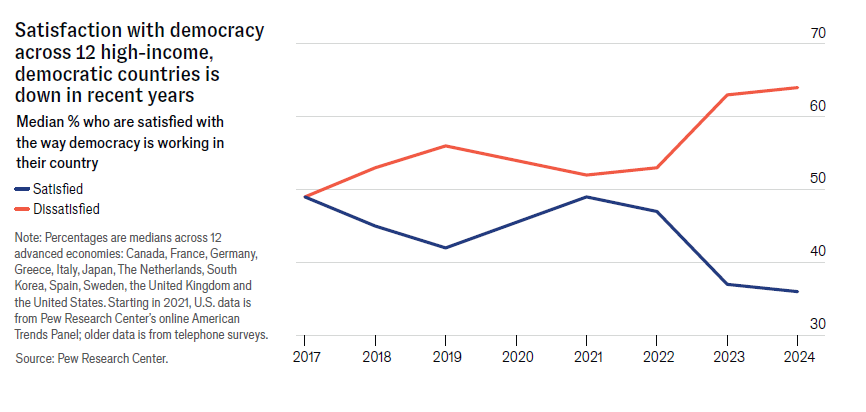
Not surprisingly, satisfaction with democracy across 12 high-income, democratic countries is down in recent years.
There are multiple reasons, and countless ongoing analyses. But one fact is clear. Democracy has been sliding down since the beginning of XXI century, in parallel with the introduction and development of information technologies, and the ongoing information revolution.
The internet is a powerful technology for tying people together in new collaborations across vast differences. Unfortunately, it has also recently proven to be a powerful tool for thwarting those collaborations and sowing new forms of division. Building on all previous development, particularly social networks, the potential of Artificial Intelligence and Blockchain is huge (for good and bad).
Today, the AI revolution is unfolding alongside an unprecedented geopolitical crisis, war and authoritarian influence. AI is no longer just a tool: it is a weapon that can be used to manipulate public opinion, distort elections, and reshape power dynamics on a global scale.
However technology can be, should be, and in fact will be part of any possible solution.
Announced at the AI Action Summit in February, in Paris, the Worldwide Alliance for AI & Democracy has been officially launched, with the objective to promote a global coalition committed to ensuring AI is used to reinforce democracy, rather than dismantle it.
Recognizing the urgency to act, Make.org, Bertelsmann Stiftung, Aspen Digital, HEC, and CNNum conducted an extensive study mapping global initiatives that use AI to protect and strengthen democracy. Their findings revealed hundreds of projects dedicated to ensuring AI serves the public good. Among them, the 100 most impactful initiatives were identified, spanning researchers, NGOs, foundations, companies, and public institutions.

How can we write a desirable future for AI and democracy?
First of all, we need to avoid two pitfalls. The first is to attribute to AI and technology an autonomous force that they do not have. The second is to underestimate the disruptive capacities of AI on democracies. We always have the possibility of making choices that are essential… The current risk is to leave the debate on the future era of AI to a few individuals. Society, workers and trade unions need to be involved in the AI debate.
In his 1992 classic, Snow Crash, Neal Stephenson imagines a future where most people have retreated to live much of their lives in an immersive “metaverse”. During the pandemia, Marc Andreesseen vindicated the idea as the lesser evil. It is of course an option (Matrix).
But there is another option which is to gain consciousness, to be open and actually diverse, plural. In their tour de force Plurality, E. Glen Weyl and Audrey Tang explore the incredibly wide range of possibilities to explore.
In Mandarin, 數 位 means both “digital” and “plural.” To be plural is to be digital. To be digital is to be plural.
Plurality captures the symbiotic relationship between democracy and collaborative technology. Together, democracy and collaborative technology can power infinite diversity in infinite combinations.
Let’s free the future — together.
Ask not ”why is nobody doing this?” —Weyl and Tang stress— You are the nobody!
____________________
Featured Image: AI and Democracy, NightCafe inspired by this image by JoWoKo for Helen Landemore’s “Fostering More Inclusive Democracy with AI.”
 Mind the Post
I hope you are right,… not too optimistic though. AI is very useful, but I doubt it will save democracy.
[…] Weyl and Tang’s provocative question in the introduction of Plurality, Ask not “Why is AI doing this?” You are the […]