
It is a mistake to limit collective action to state action.
Kenneth Arrow urged economists to take a broader view of the field of economics, in 1971.
In a new Economics Letters paper1 (also here), Samuel Bowles, Wendy Carlin, and Sahana Subramanyam document a shift away in economics over the last 50 years, from an almost exclusive focus on market transactions and government policies toward a much broader one on what they term civil society:
This includes firms as organizations, families, neighborhood communities, NGOs, trade unions, social movements, identity groups and other face to face settings. Although the term will be unfamiliar to many economists, it dates back to Adam Smith and the Scottish Enlightenment and has been variously applied in the other social sciences and philosophy
Using a probabilistic machine learning technique —topic modelling— they process a corpus of more than 27.000 papers to generate 100 topics (vectors of words) and weights measuring the relative frequency of their usage.
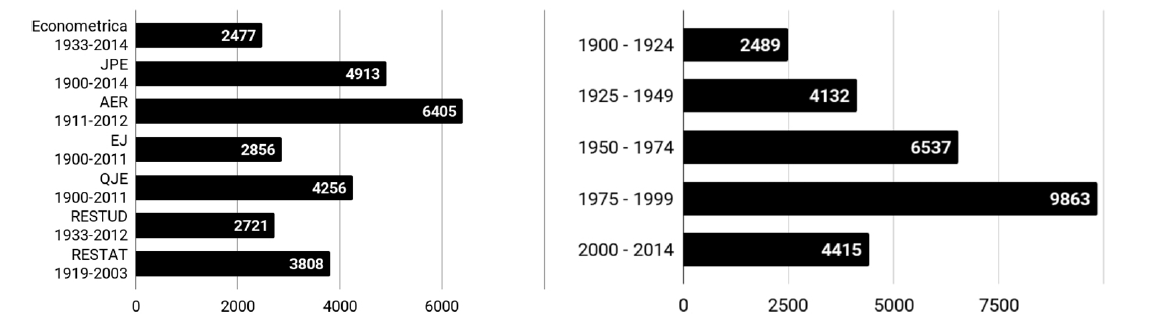
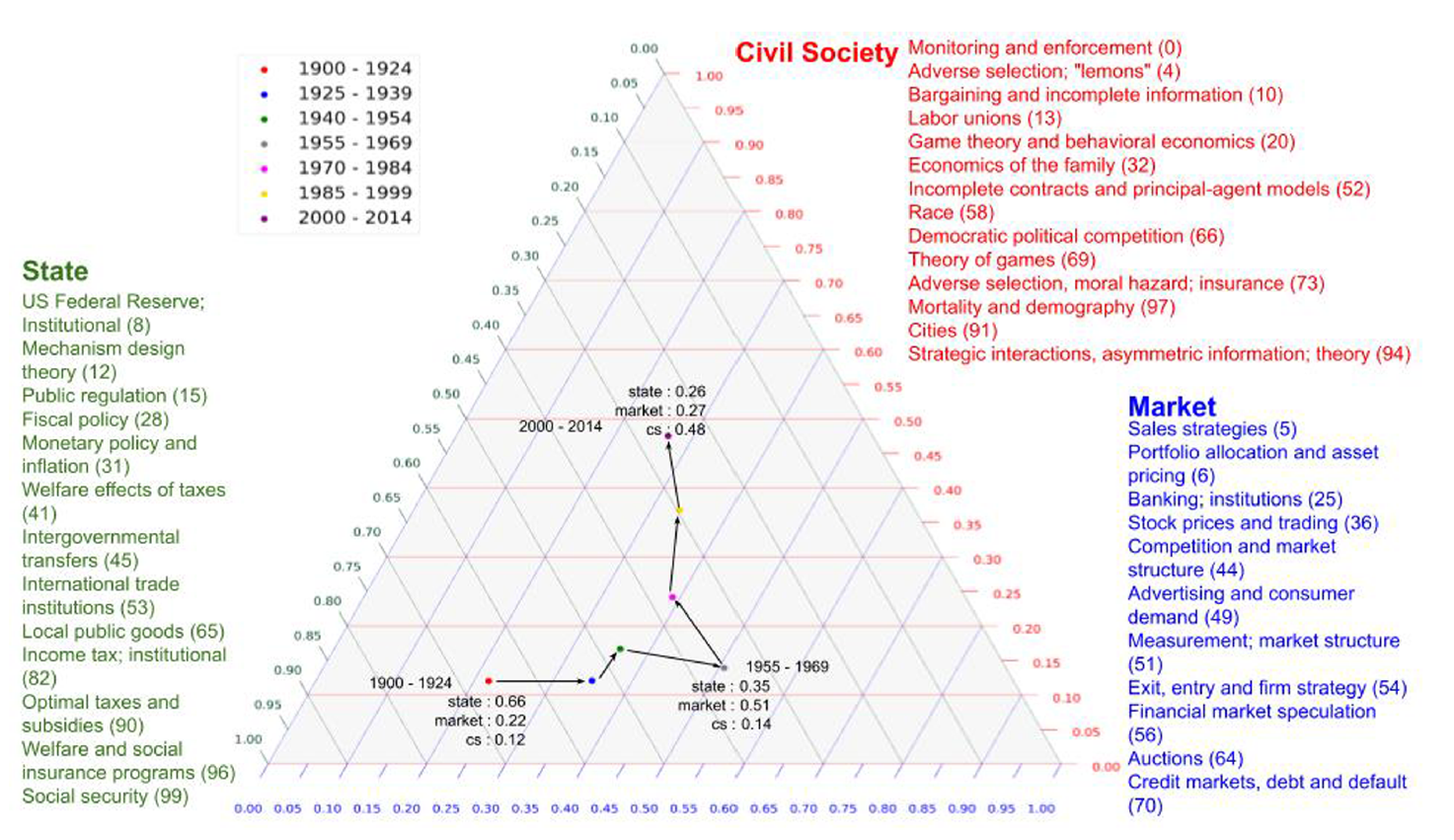
Using topic modeling on the corpus of papers published in seven leading economics journals since 1900, we study the evolving emphasis in research on themes relating to the state, markets, and civil society, the latter referring to families, firms as organizations, other private organizations, neighborhoods, and identity groups. We document a shift between 1900 and 1970 away from research on state-related topics towards the market, even as the economic importance of the state was growing. This was followed by a substantial movement away from market topics towards topics related to civil society. We associate the first shift with the mathematical formalization of the Marshallian paradigm. The subsequent increased attention to civil society coincided with novel research questions and empirical methods including experiments and the use of large datasets. Since the middle of the last century advances in game theory and the economics of asymmetric information also facilitated the extension of economists’ research agendas to encompass themes central to economic behavior in civil society, including other-regarding preferences and social norms as well as strategic interactions not covered by complete contracts.
The shift in focus described in the paper is reflected in Nobel awards to Myrdal and Hayek (in 1974), Simon (1978), Coase (1991), Nash (1994), Sen (1998), Akerlof and Stiglitz (2001), Kahneman and Smith (2002), Schelling (2005), Ostrom and Williamson (2009), Hart (2016), Thaler (2017), Goldin (2023) and Acemoglu, Johnson and Robinson (2024).
This is a fabulous time to be studying economics,
says Subramanyam, quoted by SFI.
And what an amazing time would be if / will be when a lot more people study and understand the very basics of the last 100 years of research in economics. And very specifically those and every one in charge of our supposedly democratic institutions (yes, states and governments).
____________________
- Bowles, Samuel, Wendy Carlin, and Sahana Subramanyam. “Civil Society Comes of Age in Economics: Tracking a Century of Research.” Economics Letters 246 (January 1, 2025): 112070. https://doi.org/10.1016/j.econlet.2024.112070. ↩︎
Featured Image: Civil society (2019), by Pavel Kuragin
 Mind the Post
Wonderful post 🎸🎸
Thanks for reading. Glad to see you enjoy it!
A very broad and interesting topic. I think it deserves more clarification on how to implement policy changes, which is a difficult issue.In any case, I think the graphs need some explanation.
Sorry for the comments from anonymous. It seems the login procedure is a bit erratic. You can delete them!
Thanks for the Anonymous clarification 😉 I was intrigued