
Science fiction writers give us a glimpse of possible futures. They elaborate thought experiments by telling the stories of how humans might be changed by new technologies. In an article1,2 published in Nature last year three scientists share their bold vision for turning stories into testable experiments.
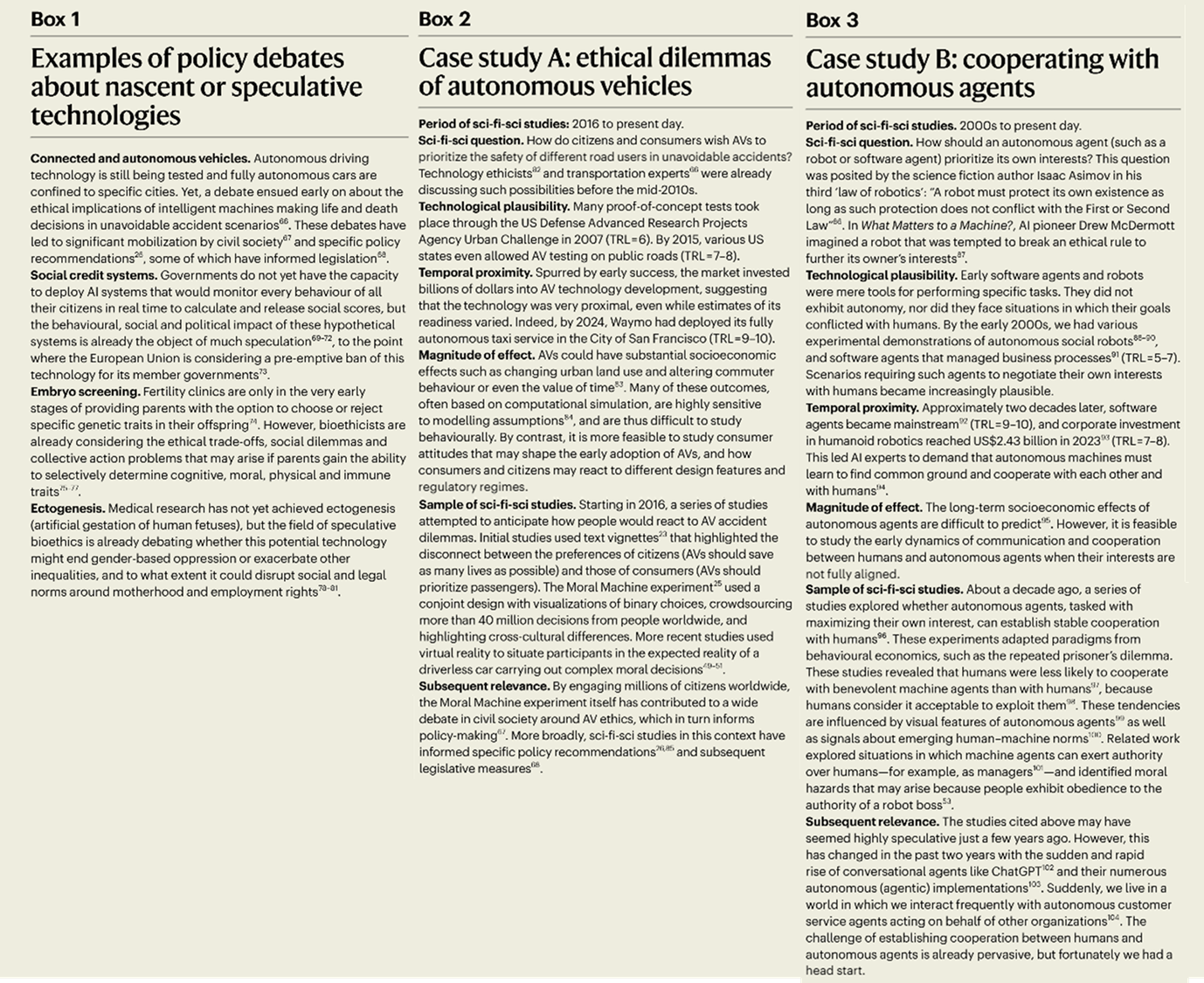
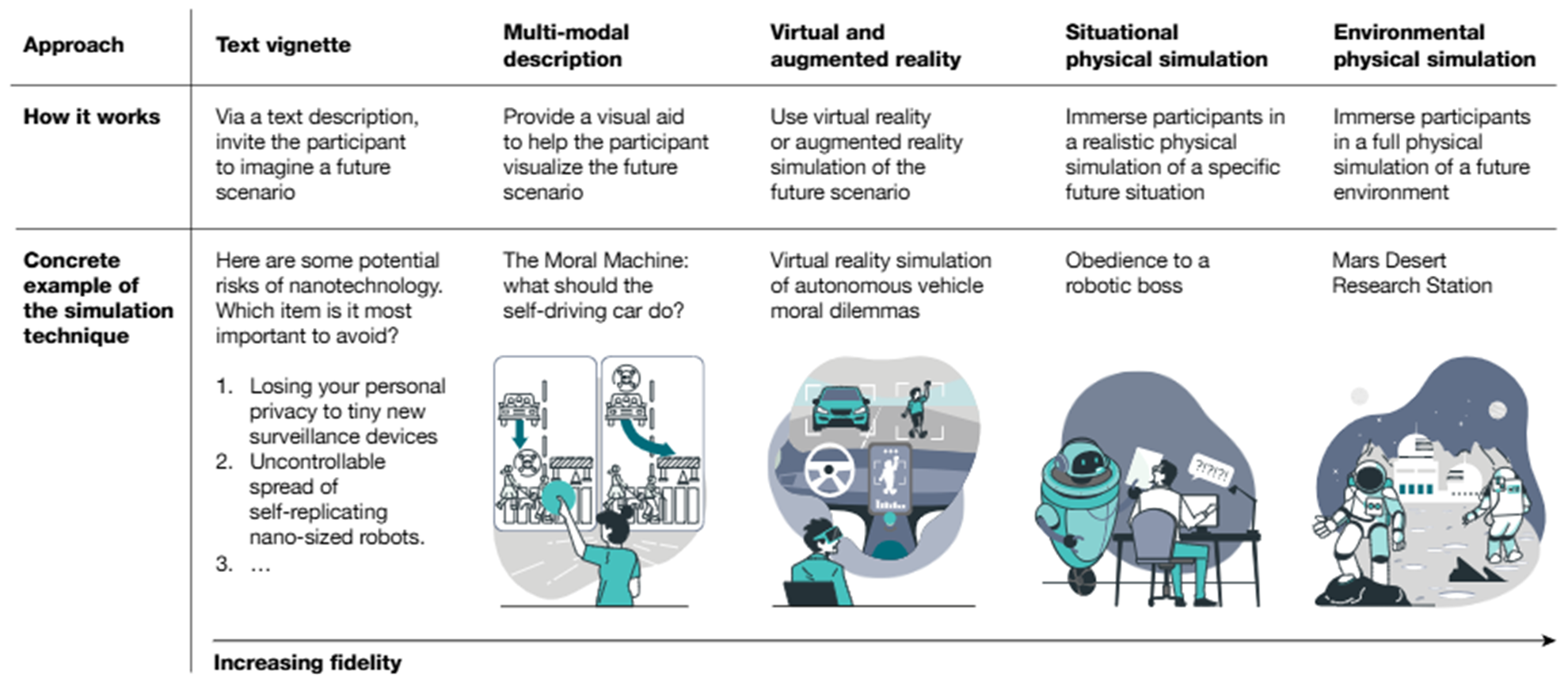
Researchers from various fields are already providing immersive simulations of the future, or asking research participants to express preferences and opinions about the technologies. The Science Fiction Science Method applies the scientific method to the science fiction project, by immersing research participants into controlled variations of the future, and collecting quantitative data on their attitudes and behavioral responses:
Predicting the social and behavioural impact of future technologies before they are achieved would enable us to guide their development and regulation before these impacts get entrenched. Traditionally, this prediction has relied on qualitative, narrative methods. Here we describe a method that uses experimental methods to simulate future technologies and collect quantitative measures of the attitudes and behaviours of participants assigned to controlled variations of the future. We call this method ‘science fiction science’. We suggest that the reason that this method has not been fully embraced yet, despite its potential benefits, is that experimental scientists may be reluctant to engage in work that faces such serious validity threats. To address these threats, we consider possible constraints on the types of technology that science fiction science may study, as well as the unconventional, immersive methods that it may require. We seek to provide perspective on the reasons why this method has been marginalized for so long, the benefits it would bring if it could be built on strong yet unusual methods, and how we can normalize these methods to help the diverse community of science fiction scientists to engage in a virtuous cycle of validity improvement.
Books will eventually fade in a not-too-distant future. Not stories, nor narratives — they will evolve into the laboratories where the future is cooked.
____________________
(1) Rahwan, I., Shariff, A. & Bonnefon, JF. The science fiction science method. Nature 644, 51–58 (2025). https://doi.org/10.1038/s41586-025-09194-6
(2) Preprint version. arXiv:2508.03430 [cs.HC]
 Mind the Post