When will humans set foot on Mars? Is cryogenics technically feasible? When will nanorobots be practical? How quickly will the market adopt them? Will it ever be possible to store our memories on a hard drive? When will artificial intelligence replace me in my job? (For example, when writing this article.)
This is how I started an article which attempted to summarize the potential and state of development of prediction markets, published in The Conversation Spain just five years ago, (Please, do notice those last words in parentheses 😉
Prediction markets are forums where people trade contracts that pay out depending on whether an uncertain event happens or not, and the resulting prices can be read as crowd based probabilities. Betting on future events is as old as horse racing and 19th century election betting on Wall Street, but digital platforms have made it possible to trade on almost anything, from elections and regulations to technological breakthroughs. There is extensive evidence that, under the right conditions, these markets can produce forecasts with lower prediction error than many traditional methods, which is why academics and tech firms have experimented with them for decades.
From geeky curiosity to contested infrastructure
For years, prediction markets lived in academic circles, internal corporate experiments, and among a handful of enthusiasts. Some large tech companies ran internal markets to experiment, using them as a complement to conventional planning tools. And current leaders and advisors at platforms like e.g. Metaculus bring direct experience from large tech companies that pioneered internal prediction market experiments.
That relatively quiet phase is over. New platforms like Polymarket and Kalshi have popularized real money markets on elections, policy, macroeconomic indicators, and other sensitive events, with growing liquidity and media coverage. We have entered the familiar “tipping point” of adoption where the key questions are no longer “Do they work?” but “Who wins, who loses, and who controls the rules?”
Why the controversy is exploding now
Over the last months, a wave of critical pieces in mainstream outlets has framed prediction markets less as forecasting tools and more as a new source of political and financial risk. The Financial Times warned of “a new spectre” over democracy, arguing that liquid markets on elections and political events offer a troubling opportunity to manipulate perceptions of likely outcomes. Kyla Scanlon, in the New York Times, goes further. She argues that prediction markets are becoming part of the infrastructure that grants legitimacy to events, because odds are now reported alongside news by major media organizations. Saahil Desai in The Atlantic describes how platforms like Polymarket enable wealthy or strategic actors to move prices and thus “launder” narratives into apparent consensus, something a candidate could never do with traditional polling.
Financial and tech media have started to treat prediction markets as a new competitive threat to incumbent gambling and trading businesses. A MarketBeat analysis frames them as a potential challenge to sportsbooks such as DraftKings and FanDuel, which could lose action if users migrate from sports to “everything markets”. ITV News recently presented prediction markets to a general audience as a hybrid between gambling and trading, highlighting ethical questions like whether you should be allowed to bet on war, disasters, or politically sensitive events.
Meanwhile Polymarket says that “journalism is better when it’s backed by live markets”
Uses, abuses, and the “legitimacy” problem
Supporters point to three broad families of use cases recently discussed even in Davos by Brian Armstromg, CEO of cryptocurrency platform Coinbase:
- A faster alternative to traditional media and polling,
- Hedging tools for sectors like global shipping or commodities, and
- Decision aids for le
Markets that aggregate dispersed information can surface early signals: a sudden spike in odds can act as a flag that something is changing and merits deeper analysis, even for professional investors.
Critics focus on three different failure modes.
- There is the risk of outright manipulation, where actors with deep pockets trade not just to forecast but to influence public perception or even real world outcomes.
- There is evidence of structural biases and consumer harm: a recent study on Kalshi finds a strong “favorite–longshot” bias in which cheap bets on unlikely outcomes lose money systematically, while the platform earns commissions as participants net lose.
- Authors like Scanlon stress the legitimacy problem: when odds are integrated into news flows and political commentary, they can turn speculation into perceived inevitability—“legitimacy increasingly flows to whoever processes uncertainty first,” in her formulation.
Where the debate goes next
We have therefore moved from a mostly technical debate (Are prediction markets accurate? Under what conditions?) to a political and regulatory debate (What events should we be allowed to bet on? Who should participate? How should media use these signals?). U.S. regulators are already grappling with how to classify these platforms—as event contract venues under commodities law, as gambling, or as something new—and lawmakers have floated proposals to restrict insider participation or to limit contracts tied to core democratic processes. In parallel, commentators warn about the specific always commented case of “betting on war” and national security, where the informational value of a market could be outweighed by perverse incentives and geopolitical signalling risks.
Yes, prediction markets are rife with insider betting. That does not mean regulators should stamp it out. While such behavior can undermine trust and raise ethical and legal concerns—especially when government officials are involved—banning insider betting outright could reduce the accuracy of prediction markets, which benefit from informed traders. Perhaps a targeted approach, particularly restricting government officials from betting on privileged information, may strike a better balance between market accuracy and public trust.
It would be a mistake to ignore the genuine informational and coordination potential of well‑designed, well‑governed markets for science, technology, and policy. The challenge for the next few years is not to decide whether prediction markets are good or bad in the abstract, but to distinguish contexts where they improve collective forecasting from contexts where they corrupt legitimacy, exacerbate inequality, or incentivize harmful behavior.
Nobody said innovation was a bed of roses, did they? —oh wait!
____________________
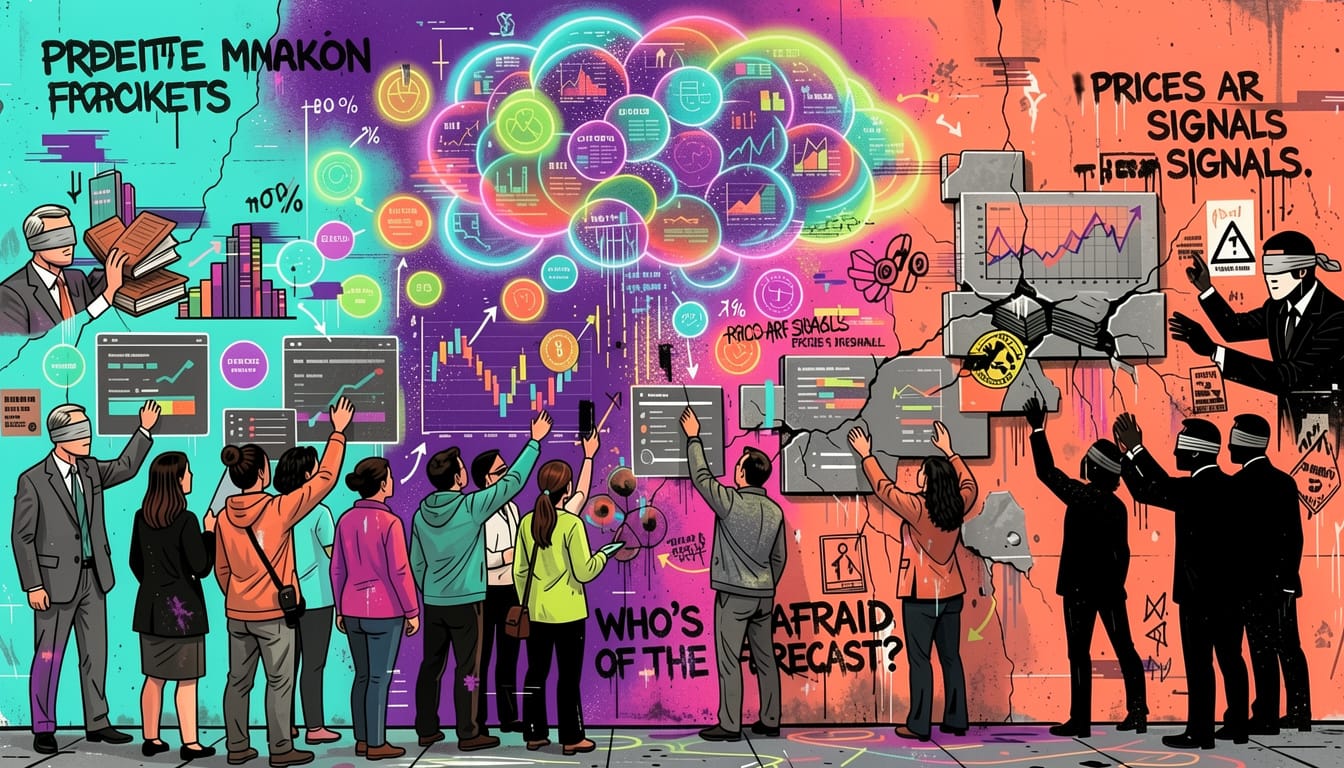
Featured Image: Philosophical Graffiti. Prediction Markets
 Mind the Post