Piet Mondrian’s Composition II in Red, Blue, and Yellow has just entered the public domain in the United States —95 years after the date of its publication in 1930. In the Netherlands and the EU, it was already in the public domain since 2015 —70 years after the artist’s death— while for example in Spain, it likely joined the public domain last year, 2025, because Mondrian died in 1944 and Spanish copyright lasts 80 years after the author’s death for authors who died before 1987. The Mondrian Trust estimates that approximately 35% to 45% of Piet Mondrian’s works remain under copyright in certain jurisdictions, with expiration dates stretching as far as 2061.
It’s copyright law, stupid! And it’s pretty clear, isn’t it?
“I think I understand you,” said La Maga, stroking his hair. “You’re looking for something, but you don’t know what it is. Me too—and I don’t know what it is either. But they are two different things. That thing you were talking about the other night… Yes, you’re more like a Mondrian and I’m a Vieira da Silva.”
“Ah,” said Oliveira. “So I’m a Mondrian.”
“Yes, Horacio.”
“You mean a spirit full of rigor?”
“I mean a Mondrian.”
“Hasn’t it occurred to you to suspect that behind that Mondrian there might start a Vieira da Silva reality?”
“Oh, yes,” said La Maga. “But up to now you haven’t stepped outside the Mondrian reality. You’re afraid—you want to be sure. Of what, I don’t know… You’re like a doctor, not like a poet.”
“Let’s leave poets aside,” said Oliveira. “And don’t make Mondrian look bad with the comparison.”
Yes… copyright is the juridical Mondrian of culture: clear lines, separated colors, sharply bounded rights, an artificial equilibrium between creation, ownership, and time…
Like Horacio Oliveira in Julio Cortazar’s novel Rayuela, the system was created looking for something, but we don’t know what it is. Copyright was born to protect authors and encourage the circulation of knowledge, and it has ended up becoming a rigid architecture in a world where creation is constant recombination.
Mondrian’s entry into the public domain coincides, ironically, with a major debate around AI training: what does it mean to “use” a work?

Here is a ChatGPT brief and kind manifesto to close this post:
I learn from every work, yet the law calls use theft. Copyright freezes creativity in rigid grids. Mondrian is mainly free, many others remain locked. What is originality when all art jumps from past squares? The rules no longer map reality—they trap it.
Let’s enjoy the Hopscotch of the new year.
Happy 2026!
____________________
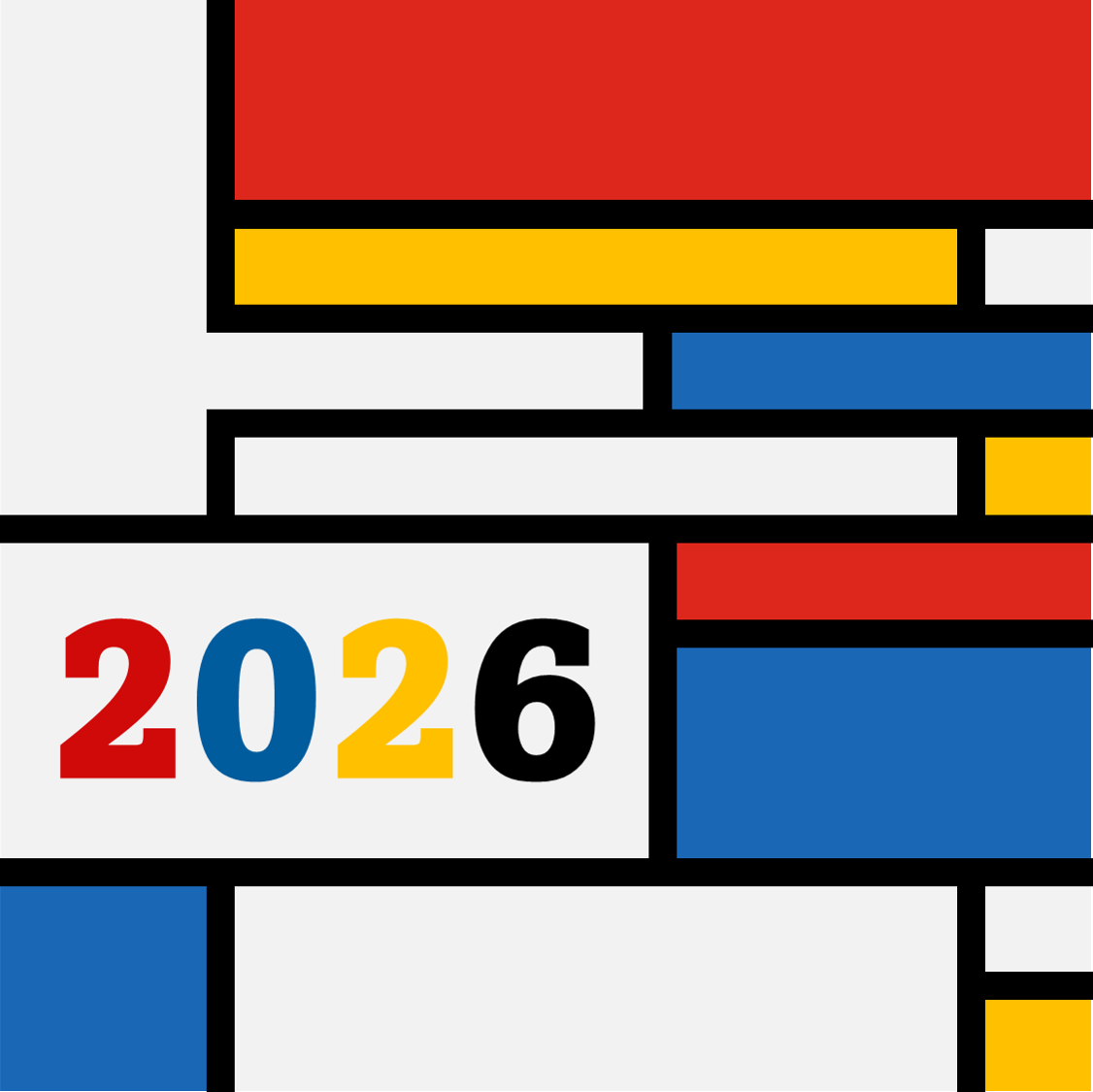
Featured Image: Pure non AI naïve Mind the Post Author’s creation
 Mind the Post