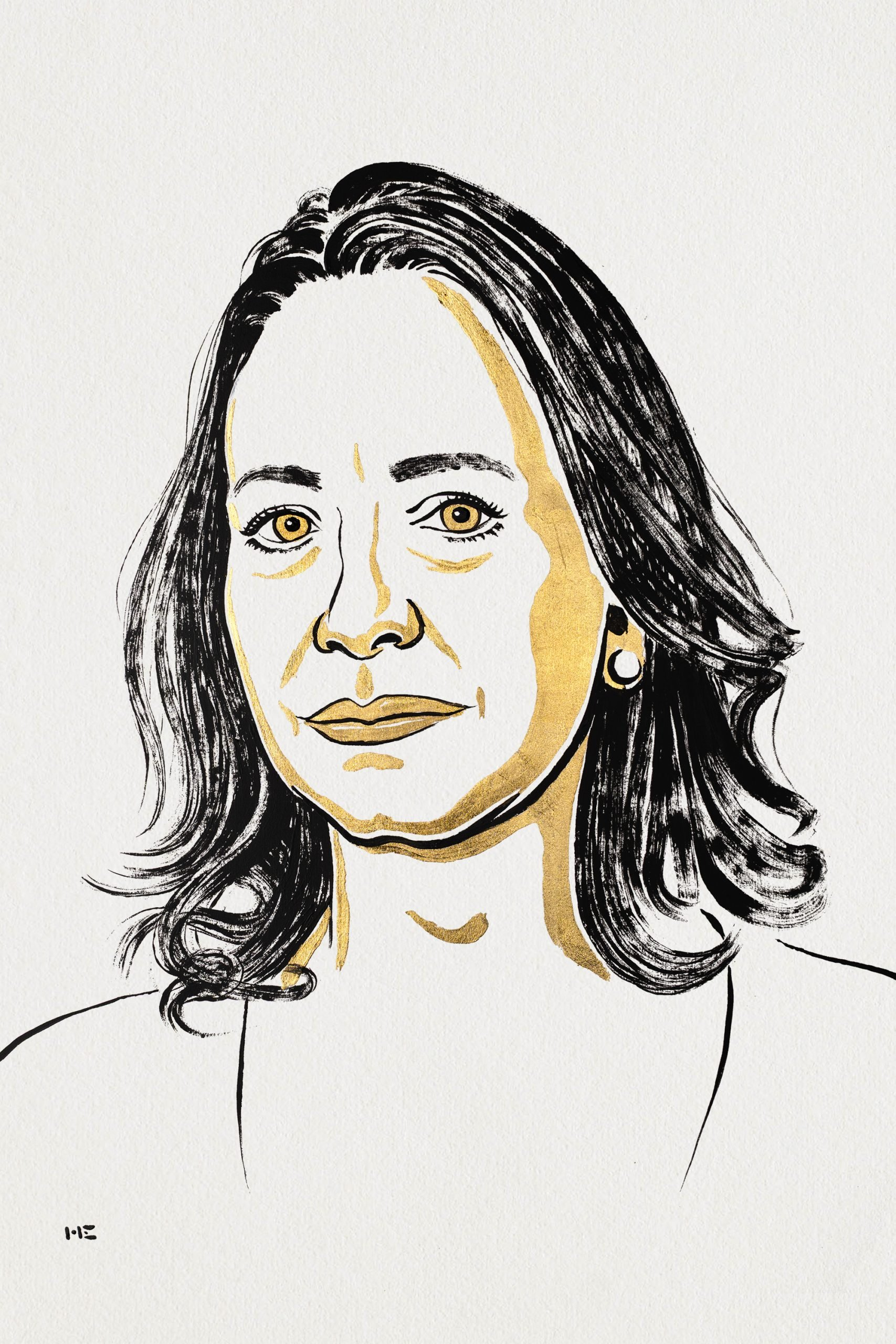
María Corina Machado, Venezuela’s de facto opposition leader, was awarded this year Nobel Peace Prize 2025 for “her tireless work promoting democratic rights for the people of Venezuela and for her struggle to achieve a peaceful and just transition from dictatorship to democracy.”
She was hailed by the Nobel Committee as “one of the most extraordinary examples of civilian courage in Latin America in recent times”.
Last Wednesday, December 10, her daughter Ana Corina Sosa, accepted the award on her mother’s behalf and delivered a lecture at the ceremony in Oslo’s City Hall.
After more than a year in hiding for security reasons, Maria Corina arrived finally in Oslo at midnight on Thursday, at around 2:30 a.m. A moving moment…
Even more interesting was the speech given by Jørgen Watne Frydnes, Chair of the Norwegian Nobel Committee. Just a brief sample:
Venezuela has evolved into a brutal, authoritarian state facing a deep humanitarian and economic crisis. Meanwhile, a small elite at the top – shielded by political power, weapons and legal impunity – enriches itself.
Venezuela is not alone in this darkness. The world is on the wrong track. The authoritarians are gaining.
Authoritarian regimes learn from each other. They share technology and propaganda systems. Behind Maduro stand Cuba, Russia, Iran, China and Hezbollah – providing weapons, surveillance and economic lifelines. They make the regime more robust, and more brutal.
Venezuela’s future can take many forms. But the present is one thing only – and it is horrific.
This is why the democratic opposition in Venezuela must have our support – not our indifference, or worse, condemnation. Every day, its leaders must choose a path that is in fact open to them, not the path of wishful thinking.
Support for democratic development is support for peace.
In its long history, the Norwegian Nobel Committee has honoured brave women and men who have stood up against repression, who have carried the hope of freedom in prison cells, in the streets and in public squares, and shown by these actions that resistance can change the world.
Today, we honour you, Maria Corina Machado.
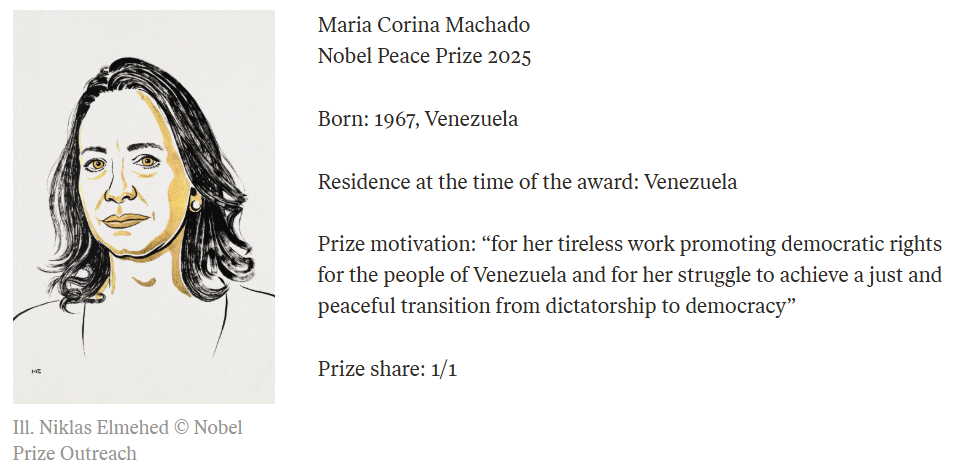
Keeps the flame of democracy burning amidst a growing darkness
The very same day of the award ceremony, the New York Times published and article by Katrin Bennhold titled “A Controversial Nobel Peace Prize:” The Venezuelan opposition leader María Corina Machado supports the use of force to overthrow her country’s government.
María Corina Machado, Venezuela’s de facto opposition leader, was awarded this year’s Nobel Peace Prize for her attempts to push an authoritarian country toward democracy through peaceful means — at least for now.
When other opposition leaders fled into exile, she stayed to challenge a government that jails opponents, tortures critics and censors the press. She stayed in hiding for more than a year after President Nicolás Maduro declared victory in a vote that was widely seen as rigged.
But Machado’s peace prize has been highly contentious. She dedicated it to President Trump, who has amassed U.S. warships in the Caribbean, killing at least 87 people in boats in strikes that critics say amount to war crimes. Officials in the Trump administration privately say their ultimate goal is to bring about regime change in Venezuela. Machado has expressed support for using force to oust Maduro.
Meanwhile, 2023 Nobel Peace Prize Winner Narges Mohammadi was “violently” arrested In Iran. The Nobel Peace Prize committee condemns the “brutal” arrest. Ales Bialiatski, who won Nobel prize while behind bars, is freed from prison in Belarus.
Yes, just by looking at Nobel Peace Prize news over a simple week, it is unavoidable to conclude that we are certainly living dark times.
And it is hard to admit that only history will judge what has been lacking.
____________________
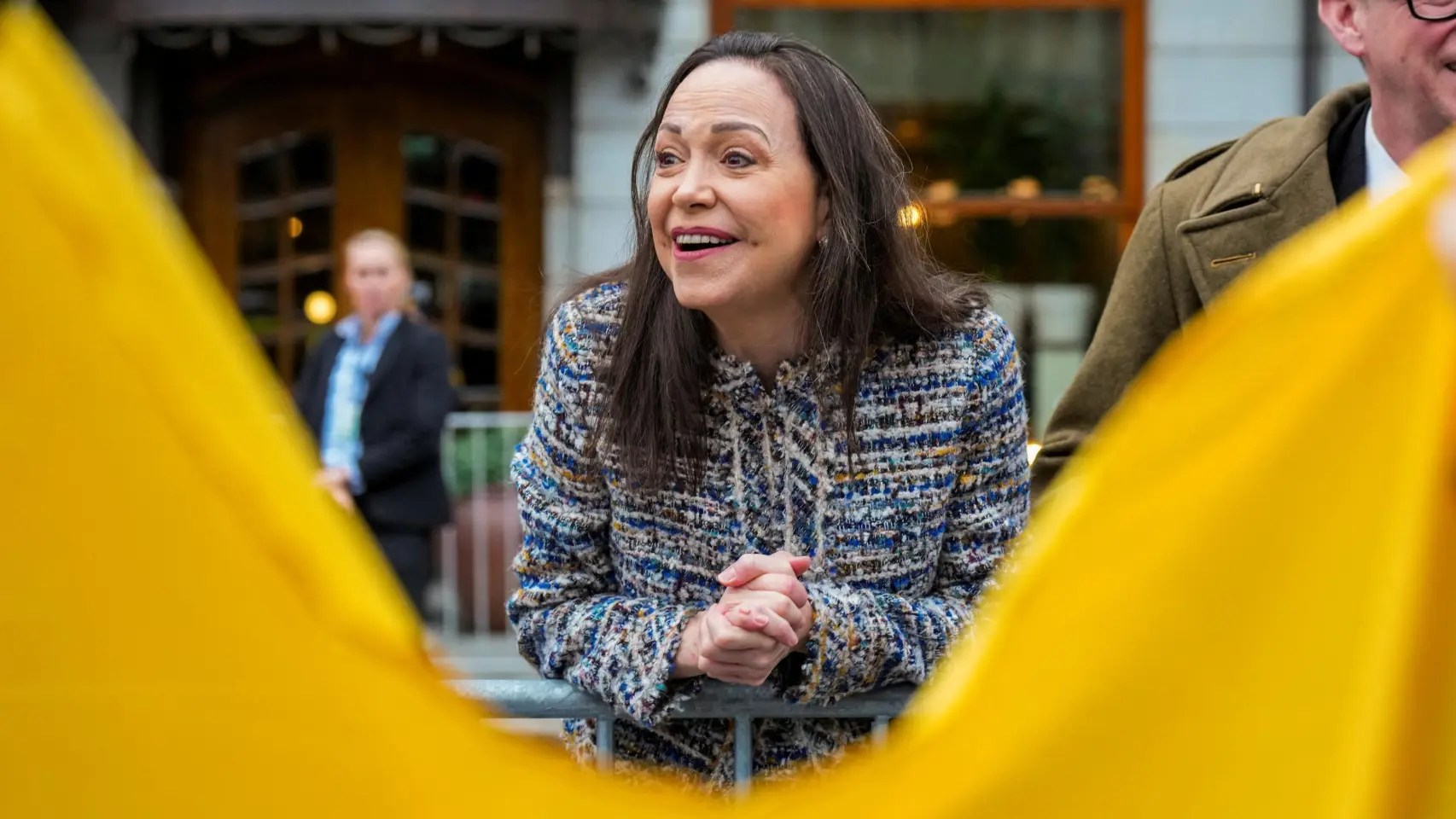
Featured Image: Maria Corina Machado, Nobel Peace Prize 2025
 Mind the Post