What’s the impact of AI on work, scientific research, energy, medicine, business, and more? We are overwhelmed by all sort of studies, pronouncements, statements and opinions. Here is a brief sample of publicationes over the last 3 months.
- Stanford Institute for Human-Centered AI (HAI), The 2025 AI Index Report
- McKinsey, The state of AI in 2025: Agents, innovation, and transformation
- Statement on Superintelligence
- Nathan Benaich and Air Street Capital, State of AI Report 2025
- Pew Research, How People Around the World View AI
- Eliezer Yudkowsky, Nate Soares, If Anyone Builds It, Everyone Dies: Why Superhuman Ai Would Kill Us All
- MIT, The GenAI Divide. State of AI in Business 2025
The aggregation of all those different views is a great cacophony. Public debates about AI rarely culminate in precise, falsifiable forecasts of AI capabilities, adoption, and impact. And there is little work systematically mapping the full spectrum of views among experts (computer scientists, economists, technologists) and the general public.
AI today is perhaps the best example of our collective disability: every (wo)man for her/himself!
The Longitudinal Expert AI Panel (LEAP) is a three-year project tracking the views of leading computer scientists, industry professionals, policy researchers, and economists on the trajectory of artificial intelligence. Every month, LEAP participants provide thousands of forecasts in response to carefully crafted questions, leveraging the science of judgmental forecasting to provide a representative set of expert views about the future of AI.
LEAP is led by researchers at the Forecasting Research Institute (FRI), Stanford University, the Federal Reserve Bank of Chicago, and the University of Pennsylvania, with the support of the Princeton AI Lab. It aims to create the most reliable map of the future of AI and its impacts:
we aim to make LEAP the most useful and widely-cited single source of expert and public opinions on the future of AI
Just an example of the kind of question included in the monthly surveys:
Millennium Prize: Question. What is the probability that AI will solve or substantially assist in solving a Millennium Prize Problem in mathematics by the following resolution dates?
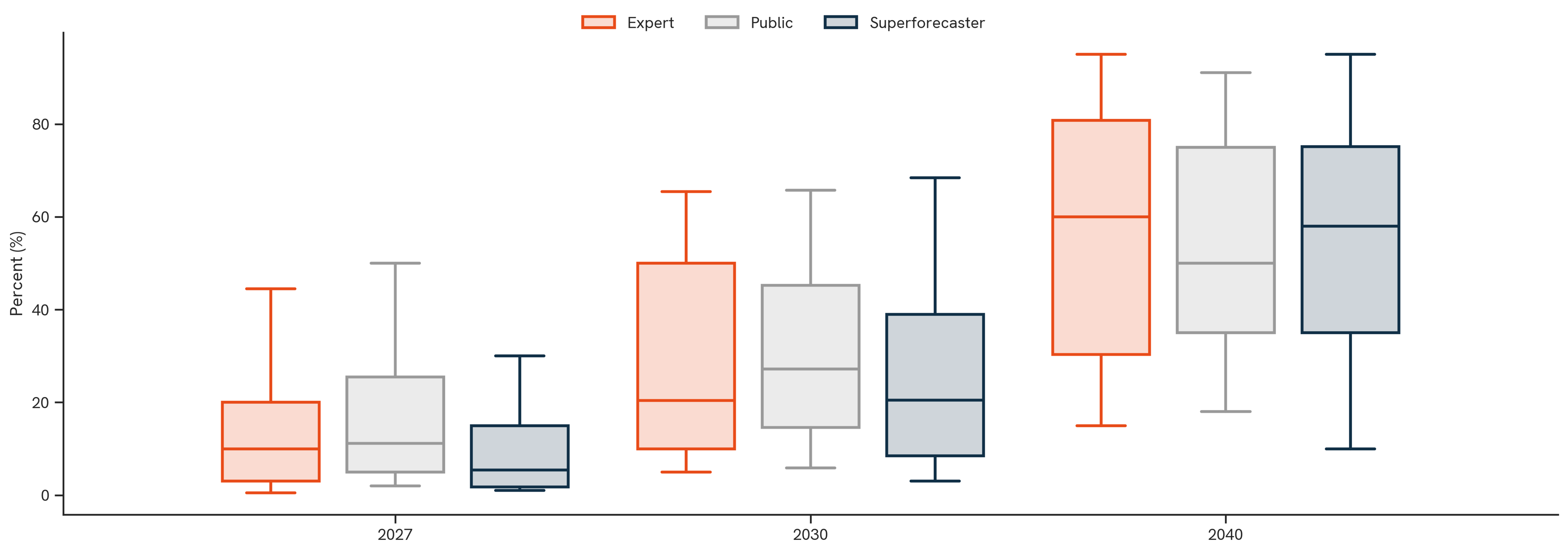
Insights from Waves 1-3 (monthly surveys):
- Experts expect sizable near‑term societal effects from AI by 2040.
- Experts disagree and express substantial uncertainty about the trajectory of AI.
- The median expert expects significantly less AI progress than leaders of frontier AI companies.
- Experts predict much faster AI progress than the general public.
- There are few differences in prediction between superforecasters and experts, but, where there is disagreement, experts tend to expect more AI progress. LEAP doesn’t see systematic differences between the beliefs of computer scientists, economists, industry professionals, and policy professionals.

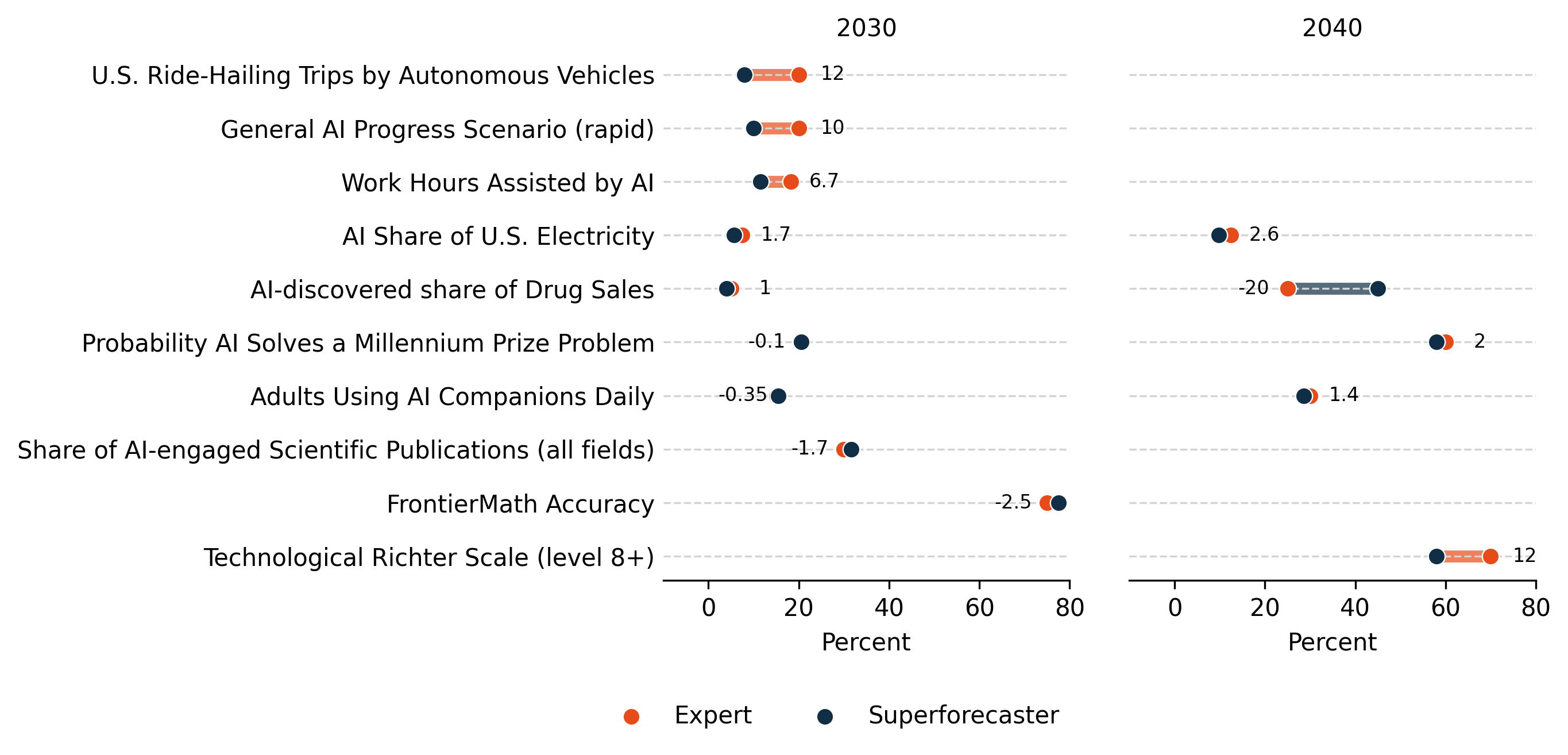
You can find all the details in the Launch White Paper1:
Curious, just curious: what I’m reading about “anticipation” in the general media doesn’t make me feel very optimistic 🤔.
____________________
(1) Murphy, C., Rosenberg, J., Canedy, J., Jacobs, Z., Flechner, N., Britt, R., Pan, A., Rogers-Smith, C., Mayland, D., Buffington, C., Kučinskas, S., Coston, A., Kerner, H., Pierson, E., Rabbany, R., Salganik, M., Seamans, R., Su, Y., Tramèr, F., Hashimoto, T., Narayanan, A., Tetlock, P. E., & Karger, E. (2025). The Longitudinal Expert AI Panel: Understanding Expert Views on AI Capabilities, Adoption, and Impact (Working paper No. 5). Forecasting Research Institute. Retrieved 2025-11-16, from https://leap.forecastingresearch.org/reports/waves-1-to-3-insights
Featured Image: Vibrant portrait painting of Salvador Dalí with a robotic half face.
 Mind the Post