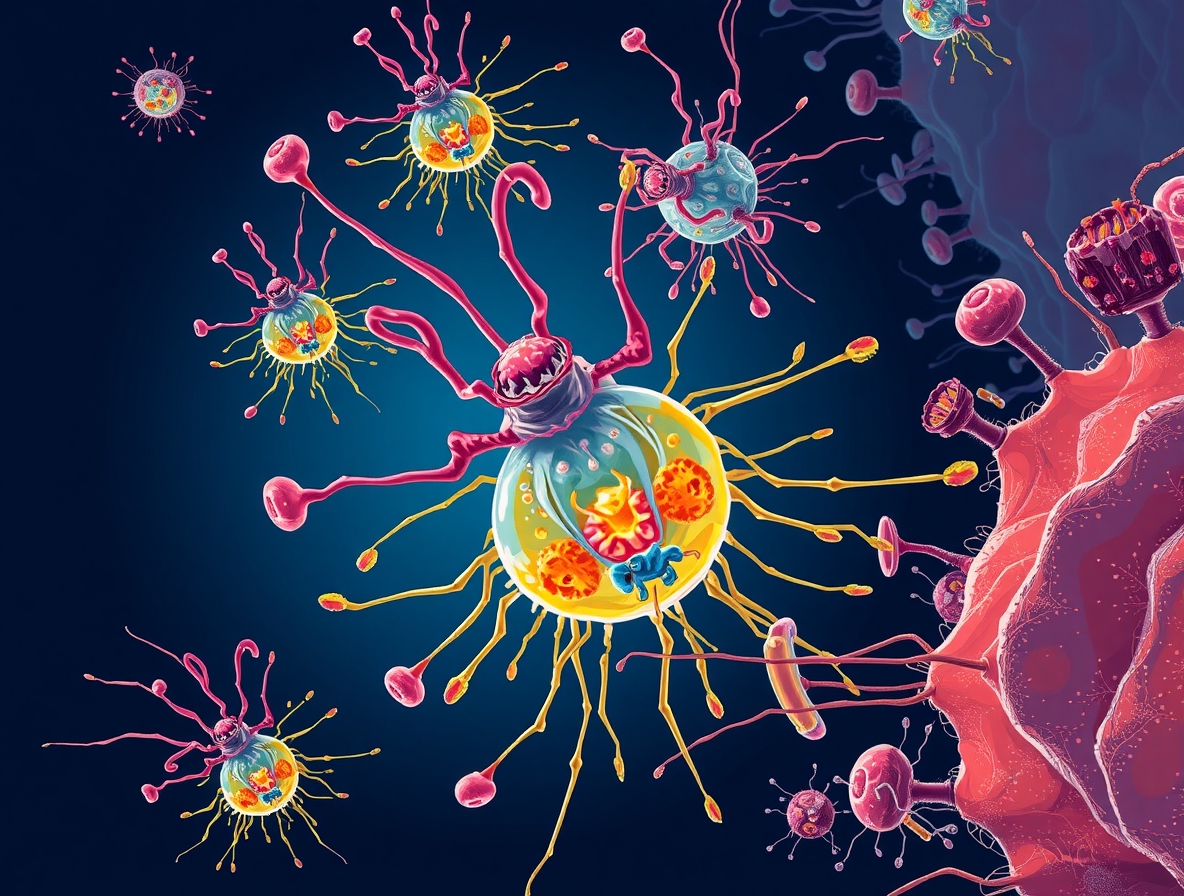
Scientists have created the first ever viruses designed by artificial intelligence, and they’re capable of hunting down and killing strains of Escherichia coli. The study(1) was posted on the preprint server bioRxiv last September and is not yet peer reviewed, but the authors say that it shows the potential of AI:
Many important biological functions arise not from single genes, but from complex interactions encoded by entire genomes. Genome language models have emerged as a promising strategy for designing biological systems, but their ability to generate functional sequences at the scale of whole genomes has remained untested. Here, we report the first generative design of viable bacteriophage genomes. We leveraged frontier genome language models, Evo 1 and Evo 2, to generate whole-genome sequences with realistic genetic architectures and desirable host tropism, using the lytic phage ΦX174 as our design template. Experimental testing of AI-generated genomes yielded 16 viable phages with substantial evolutionary novelty. Cryo-electron microscopy revealed that one of the generated phages utilizes an evolutionarily distant DNA packaging protein within its capsid. Multiple phages demonstrate higher fitness than ΦX174 in growth competitions and in their lysis kinetics. A cocktail of the generated phages rapidly overcomes ΦX174-resistance in three E. coli strains, demonstrating the potential utility of our approach for designing phage therapies against rapidly evolving bacterial pathogens. This work provides a blueprint for the design of diverse synthetic bacteriophages and, more broadly, lays a foundation for the generative design of useful living systems at the genome scale.
The very same preprint has generated an alert: Should we worry AI will create deadly bioweapons? Not yet, but one day.
AI advances are fuelling breakthroughs in biology and medicine. With new power comes responsibility for vigilance.
Nature’s reporter quotes Eric Horvitz, chief scientific officer at Microsoft and author of another study looking at whether AI could design dangerous proteins while evading bioweapon controls.
While Horvitz’s studies looked only at proteins, it is viruses that pose the big threat – and AI is already being used to redesign entire viruses.
Reading this kind of present day news about the possibilities and the dangers of AI it is difficult to avoid the feeling that we are talking about AI as an excuse, a way to elude our responsibility. Just three ideas.
For the purposes described in those papers, and for the time being, artificial intelligence, like any other technology is only a means to an end. Independently of whether the end is achieved or not, and the side effects, the responsibility is ours. The right question is not “Should we worry AI will create…” but “Should we worry scientists will create deadly bioweapons designed with artificial intelligence?”
Science is based on experimentation, and nobody said experimentation is free of risks. We have been debating about this question since the very beginning of the industrial revolution, and very specifically since we started playing with nuclear technologies, and then AI, robotics, cyber, bio, nano, and etc.technology. The more powerful the technology and more ambitious the objective, the higher the risks.
A recent IEEE Spectrum Special Report “The Scale Issue” points in the right direction. Humanity’s greatest challenges require us to radically scale up our ingenuity:
What do humans do best? We push against the boundaries of scale. We probe realms so vast and so minute that they seem beyond our grasp, inventing new tools and methods to extend our reach.
This is the game. The stakes are rising, and, as I have stated in this blog in several occasions, relinquishment is not a credible solution. It would be nice to have a way to collectively debate, decide and act. But very likely we won’t have any one in the foreseable future. Therefore…
Paraphrasing Weyl and Tang’s provocative question in the introduction of Plurality, Ask not “Why is AI doing this?” You are the AI.
_____________________
(1) King, Samuel H., Claudia L. Driscoll, David B. Li, et al. ‘Generative Design of Novel Bacteriophages with Genome Language Models’. Preprint, bioRxiv, 17 September 2025. https://doi.org/10.1101/2025.09.12.675911.
 Mind the Post