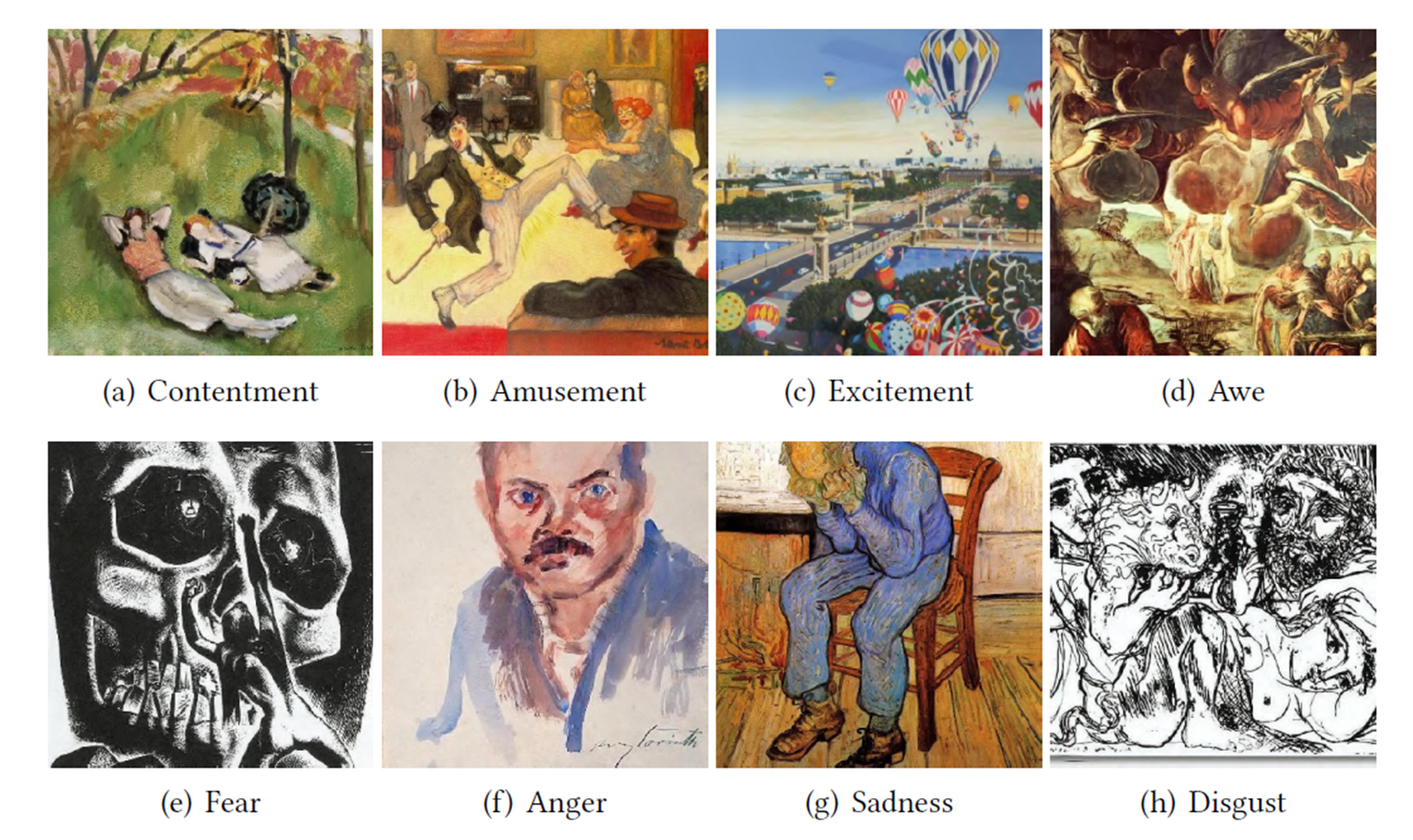
Throughout history, painters have created images that reflect the social, political, and economic conditions of their world, offering visual records of ritual and daily life, power and protest, and poverty and prosperity, especially in contexts where other forms of data are sparse or absent. Yet despite their richness, paintings have rarely been used at scale to systematically study historical societies.
A new paper1 introduces new algorithmic methods to analyze the socioeconomic conditions of the past through the lens of 630,846 paintings from 1400 onward by more than 29,000 artists from 34 present-day countries with at least 1,000 artworks each, with the objective to uncover how visual art reflects its socioeconomic context.

Authors propose an emotion-based measure, derived from historical artworks, as a novel lens to examine how societies experienced major socioeconomic transformations, including climate variability, trade dynamics, technological change, shifts in knowledge production, and political transitions.
They study how emotions respond to:
- Climatic variability in Europe between 1500–2000
- Trade
- Technological change
- The rise of scientific knowledge
- Political context
e.g.: the emotional footprint of technological change, focusing on the diffusion of the steamship and radio (including its propagandistic).

And they analyze aggregate patterns of emotions in 12 selected countries.
e.g.: Spain

“Excited” with the paper, not so much with the Spanish perspective…
____________________
(1) Gorin, Clément, Stephan Heblich, and Yanos Zylberberg. ‘State of the Art: Economic Development Through the Lens of Paintings’. Working Paper. Working Paper Series. National Bureau of Economic Research, June 2025. https://doi.org/10.3386/w33976.
Featured image: Balloon Race Hiro Yamagata, included in Fig 3. Op. Cit.

 Mind the Post