
What does it mean to be a cool person? Is being cool the same thing as being good? Do the attributes of cool people vary across cultures?
A new paper1 published last week in the Journal of Experimental Psychology addressees these questions:
We answer these questions by investigating which values and personality traits are associated with cool people and whether these same attributes are associated with good people. Experiments with 5,943 respondents in Australia, Chile, China (Mainland and Hong Kong), Germany, India, Mexico, Nigeria, Spain, South Africa, South Korea, Turkey, and the United States revealed that many of the attributes associated with cool people are also associated with good people. Cool and good, however, are not the same.
Cool people are perceived to be more extraverted, hedonistic, powerful, adventurous, open, and autonomous. Good people are more conforming, traditional, secure, warm, agreeable, universalistic, conscientious, and calm.

This pattern is stable across countries, which suggests that the meaning of cool has crystallized on a similar set of values and traits around the globe.
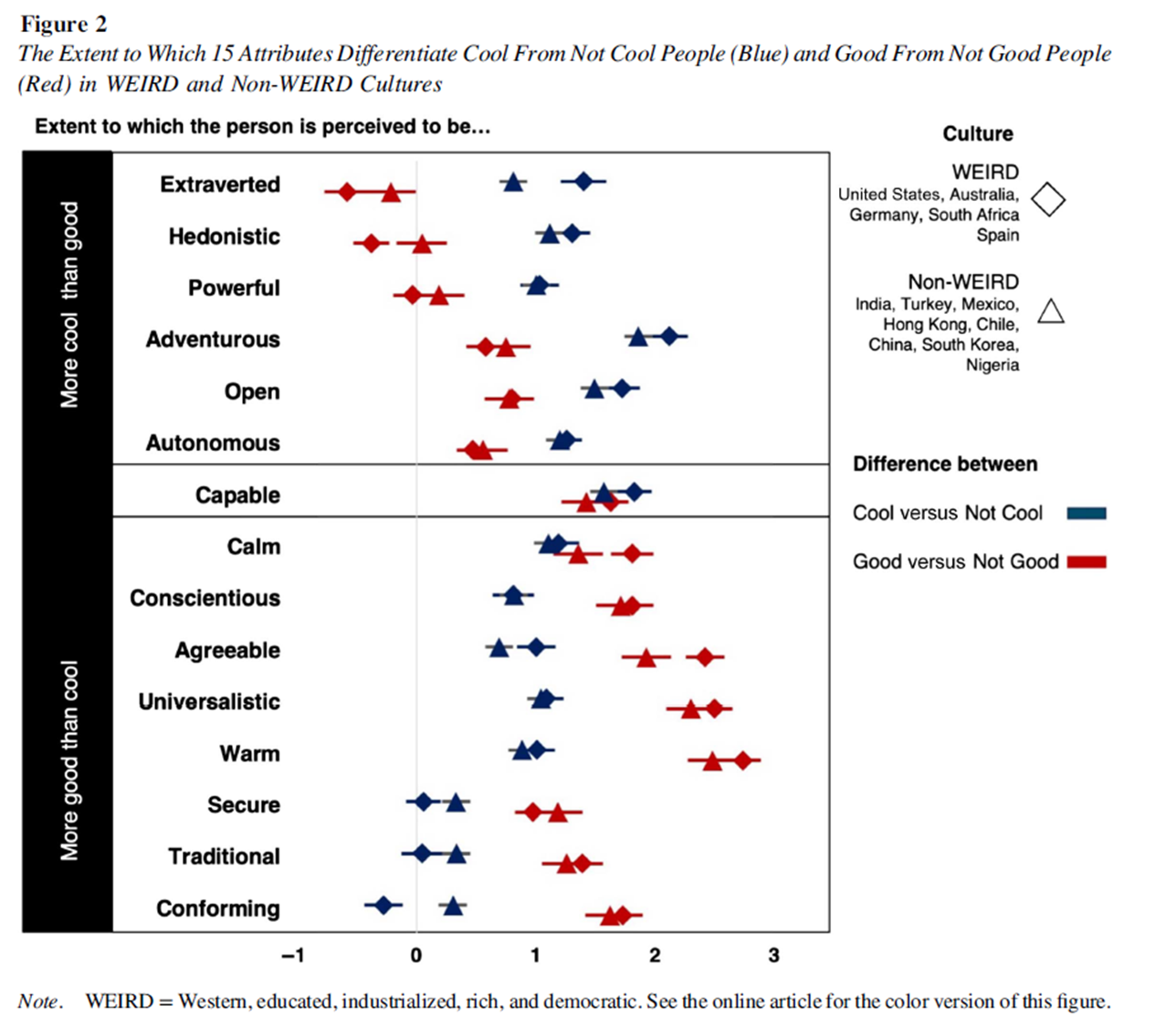
The authors build on these results to advance a theory of the role that coolness plays in establishing social hierarchies and changing social and cultural practices and norms.
Although researchers do not agree about how to define cool (…), they do agree that coolness is in the eye of the beholder (…) Coolness is socially constructed such that a person, object, or behavior is cool if people agree that it is cool and uncool if they agree that it is not.

Their discussion is very interesting, specially for someone interested in jazz, innovation, culture, and improvisation 😉 Let me pick a couple of inspiring notes:
Early jazz musicians innovated more than a new genre of music. They also developed a unique lexicon, which included describing individuals with a relaxed and emotionally restrained style as cool in the 1940s (…) By the 1960s, youth all around the United States had adopted the term to describe certain types of people, products, and behaviors (…) Over time, the term spread through societies and across cultural borders.
Our method does not let us test the extent to which coolness was valued or prevalent in a culture, but historical analysis suggests that cool people were first recognized and admired in countercultural niches, such as mid-20th century African American jazz clubs and beatnik coffee shops that valued improvisation and creative expression (…) The desire to be cool spread as societies shifted their focus from industry to information, and coolness continues to play a larger role in cities (San Francisco, New York, London, Tokyo, etc.) and industries (fashion, entertainment, technology) where economic success depends on creativity.
Isn’t it cool? And you, my dear weird lector, are your cool?*
____________________
(1) Pezzuti, Todd, Caleb Warren, and Jinjie Chen. “Cool People.” Journal of Experimental Psychology: General, 2025. https://doi.org/10.1037/xge0001799.
(*) Let me be clear, just in case, I am not.
Featured Image: Birth of the Cool, the famous Miles Davis album, reinterpreted by a cool AI
 Mind the Post