
After the Trump-Vance-Zelensky infamous meeting at the Oval Office Meeting on Friday last week, plenty of news in mass media are reflecting on the “world order.” Are we entering a totally new period of history?

Just a snapshot.
Trump Is overturning the world order that America built, according to Yaroslav Trofimov, WSJ:
In his first presidency, Trump openly questioned the value of alliances and free trade, while expressing admiration for authoritarian leaders and contempt for fellow democracies, particularly in Europe. But today, with virtually no opposition in Congress or within the administration, those impulses are pursued with unrestrained, and unmatched, vigor. There is also a new, much more destabilizing ingredient: predatory claims on foreign land, such as Canada, Greenland, the Panama Canal and even the Gaza Strip.
While Trump says he seeks global peace with his radical shifts in America’s generations-old consensus, the explosive combination of his neo-mercantilism and his embrace of 19th-century-like imperial thinking could actually push the world toward a new conflagration, warned Evelyn Farkas, executive director of the McCain Institute
US decisions can no longer be analysed using assumptions shared across the democratic west. Why the Maga mindset is different, and by the way, seemingly driven by zero–sum ideology, according to John Burn-Murdoch, FT:

The next four years and beyond will be a bumpy ride come what may, but it will be more navigable after accepting that the world has fundamentally changed. For decades, the US was the champion of western values. The America of Trump, Vance and Musk has left them behind.
Cartoonists are having their day.


What does the always politically correct ChatGPT thinks?
While recent political developments can feel significant, history shows that major shifts in global order are the result of gradual, multifaceted changes. The meeting in question may serve as a symbolic marker or a point of discussion, but it does not, on its own, signal that we are entering an entirely new period of history. Instead, it reflects ongoing debates and uncertainties about the future direction of international relations.
In summary, the world is indeed in a state of flux, but defining this moment as a complete break from the past might be an oversimplification of complex, evolving global dynamics.
Very much in line with what Joseph S. Nye, Jr. thinks:
The question is whether we are entering a totally new period of American decline, or whether the second Trump administration’s attacks on the American Century’s institutions and alliances will prove to be another cyclical dip. We may not know until 2029.
Before a complex, evolving global dynamics like this, I always wonder what some of the best minds of the past, with a lot more perspective, would think…
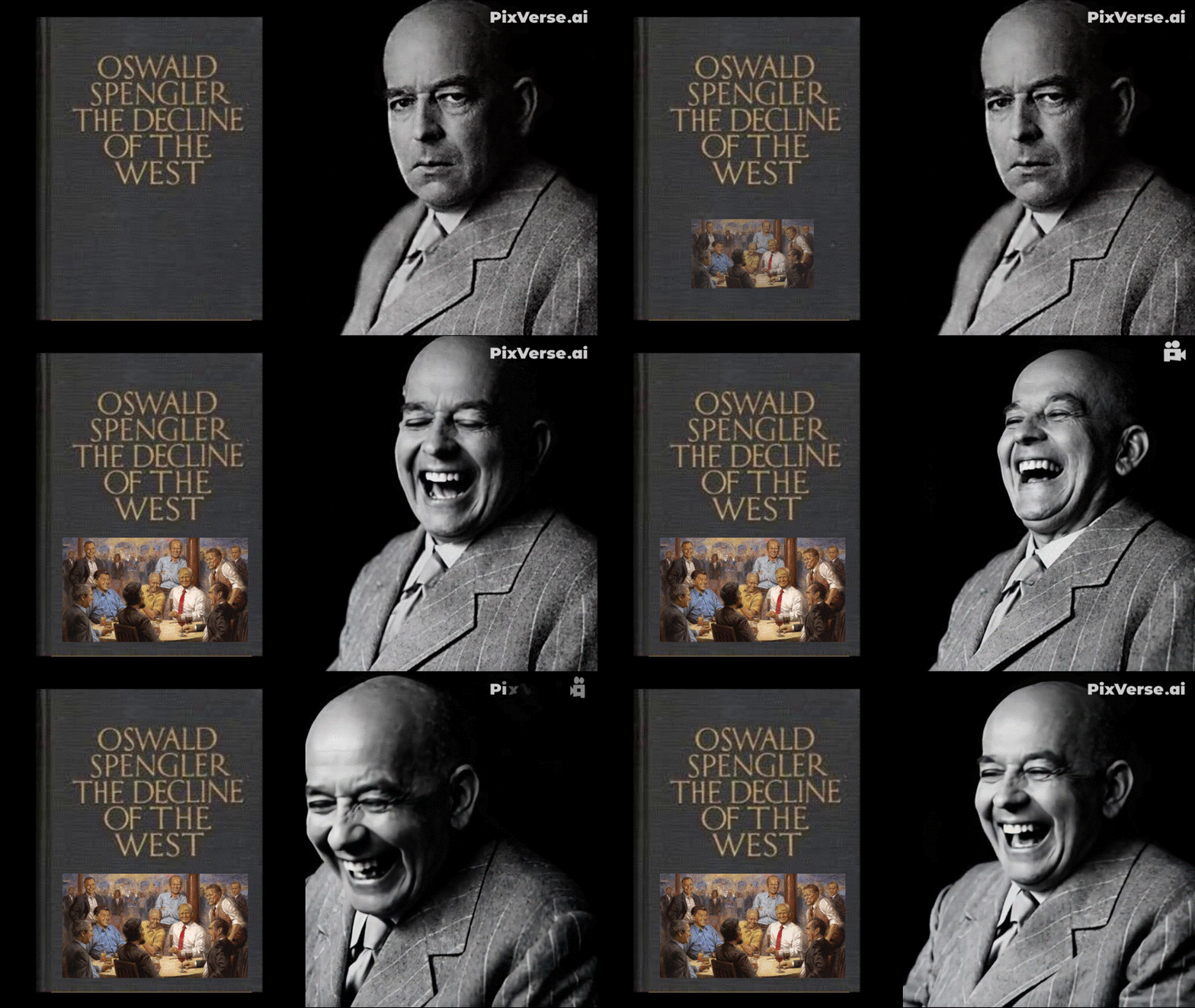
Enjoy it!
 Mind the Post
Even if I agree that the “style” is definitely shocking, I think something had to be done to reach peace. After all, there has been already too many casualties.