
A new report1 by EU Joint Research Centre (JRC) presents a detailed analysis of 221 weak signals in technology development, distributed in 12 clusters, detected over the course of year 2024. The signals were spotted using text mining, clustering techniques and scientometric indicators applied to peer-reviewed scientific publications (Scopus) and patent documents (Patstat).
These are the key findings:
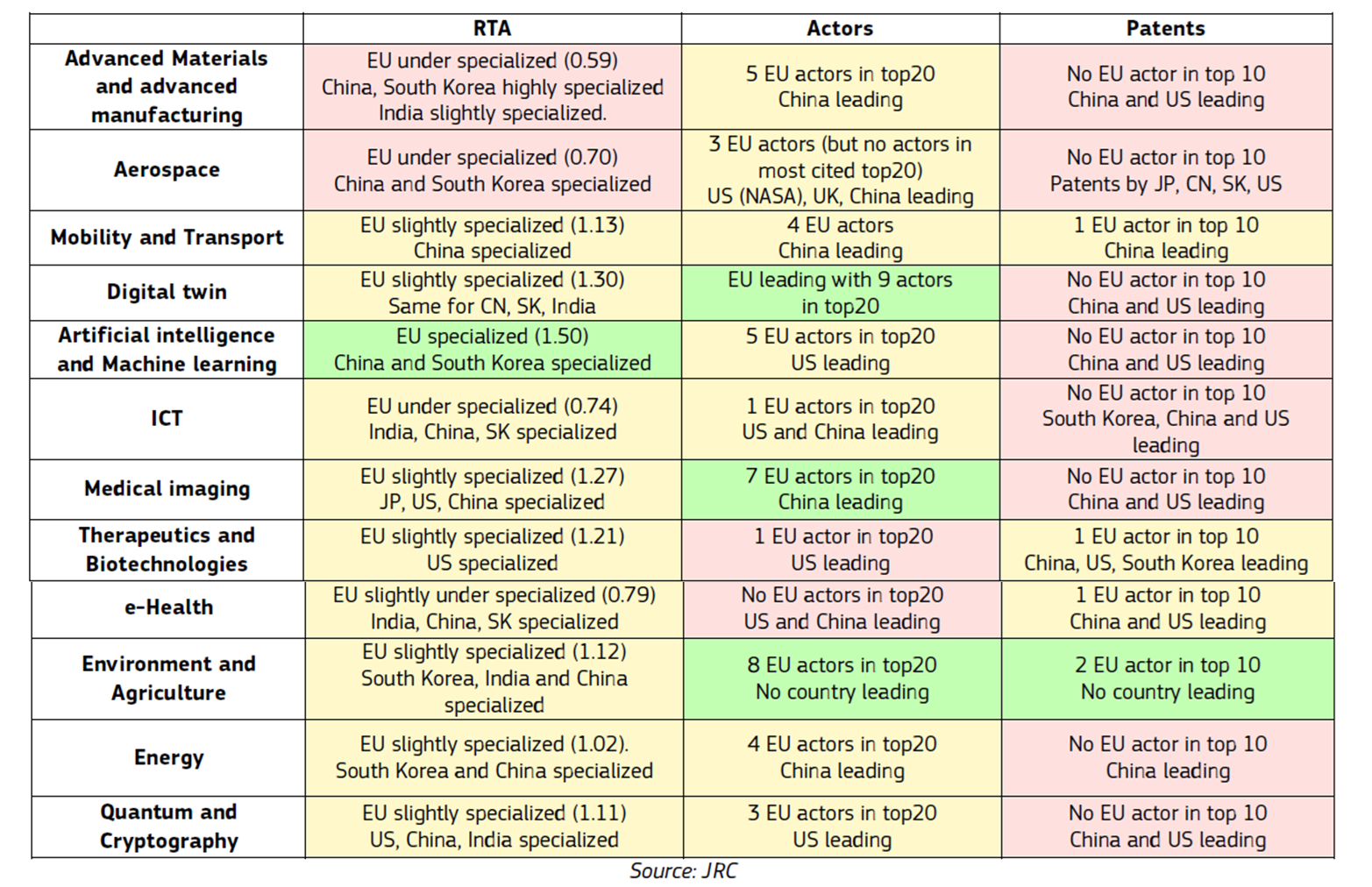
- The United States and China are at the forefront of producing scientific knowledge across most clusters of emerging technologies. China and the US are leading in patenting for all twelve categories.
- European R&D organisations file less patents on their research results than organisations in China or in the United States.
- Although it does not lead, Europe holds a strong position in research for emerging technologies in the clusters of Digital Twin, Artificial Intelligence and Machine Learning, Therapeutics and Biotechnologies, Energy, and Environment and Agriculture, contributing a significant share of scientific publications. European organisations also contribute significantly to top 1% most impactful scientific articles.
- The European R&D ecosystem appears fragmented. While Europe serves as a key global hub for the exchange of scientific knowledge in most of the emerging technologies covered in this report, the presence of European organizations among the top-performing entities is limited. This suggests a lack of critical mass with many strong scientific actors of small size.
- Overall, the European R&D ecosystem does not show specialization across most clusters of emerging technologies, except for Artificial Intelligence and Machine Learning. In this area, Europe demonstrates a certain degree of specialization, though to a lesser extent than China.
The reports concludes identifying some high-level trends shaping the future of technological innovation:
- Emphasis on sustainability and environmental impact.
- Interdisciplinary integration with different areas of expertise merging to propel technological advancement.
- Incorporation of AI and machine learning into various technology fields (e.g. medical imaging, edge computing in agriculture) is transforming traditional processes and enabling new capabilities.
- Advancements in personalization and precision, particularly in healthcare (e.g. personalized therapies like mRNA vaccines and CAR macrophage therapy).
- Non-invasive and minimally invasive approaches are being prioritized to improve user experience and safety.
- Digitalization of systems and data-driven decision-making.
- A heightened focus on security and data privacy,
The trends described above reveal a dynamic global landscape where technological leadership is influenced by a multitude of factors, including government policy, investment priorities, and the agility of research and industry sectors to adapt to the evolving demands of the global economy. The global technological landscape is characterized by intense competition among regions to develop capabilities in key strategic technologies with disruptive potential. In this context, the clusters Quantum and Cryptography or AI & ML stand as prime examples of fields where this dynamic is particularly evident. All major economies demonstrate some relative specialization in various emerging technologies related to these areas, which evidences their understanding of the potential of these emerging technologies to create new opportunities and disrupt existing markets. As emerging technologies appear and new R&D players emerge or grow on the international scene, global technological progress will be shaped by multiple knowledge hubs, adding to the complexity and fierce competition of the worldwide innovation ecosystem.
The report, of course, follows the strict rules of formal reporting, the polar opposite of current political debate. However there is a clear not so weak signal which pervades the whole report. In a time of deepening geopolitical and geoeconomic tensions, Europe should recharge its innovation batteries, and pull its socks up.

____________________
(1) European Commission: Joint Research Centre, Eulaerts, O., Grabowska, M. and Bergamini, M., Weak signals in science and technologies 2024 – Technologies at an early stage of development that could impact our future, Publications Office of the European Union, 2025, https://data.europa.eu/doi/10.2760/6571994
(via Jose M. Roca‘s always updated Informetiplus 👍)
 Mind the Post