Technological advancement and innovation are widely accepted as fundamental sources of economic growth. In recent years, it has been argued that the capabilities to develop and use complex activities are at the core of economic competitive advantages.
However, the link between complexity and economic growth is not straightforward. While most studies acknowledge that complexity primarily determines long-term economic growth, the analyzed periods rarely span more than two decades.
A new study1 addresses this gap. These are their three central hypothesis:
- H1: The capabilities to advance and use technological complexity stimulate economic growth.
- H2a: The relationship between capabilities to advance and use complex technologies and economic growth is time-variant.
- H2b: The positive link between the capabilities to advance and use complex technologies and economic growth (H1) is strong in more recent periods.
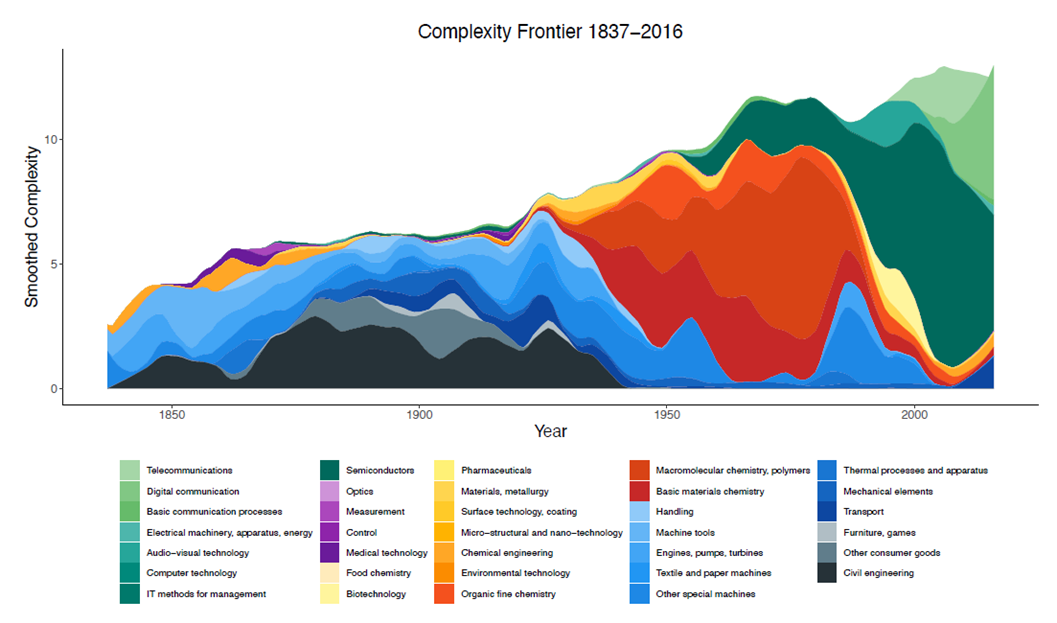
Utilizing patent data and the concept of the so-called complexity frontier proposed by Mewes and Broekel (2022), we empirically capture the capabilities of the US economy to invent and apply the most complex technologies. Secondly, we relate shifts of the frontier over more than 170 years to national economic growth using wavelet gain analysis, which allows a Granger-causal identification of the link between complexity and economic growth, as well as vice versa,
The US complexity2,3 frontier has moved upwards over time, indicating that the capabilities to invent and employ increasingly sophisticated technologies have been growing continuously. However, for the longest time, other factors than the capabilities in the most complex technologies were more important for the growth of the US economy.

Key results:
H1: Our empirical investigation shows that economic development and the economy’s ability to expand its competencies in more complex technologies, i.e., pushing the complexity frontier, are not related for the longest time. Two exceptions are the period 1890-1907 and the time after 1990. Contrary to our expectations, between 1890 and 1907, economic growth enabled an expansion of the complexity frontier, i.e., economic expansion drove the capabilities to invent and utilize complex technologies. Only in the years after 1990 is our primary hypothesis (H1) confirmed.
H2a: Our study goes beyond existing empirical insights by providing empirical support for the timevariant nature of the relationship between technological capabilities and economic growth (hypothesis H2a). Advancing technological capabilities has not always been the strongest direct driver of economic growth in the history of the USA
H2b: Our study also supports our last hypothesis, H2b, implying that the positive link between the capabilities to advance technological complexity and economic growth is more pronounced in recent periods.
Yeah, Economics (and the economy) is complex.
_____________________
(1) Broekel, Tom, and Torben Klarl. ‘The Long-Term Evolution of Technological Complexity and Its Relationship with Economic Growth’. Utrecht University, Department of Human Geography and Spatial Planning …, 2024. http://econ.geo.uu.nl/peeg/peeg2427.pdf
(2) Mewes, Lars, and Tom Broekel. ‘Technological Complexity and Economic Growth of Regions’. Research Policy 51, no. 8 (2022): 104156. https://www.sciencedirect.com/science/article/pii/S0048733320302304
(3) Broekel, Tom. ‘Using Structural Diversity to Measure the Complexity of Technologies’. PloS One 14, no. 5 (2019): e0216856. https://journals.plos.org/plosone/article?id=10.1371/journal.pone.0216856.
 Mind the Post