
It has to be sheer chance that the very same day that catastrophic flash floods resulting from a cold drop (or DANA) killed more than 200 people (and counting) in Spain1, the RAND Corporation published two reports on Global Catastrophic Risk2,3.
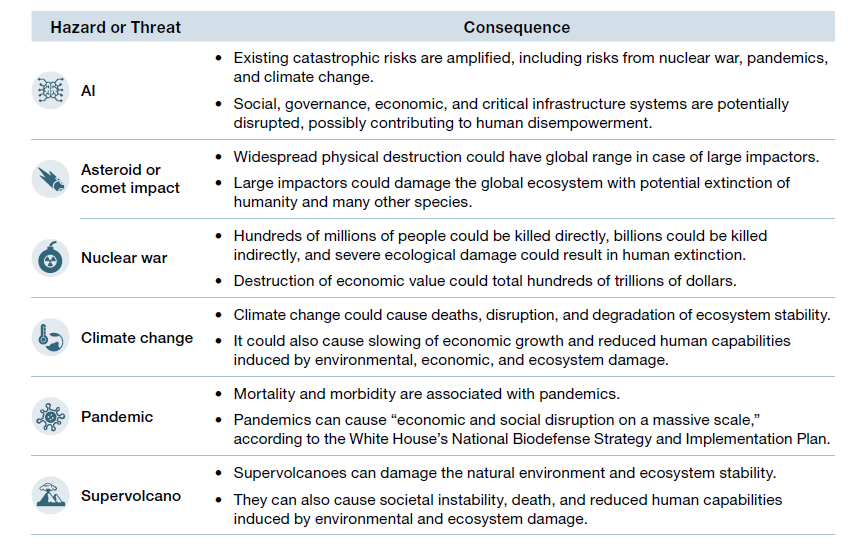
Climate change is one of the six threats and hazards they analyse: artificial intelligence; asteroid and comet impacts; sudden and severe changes to Earth’s climate; nuclear war; severe pandemics, whether resulting from naturally occurring events or from synthetic biology; and supervolcanoes.
And it is an open matter of debate whether the DANA is a direct consequence of raising temperatures and climate change or just an extreme event, aggravated by a dubious risk policy or even a confused political strategy.
This has the fingerprints of climate change on it, these terribly heavy rainfalls, and these devastating floods,” said Hannah Cloke, professor of hydrology at the University of Reading.
Be that as it may, RAND reports conclude that the WORLD4 faces risks from natural hazards and human-caused threats that could significantly harm or set back human civilization at the global scale (i.e., catastrophic risk) or even result in human extinction.
Overall, global catastrophic risk has been increasing in recent years. In the coming decade, catastrophic risk appears to be
- increasing for pandemics, climate change, nuclear conflict, and artificial intelligence (AI)
- constant or decreasing for asteroid and comet strikes and for supervolcanoes.
The hazards and threats identified in the Global Catastrophic Risk Management Act5 (GCRMA)
can vary widely in terms of:
- the geographic extent of potential consequences
- the quality of understanding about the hazards’ and threats’ scope, likelihood, and consequences.
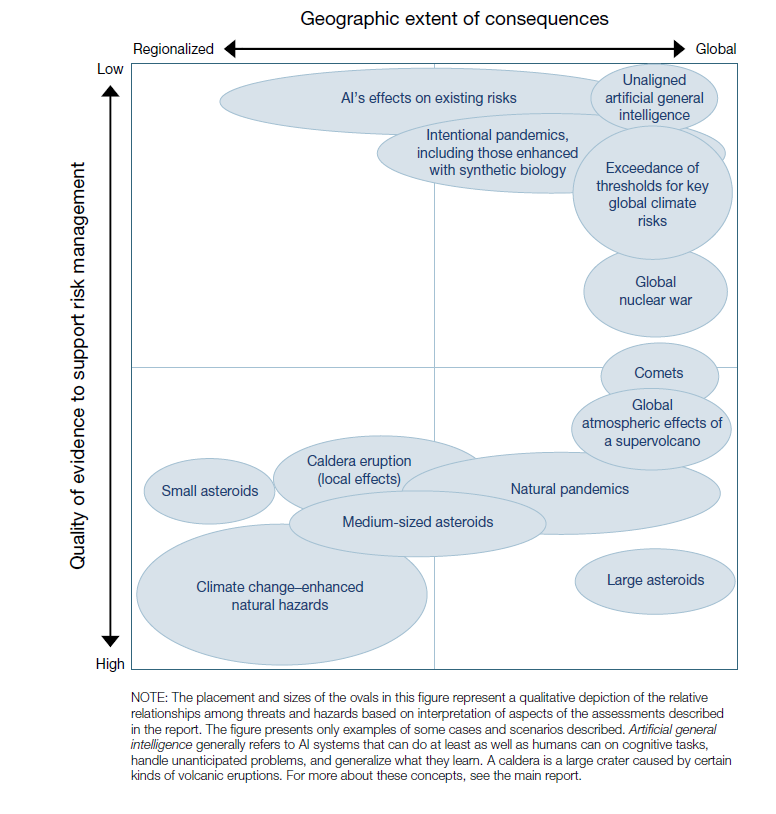
Four key factors govern the changes in risks from the hazards and threats covered in this brief:
- the rate and nature of technological change
- the maturity of global governance and coordination
- failure to advance human development, thereby threatening societal stability
- interactions among the hazards themselves.
I guess it is also sheer chance that only one day before the DANA and RAND Corporation’s reports, the Forecasting Research Institute just published another report6: “Can Humanity Achieve a Century of Nuclear Peace? Expert Forecasts of Nuclear Risk.”
Experts assigned a median 5% probability of a nuclear catastrophe by 2045, while superforecasters put the probability at 1%.
Risks are dispersed roughly uniformly across regional conflict theatres (Russia and NATO, China and the USA, the Korean Peninsula, India and Pakistan, and Israel and Iran).
We are living dangerous times… as we have surely been living always as a species evolving on planet Earth. Chance is the mechanics of reality, but the question I asks myself is whether we are learning something… or not, and whether our collective intelligence and consciousness serves to improve or aggravate our sheer chances.
____________________
(1) May this posts serve to express my condolences and support for all the affected people.
(2) Henry H. Willis et al., Understanding and Managing Global Catastrophic Risk (Santa Monica, CA: RAND Corporation, 2024), https://doi.org/10.7249/RBA2981-1.
(3) Henry H. Willis et al., Global Catastrophic Risk Assessment (Santa Monica, CA: RAND Corporation, 2024), https://doi.org/10.7249/RRA2981-1.
(4) I always marvels how our “metaphors” serve to hide us the crude reality: Are we sure it is actually “the World” “who” is facing those risks?
(5) In 2022, the US Congress passed the GCRMA to provide policymakers, emergency management planners, and other stakeholders with a strategy to respond to catastrophic risks.
(6) Can Humanity Achieve a Century of Nuclear Peace?: Expert Forecasts of Nuclear Risk Williams, B., Karger, E., Persbo A., Pirnavskaia, K., Kamel, K., Schmidt, V., Kuusela, O., Jacobs, Z., Tetlock, P. (Oct 2024)
 Mind the Post