To digest all that has been written on the extremely flexible notion of imagination would be a lifetime’s work. (…) What I offer here is a philosophical overview, and I hope a conceptual clarification, of the most important conceptions of imagination. The topic sprawls promiscuously over philosophy of mind, aesthetics, ethics, poetry, and even religion.
A conceptual pearl1 by Leslie Forster Stevenson:
- The ability to think of something not presently perceived, but spatio-temporally real.
- The ability to think of whatever one acknowledges as possible in the spatio-temporal world.
- The liability to think of something that the subject believes to be real, but which is not.
- The ability to think of things that one conceives of as fictional.
- The ability to entertain mental images.
- The ability to think of anything at all.
- The non-rational operations of the mind, that is, those explicable in terms of causes rather than reasons.
- The ability to form perceptual beliefs about public objects in space and time.
- The ability to sensuously appreciate works of art or objects of natural beauty without classifying them under concepts or thinking of them as useful.
- The ability to create works of art that encourage such sensuous appreciation.
- The ability to appreciate things that are expressive or revelatory of the meaning of human life.
- The ability to create works of art that express something deep about the meaning of life
____________________
(1) Leslie Stevenson, ‘Twelve Conceptions of Imagination’, The British Journal of Aesthetics 43, no. 3 (1 July 2003): 238–59, https://doi.org/10.1093/bjaesthetics/43.3.238.
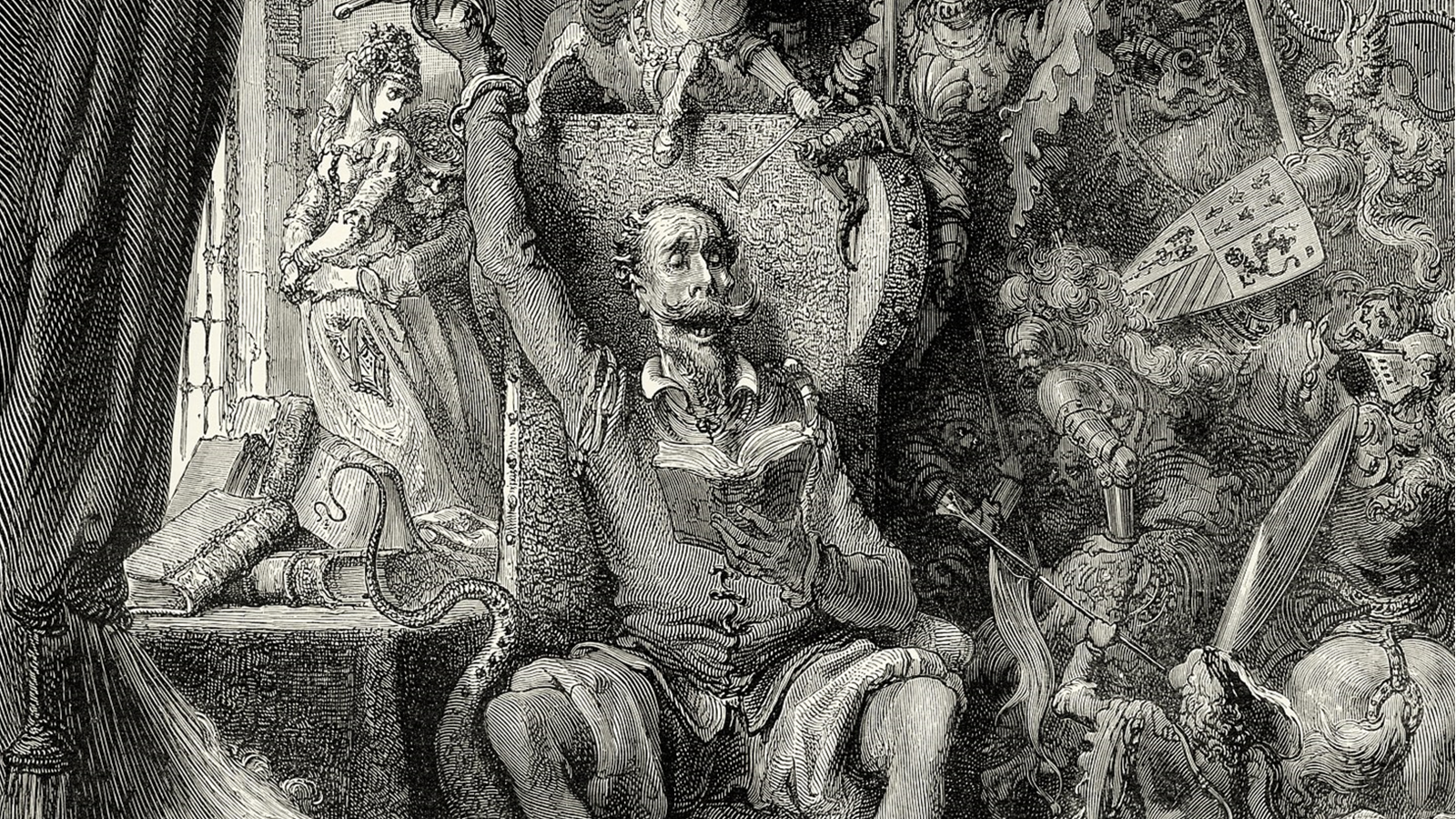
Featured Image: Gustave Doré, Miguel de Cervantes, Don Quixote, Plate 1 (detail). Via wikipedia (Imagination) “Don Quixote, engrossed in reading books of chivalry.”
 Mind the Post