
Policymakers across the world devote enormous energy to fostering nascent technologies, ranging from efforts to support academic research to luring start-ups from other cities and nations. Such strategies are often predicated on the notion that early advantages in innovation and employment will yield lasting benefits for regions, particularly in the form of high-quality employment.
In fact, the concentration of innovation in a handful of urban centers engenders large and persistent regional disparities in economic opportunity.
A working paper1 in which Nicholas Bloom et. al. have been working since at least 2021 identifies new technologies using textual analysis of quarterly earnings conference calls, patents, and online job postings (my emphasis).
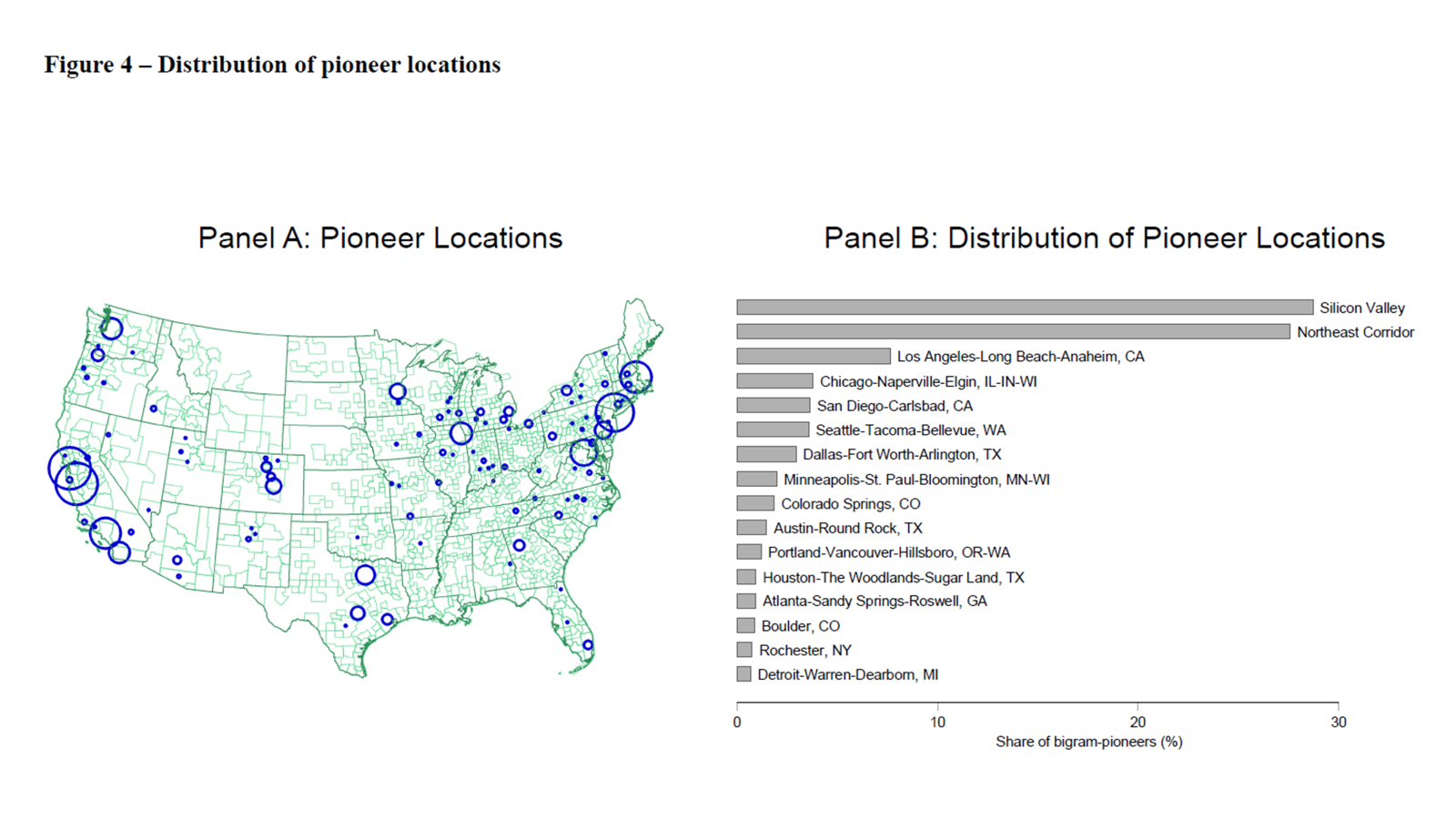
We identify phrases associated with novel technologies using textual analysis of patents, job postings, and earnings calls, enabling us to identify four stylized facts on the diffusion of jobs relating to new technologies. First, the development of economically impactful new technologies is geographically highly concentrated, more so even than overall patenting: 56% of the most economically impactful technologies come from just two U.S. locations, Silicon Valley and the Northeast Corridor. Second, as the technologies mature and the number of related jobs grows, hiring spreads geographically. But this process is very slow, taking around 50 years to disperse fully. Third, while initial hiring in new technologies is highly skill biased, over time the mean skill level in new positions declines, drawing in an increasing number of lower-skilled workers. Finally, the geographic spread of hiring is slowest for higher-skilled positions, with the locations where new technologies were pioneered remaining the focus for the technology’s high-skill jobs for decades.
The dataset constructed as part of this paper is available at Diffusion of New Technologies.

New “ideas” spread at a very slow pace!
____________________
Nicholas Bloom et al., ‘The Diffusion of New Technologies’, Working Paper (Federal Reserve Bank of St. Louis, 26 August 2024), https://econpapers.repec.org/paper/fipfedlwp/98770.htm.
Featured Image: NightCafe
 Mind the Post