
The Nobel Prize in Physics 2024 has just been awarded to John J. Hopfield and Geoffrey E. Hinton
for foundational discoveries and inventions that enable machine learning with artificial neural networks
John Hopfield created a structure that can store and reconstruct information (Hopfield network or associative memory). Geoffrey Hinton developed a stochastic extension of Hopfield’s model called the Boltzmann machine. Both the Hopfield model and the Boltzmann machine are recurrent neural networks, which were soon used to develop successful applications, including pattern recognition in images, languages and clinical data.
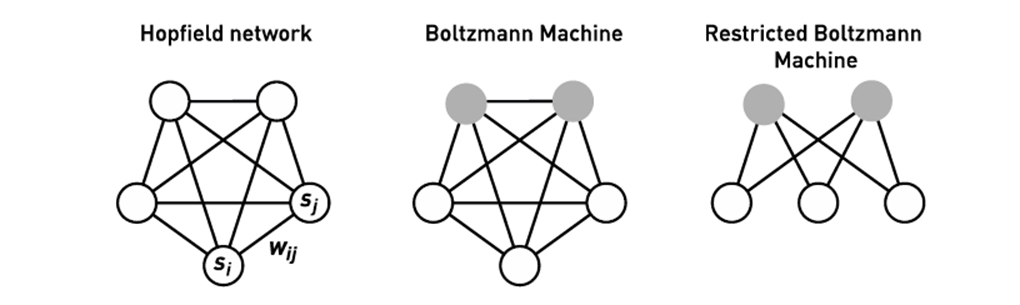
With its roots in the 1940s, machine learning based on artificial neural networks (ANNs) has developed over the past three decades into a versatile and powerful tool, with both everyday and advanced scientific applications. With ANNs the boundaries of physics are extended to host phenomena of life as well as computation
Inspired by biological neurons in the brain, ANNs are large collections of “neurons”, or nodes, connected by “synapses”, or weighted couplings, which are trained to perform certain tasks rather than asked to execute a predetermined set of instructions. Their basic structure has close similarities with spin models in statistical physics applied to magnetism or alloy theory. This year’s Nobel Prize in Physics recognizes research exploiting this connection to make breakthrough methodological advances in the field of ANN.
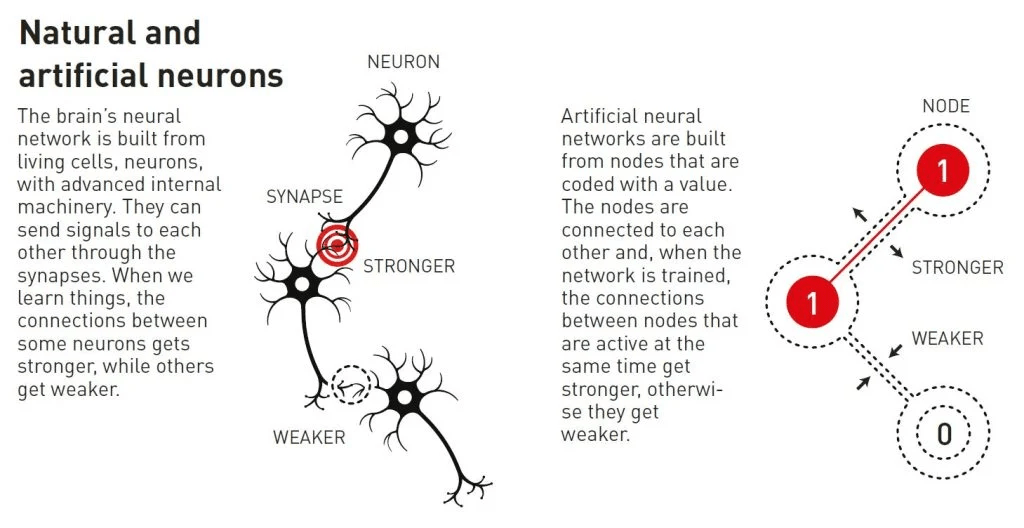
The scientific background shared by the Royal Swedish Academy of Sciences stresses the “bidirectional” connection between the achieved results in the development of Artificial Neural Networks (and today’s Deep Learning), and Physics. Their laureates used physics to find patterns in information:
Much of the above discussion is focused on how physics has been a driving force underlying inventions and development of ANNs. Conversely, ANNs are increasingly playing an important role as a powerful tool for modelling and analysis in almost all of physics.
The pioneering methods and concepts developed by Hopfield and Hinton have been
instrumental in shaping the field of ANNs. In addition, Hinton played a leading role in the efforts to extend the methods to deep and dense ANNs.With their breakthroughs, that stand on the foundations of physical science, they have showed a completely new way for us to use computers to aid and to guide us to tackle many of the challenges our society face,
The remark is necessary because some experts are critizicing the decision1: This is not physics!
John Hopfield is a theoretical physicist, a towering figure in biological physics, with seminal previous work in the 1970s, while Geoffrey Hinton is a computer scientist and cognitive psychologist, winner of the 2018 Turing Award, often referred to as the “Nobel Prize of Computing,” and deeply (pun intended) involved in the current debate on AI.
This Nobel Prize in Physics strikes a chords with someone (the writer of this blog) who studied physics and started his carreer with the application of different physics inspired methods to mathematical optimization and operations research.
If the physics was the leading science during first half of 20th century, computer science and synthetic biology will very likely be the ones leading progress throughout the rest of the 21st century. And maybe with this prize what we are watching are only the signals showing the future of science evolving along a broader, less constrained path.
An interesting challenge for Alfred Nobel’s heirs!
to endow “prizes to those who, during the preceding year, have conferred the greatest benefit to humankind”
____________________
(1) This is a technical and marginal note (to take with a pinch of salt, but worth it): A Nobel Prize for Plagiarism, by Jürgen Schmidhuber. According to Wikipedia, “Schmidhuber has controversially argued that he and other researchers have been denied adequate recognition for their contribution.”
Featured Image(s): The Nobel Prize in Physics 2024. NobelPrize.org. Nobel Prize Outreach AB 2024. Tue. 8 Oct 2024.
 Mind the Post