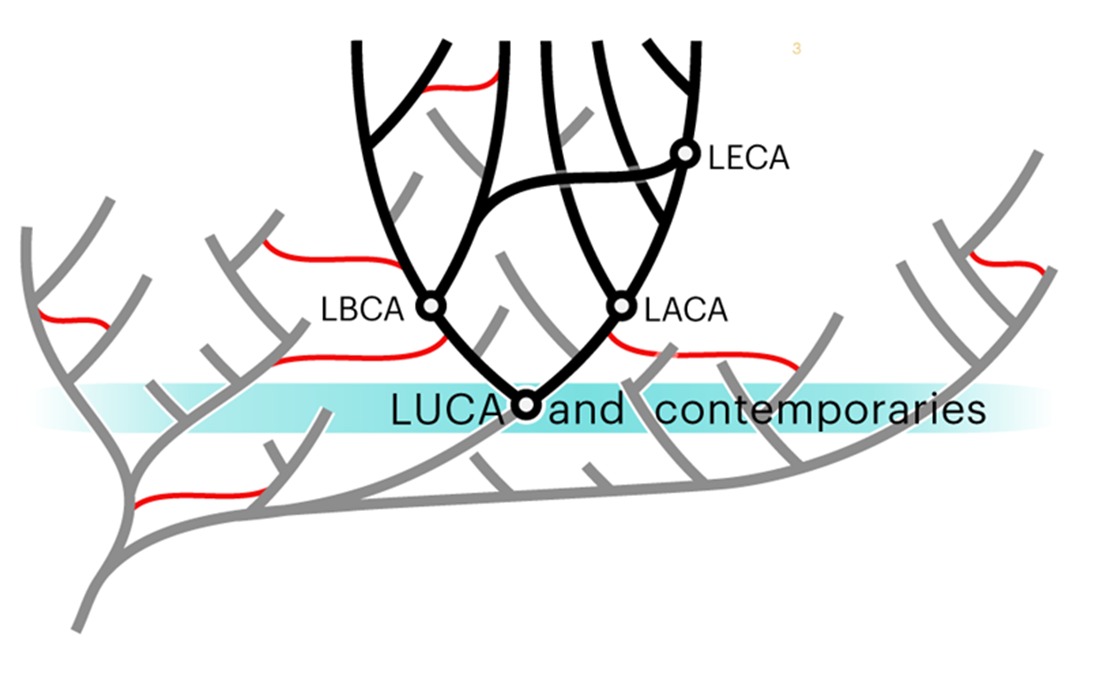
The last universal common ancestor (LUCA) is the hypothesized common ancestral life “node” from which the three domains of life, the Bacteria, the Archaea, and the Eukarya originated.
How old is IT?
Previous estimates are in conflict either due to conceptual disagreement about what LUCA is or as a result of different methodological approaches and data. Was LUCA a simple or complex organism? What kind of environment did it inhabit?
A new study1 infers that LUCA lived ~4.2 Ga (4.09–4.33 Ga), that’s about only ~400 million years after Earth’s formation:

The nature of the last universal common ancestor (LUCA), its age and its impact on the Earth system have been the subject of vigorous debate across diverse disciplines, often based on disparate data and methods. Age estimates for LUCA are usually based on the fossil record, varying with every reinterpretation. The nature of LUCA’s metabolism has proven equally contentious, with some attributing all core metabolisms to LUCA, whereas others reconstruct a simpler life form dependent on geochemistry. Here we infer that LUCA lived ~4.2 Ga (4.09–4.33 Ga) through divergence time analysis of pre-LUCA gene duplicates, calibrated using microbial fossils and isotope records under a new cross-bracing implementation. Phylogenetic reconciliation suggests that LUCA had a genome of at least 2.5 Mb (2.49–2.99 Mb), encoding around 2,600 proteins, comparable to modern prokaryotes. Our results suggest LUCA was a prokaryote-grade anaerobic acetogen that possessed an early immune system. Although LUCA is sometimes perceived as living in isolation, we infer LUCA to have been part of an established ecological system. The metabolism of LUCA would have provided a niche for other microbial community members and hydrogen recycling by atmospheric photochemistry could have supported a modestly productive early ecosystem.
____________________
(1) Moody, Edmund R. R., Sandra Álvarez-Carretero, Tara A. Mahendrarajah, James W. Clark, Holly C. Betts, Nina Dombrowski, Lénárd L. Szánthó, et al. ‘The Nature of the Last Universal Common Ancestor and Its Impact on the Early Earth System’. Nature Ecology & Evolution, 12 July 2024. https://doi.org/10.1038/s41559-024-02461-1.
 Mind the Post