
The “2023 Expert Survey on Progress in AI,” or ESPAI, is the third study by Katja Grace et. al. in a series, with the first two conducted in 2016 and 2022. The 2023 survey includes 2,778 researchers, around four times as many participants as the 2022.
This to our knowledge constitutes the largest survey of AI researchers to date.
The survey asked1:
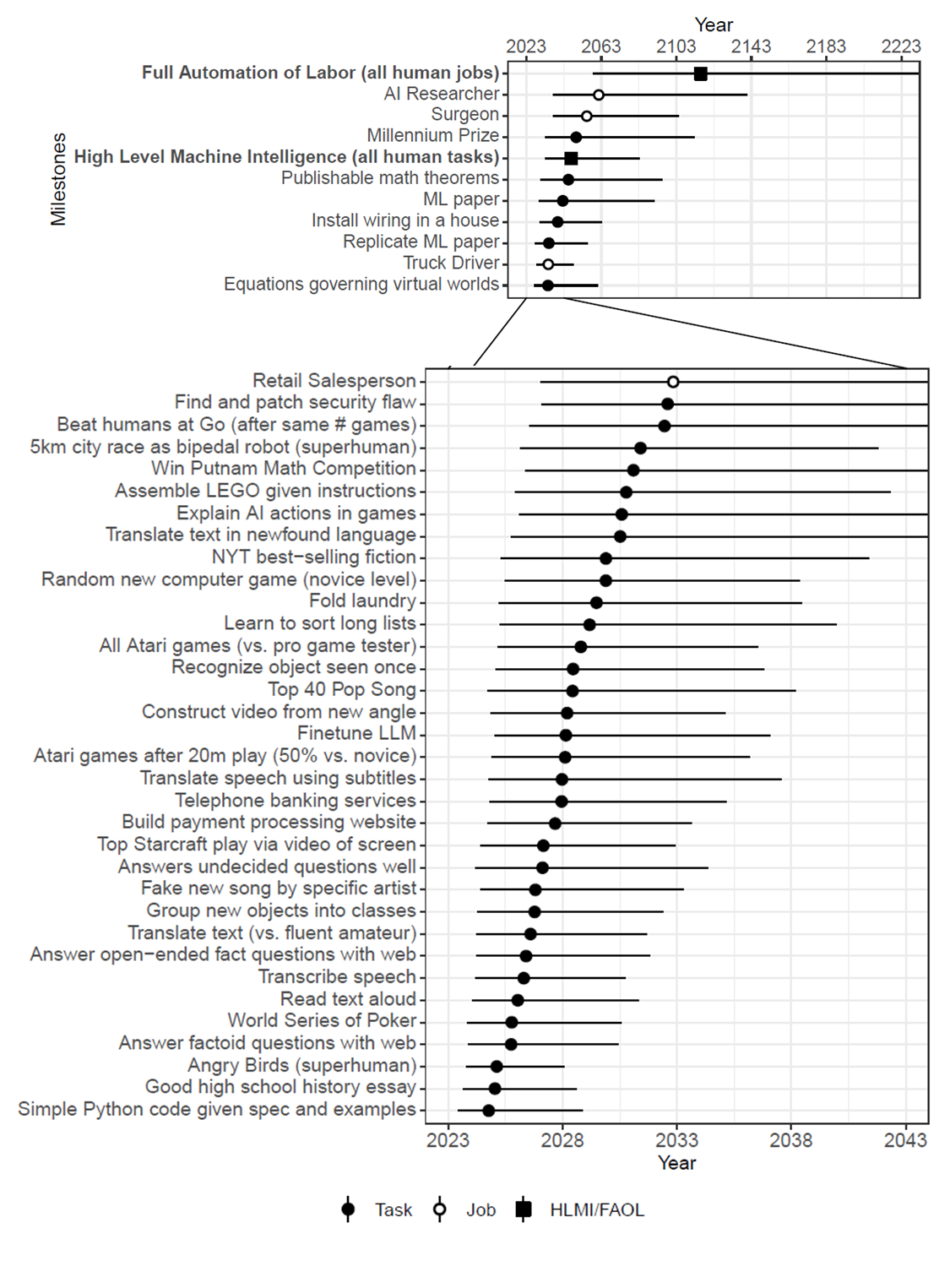
1. – When each of 39 tasks would become feasible, where “feasible” was described as meaning “one of the best resourced labs could implement it in less than a year if they chose to. Ignore the question of whether they would choose to.”
All but four of the 39 tasks were predicted to have at least a 50% chance of being feasible within the next ten years.
2.- How soon participants expected AI systems to outperform humans across all activities, where
- Tasks, in the question about “High-Level Machine Intelligence” (HLMI),
- Occupations, in the question about “Full Automation of Labor” (FAOL).
2.1- How soon will High-Level Machine Intelligence (HLMI) be feasible?
High-level machine intelligence (HLMI) is achieved when unaided machines can accomplish every task better and more cheaply than human workers. Ignore aspects of tasks for which being a human is intrinsically advantageous, e.g. being accepted as a jury member. Think feasibility, not adoption.
The aggregate 2023 forecast predicted a 10% chance of HLMI by 2027, down two years from 2029 in the 2022 survey.

2.2- How soon will ‘Full Automation of Labor’ be feasible?
Say an occupation becomes fully automatable when unaided machines can accomplish it better and more cheaply than human workers. Ignore aspects of occupations for which being a human is intrinsically advantageous, e.g. being accepted as a jury member. Think feasibility, not adoption.
[. . . ]
Say we have reached ‘full automation of labor’ when all occupations are fully automatable. That is, when for any occupation, machines could be built to carry out the task better and more cheaply than human workers.
The aggregate 2023 forecast predicted a 50% chance of FAOL by 2116, down 48 years from 2164 in the 2022 survey
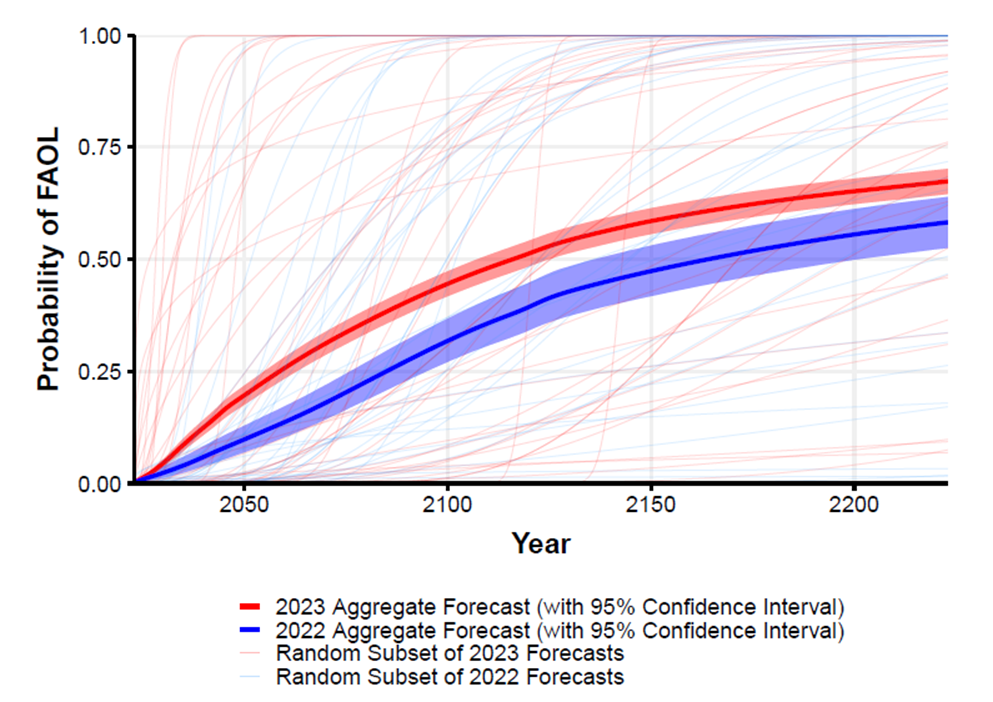
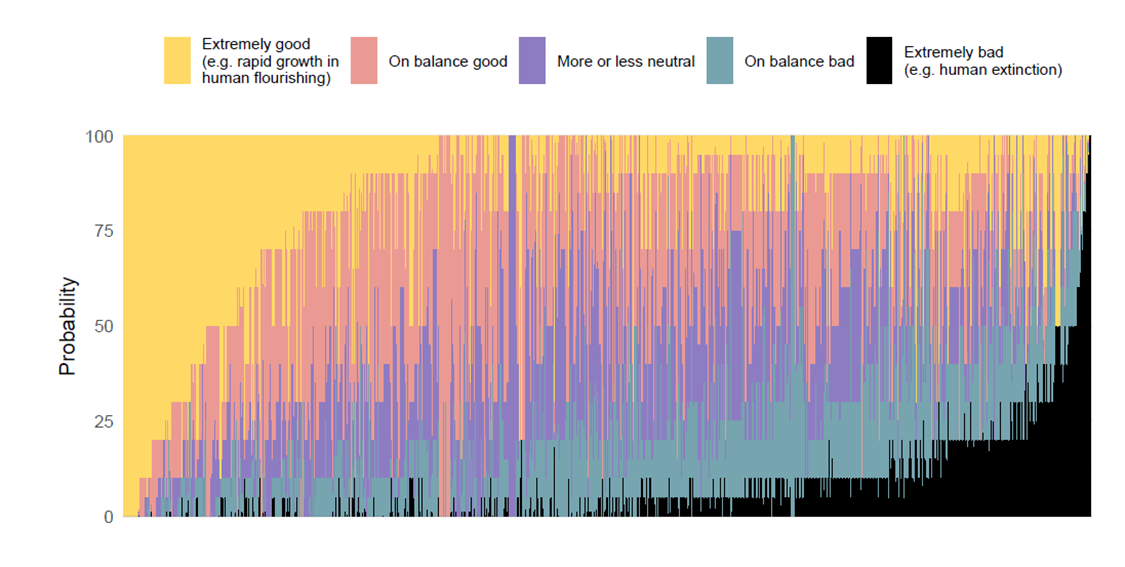
Participants expressed a wide range of views on almost every question: some of the biggest areas of consensus are on how wide-open possibilities for the future appear to be. This uncertainty is striking, but several patterns of opinion are particularly informative.
Another striking pattern is widespread assignment of credence to extremely bad outcomes from AI.
Don’t despair!
Experts in forecasting and uncertainty, like Philip E. Tetlock or Granger Morgan (explicitly quoted in the paper), emphasize that forecasting is difficult in general, and subject-matter experts have been observed to perform poorly!
____________________
(1) Grace, Katja, Harlan Stewart, Julia Fabienne Sandkühler, Stephen Thomas, Ben Weinstein-Raun, and Jan Brauner. ‘Thousands of AI Authors on the Future of AI’. arXiv, 5 January 2024. https://doi.org/10.48550/arXiv.2401.02843.
Featured Image: Lexica Art
 Mind the Post
[…] capabilities, applications, risks, and expectations over the next 2, 3, 5, 10, 25 years ahead, and even farther distant horizons. Not a single week pass without the publication of new findings, analyses and reports. It is […]