
“I see world history as a picture of endless formations and transformations, the marvellous waxing and waning of organic forms (Oswald Spengler, The Decline of the West)
More than one century ago, Oswald Spengler predicted that about the year 2000, Western civilization would enter a period of pre‑death emergency whose countering would lead to 200 years of Caesarism before Western civilization’s final collapse. He strongly influenced famous historians like Arnold J. Toynbee, or Samuel P. Huntington. Perhaps less known is that he also influenced H. P. Lovecraft. They lived a period of history particularly scary 😱.
We entered the new century happily thinking they were all crazy prophets. However, looking to our most recent history, from the pandemics starting in 2019 to wars in Ukraine, Gaza, and the turmoil in politics, it is difficult not to look backward and fear (or bet) that perhaps Splengler’s foresight was not completely farfetched. What do we know about it?
Short answer. Next to nothing.
How large-scale, hierarchical organizations emerge and why they sometimes abruptly broke down remains an intriguing enigma and open question for historians, politicians, futurist, and to be fair, all of us. A new article1 explores if aging affects the chances of termination. Authors focus on states: sets of centralized institutions that extract resources from, and impose rules on, a territorially circumscribed population:
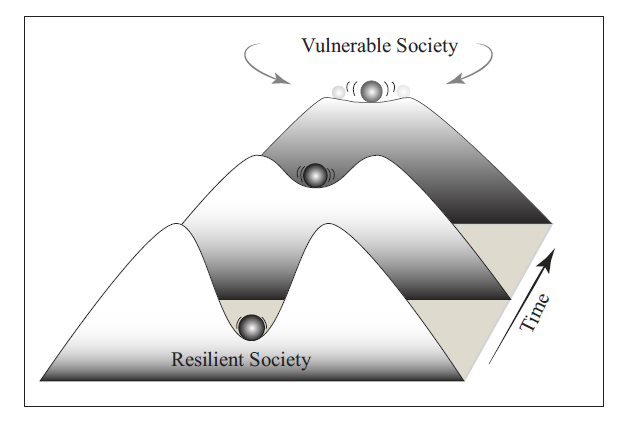
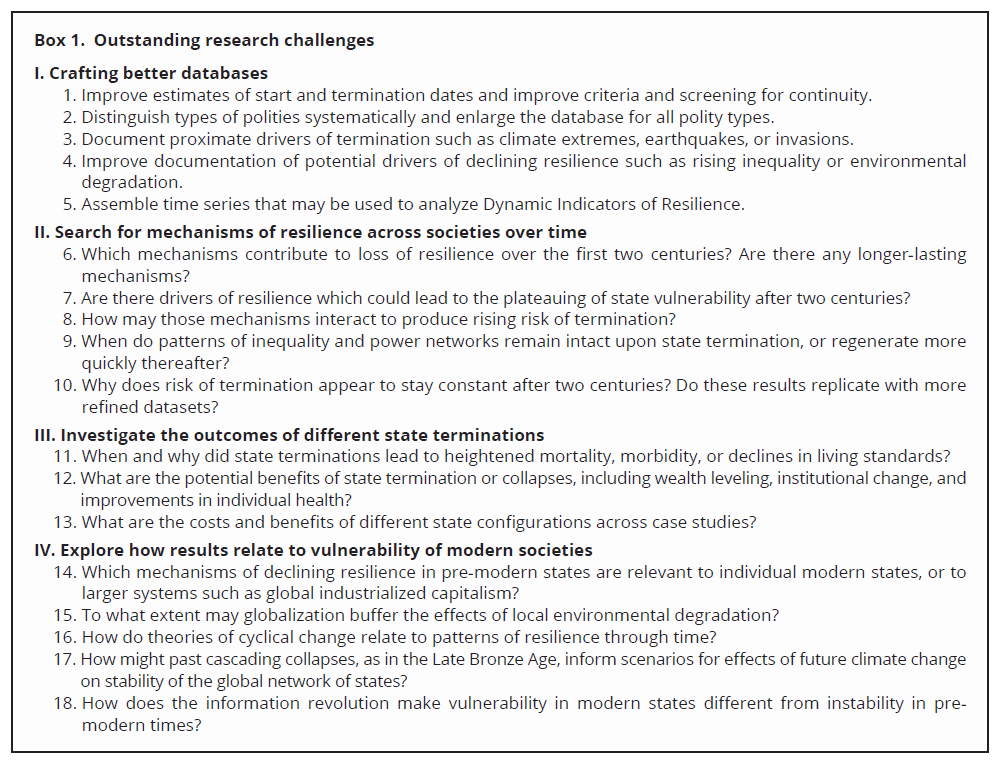
As the termination of states or societies has remained difficult to attribute to single causes, scholars have called for a complex systems approach. We offer the modest beginnings of this. Our results point to a common pattern of gradual loss of resilience across states during the first two centuries of their existence. Various mechanisms could plausibly contribute to such rising vulnerability. Over time, environmental degradation (e.g., deforestation, soil erosion, and salinization) and growing population numbers may lead to scarcity. Also, disease risks may rise in increasingly crowded settings. In addition, there is a tendency for wealth to fall increasingly into the hands of a small elite, causing a rising gulf between elites and the rest. This can lead to heightening corruption and poorer decision-making and to the exacerbation of a range of social ills, including interpersonal violence. Poor decision-making refers to choices which benefit the elite rather than the public and that are less responsive to impending challenges and risks. Increasing population and elite numbers coupled with declining real or relative wages could also generate civil strife and breakdown. Lastly, the overhead costs of growing societal complexity may drain resources. All such mechanisms might make aging societies less resilient when they are hit by adverse events.
A classical question in search of a modern answer. Let’s hope we find one before it’s too late and we sucumb to cosmicism and Cthulhu!
____________________
(1) Scheffer, Marten, Egbert H. van Nes, Luke Kemp, Timothy A. Kohler, Timothy M. Lenton, and Chi Xu. ‘The Vulnerability of Aging States: A Survival Analysis across Premodern Societies’. Proceedings of the National Academy of Sciences 120, no. 48 (28 November 2023): e2218834120. https://doi.org/10.1073/pnas.2218834120.
Featured Image: The Call of Cthulhu, Weird Tales
 Mind the Post
