
Over hundreds of millions of years, many biological species have evolved the ability to amplify their collective intelligence, making groupwise decisions that are significantly more accurate than individuals could make on their own. Biologists refer to the emergent decision-making abilities of natural organisms as Swarm Intelligence and it operates very differently from the statistical method pioneered by Galton1.
Instead of aggregating asynchronous estimates like humans do, biological populations form real-time synchronous systems that enable participants to engage in a multi-directional tug-of-war, pushing and pulling on the system until a solution emerges that best represents the combined sentiments of the population.
This is why fish school, birds flock, and bees swarm. The most famous species for Swarm Intelligence in nature is likely the honeybee which has been studied for decades and arguably demonstrates superintelligent abilities.
If this works for bees and fish – why not people?
In 2015 a new CI technology was proposed called Artificial Swarm Intelligence (or Swarm AI) to enable networked human groups to form real-time systems with features similar to bee swarms2.
Collective Superintelligence has been Louis Rosenberg‘s focus as an AI researcher for the last decade. The goal is not to replace human intellect, but to amplify it by connecting large groups of people into superintelligent systems that can solve problems no individual could solve on their own, while also ensuring that human values, morals and interests are inherent at every level.
How can we enable hundreds, thousands, or even millions of individuals to hold real-time conversations that are thoughtful and coherent and converge on solutions that amplify their collective intelligence?
The core problem is that human conversations are most productive in groups of 4 to 7 and quickly degrade as groups grow larger. This size limitation for human conversations seemed like an impenetrable barrier in building a true Collective Superintelligence until about 18 months ago when advances in the field of AI, including large language models (LLMs), opened new pathways for architecting human swarms.
Using a concept developed in 2018 called hyperswarms it is possible to divide real-time human groups into overlapping subgroups. But Information needs to propagate across the whole population. This was solved using AI agents to emulate the function of the lateral line organ in fish.
The resulting technology is called Conversational Swarm Intelligence (CSI) and it promises to allow groups of almost any size (from 200 to 2 million people) to discuss complex problems in real-time and converge on meaningful solutions that are amplified by the natural power of swarm intelligence3.
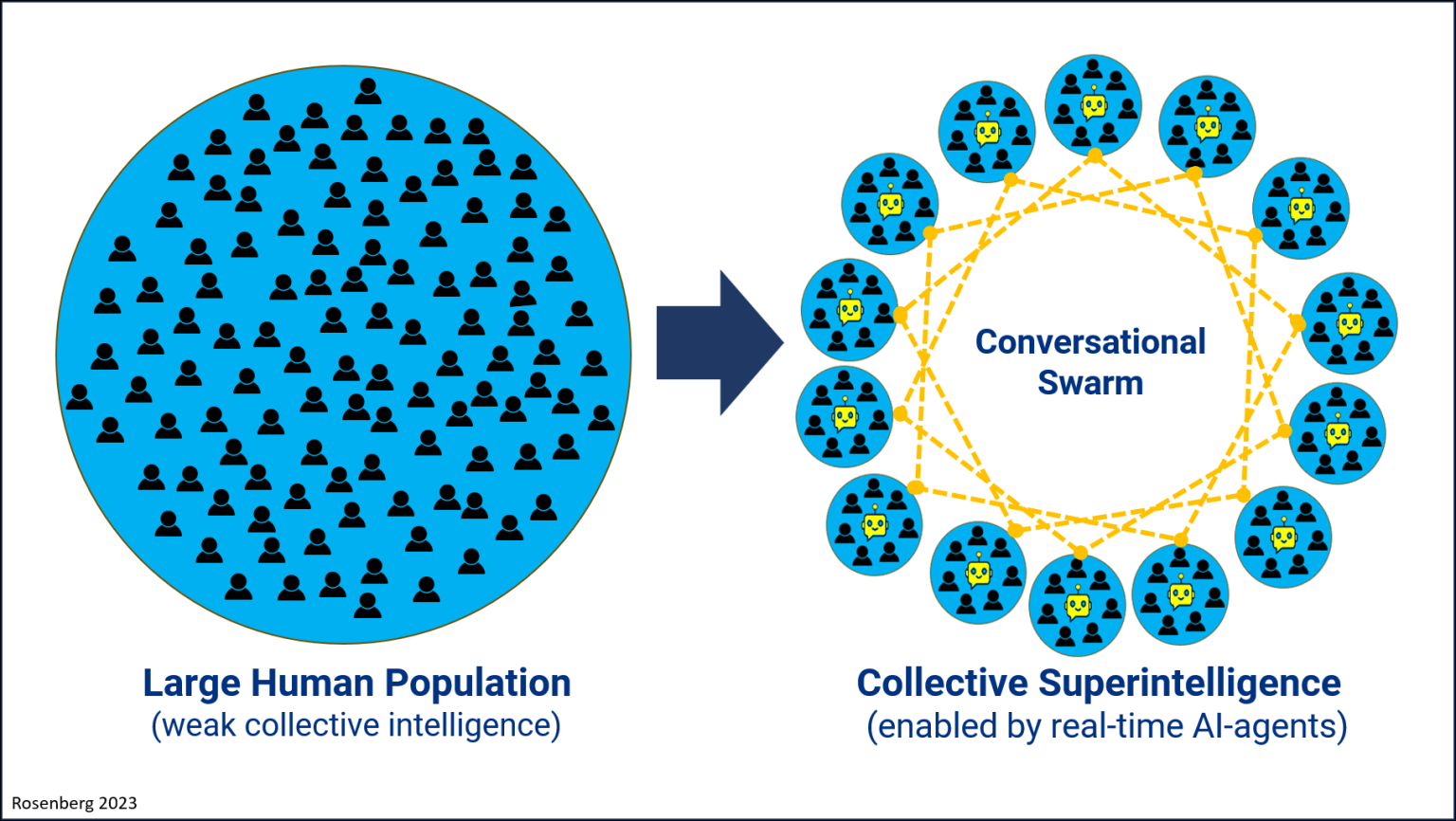
Real-time conversational deliberation is a critical groupwise method for reaching decisions, solving problems, evaluating priorities, generating ideas, and producing insights. Unfortunately, real-time conversations are difficult to scale, losing effectiveness as groups grow above 5 to 7 members. Conversational Swarm Intelligence (CSI) is a new technology modeled on the dynamics of biological swarms. It aims to enable networked groups of any size to hold productive real-time deliberations that converge on unified solutions. CSI leverages the power of Large Language Models (LLMs) in a unique and powerful way, allowing real-time dialog among small local groups while simultaneously enabling efficient content propagation across much larger populations. In this way, CSI combines the benefits of small-scale deliberative reasoning and large-scale collective intelligence.
The results1 are fascinating, according to Rosenberg 😉
____________________
(1) Rosenberg, Louis, Gregg Willcox, and Hans Schumann. ‘Towards Collective Superintelligence, a Pilot Study’. arXiv, 31 October 2023. https://doi.org/10.48550/arXiv.2311.00728.
(2) Rosenberg, Louis B. “Human Swarms, a real-time method for collective intelligence.” Artificial Life Conference Proceedings. One Rogers Street, Cambridge, MA 02142-1209, USA journals-info@ mit. edu: MIT Press, 2015.
(3) Rosenberg, Louis, Gregg Willcox, Hans Schumann, and Ganesh Mani. ‘Conversational Swarm Intelligence (CSI) Enhances Groupwise Deliberation’. arXiv, 14 September 2023. https://doi.org/10.48550/arXiv.2309.12366.
Featured Image: Photograph by Jason Edwards illustrating New Yorker’s short Trailhead, written by E. O. Wilson, 2010
 Mind the Post