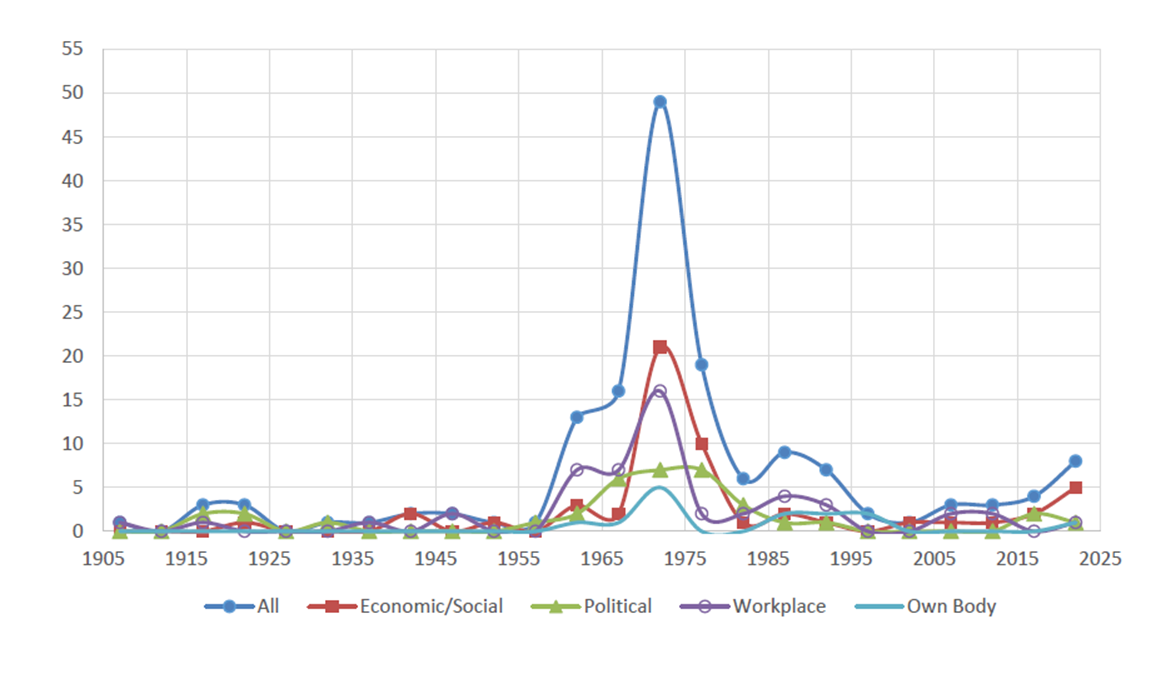
The very same day it was announced, last Monday, she was publishing her latest (working) paper Why Women Won, and interesting recap and reflection on the 155 critical moments in women’s rights history She has been compiling from 1905 to 2023.
Chronology of Critical Moments in US Women’s Rights History: 1908 to 2023. Fig 2 Op. cit.
But in this post, I just want to look to an even more personal essay by Claudia Goldin published in 1998.
I have always wanted to be a detective and have finally succeeded.
I recall the precise moment when I switched my attention to the evolution of the female labor force. I had few ideas about the location of evidence; fewer still on what the evolution was. But I knew it would be a story of importance, relevant to the current period, and a project for which my detective work would pay off. I also knew that I was the one to do it.
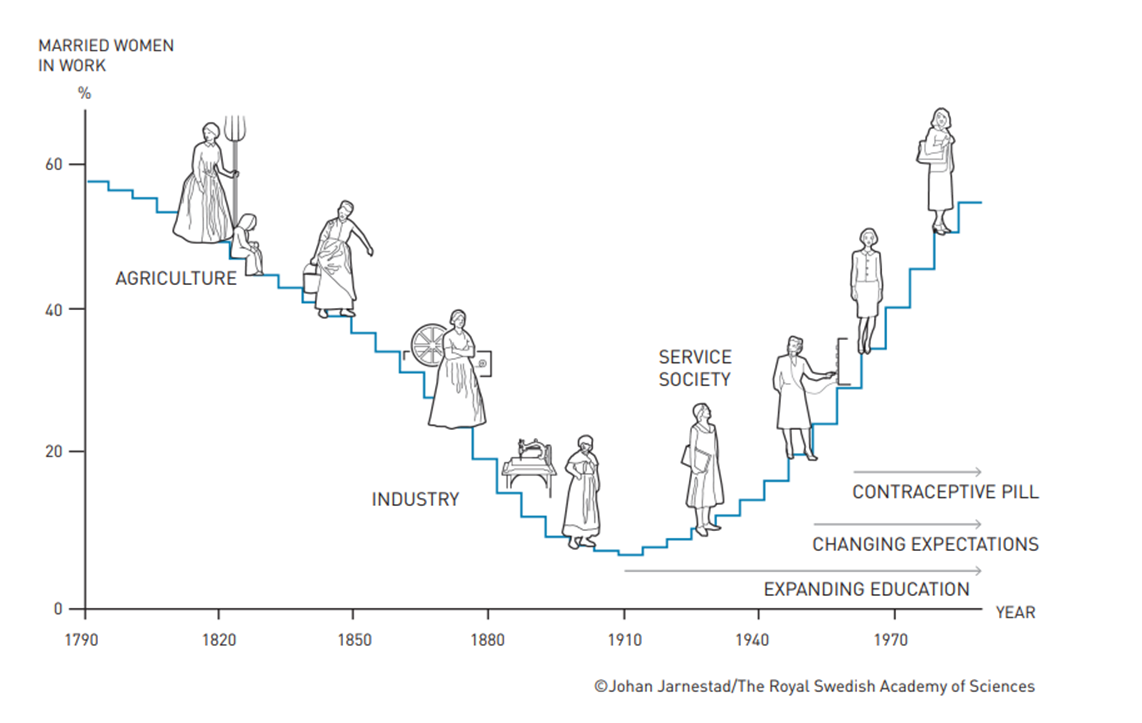
The central question I posed was “why did the female labor force expand at certain times and for certain cohorts.” What had caused married women to increase their market participation rate from around 5% to 70% across this century?
I pushed the project forward in time (almost to the present) and backward (to the 1790s). When I began the project I thought I could find all the data I needed in published census documents. I soon discovered that even recent data were not as I wanted, and, strangely enough, data from the more distant past were often better than those nearer to the present.
I quickly realized that because labor force participation tells one nothing about who participates and for how long, such data were insufficient for my project (…) I soon discovered, as well, that today’s labor force construct was not used prior to 1940 (…) I needed to know the truth about the female labor force from 1790 to the present. What would a great detective do?
I am an incurable optimist, some may say naive. I was convinced that I would find enough clues to piece together the history of the female labor force.
Although I eventually wrote Understanding the Gender Gap: An Economic History of American Women (1990), I wasn’t certain, until the year of its writing, that a book would emerge. A book requires that the author find a “voice” and my “voice” kept changing.
I’m asked frequently when I’ll write a more popular version of Understanding. I wish I had the time to do it. I should. But I’m happiest being a detective.
What is it like to be a woman and work in a field still dominated by men?
As I work I pretend I’m my worst enemy and attack every idea, piece of theory, and empirical method. Battles rage and often I lose. But I really win, of course.
Presenting your ideas out loud (to a seminar, a friend, your dog) subjects them to a scrutiny that is different from the act of writing them down. I’m not certain why that is the case. It may be that writing allows one to disguise and obscure errors of logic, but that saying the words out loud (even to a dog) makes one painfully aware of the inconsistencies. Students are important for just that reason. They respond with basic, elementary questions, often the ones that your colleagues won’t ask. Even when they don’t respond, they at least take the place of the dog (by the way, I love dogs). Teaching and research have always gone hand and hand in my life. I can’t do one without the other. I’d like more time to write, but I would never want to be without students, both undergraduate and graduate. Some of my grandest ideas are expressed in my undergraduate course.
Certain pieces of economic research are so flawlessly executed and so elegantly written that we are lured into believing that their authors are simply better researchers and writers than we are. That may be true. But the person whose work we so admire has also worked very hard at both the substance and the writing.
Learn how to write from the errors of others. They provide a limitless supply.
Summary: (1) Most importantly, find a topic of substance about which you feel passionately. (2) Then be the best detective you can be. (3) Go back and forth among theory, empirics, and stories until you iterate on the very best truth you can tell. Sherlock Holmes was known to remark that: “It is a capital mistake to theorize in advance of the facts.” And Joe Friday always sought: “the facts, Ma’m, just the facts.” They may have been great detectives, but they would have made lousy economists. (4) And, because nothing of value is easy or simple, you must: plod, plod, plod; question, question, question; write, rewrite, and rewrite again. Be your own worst enemy, so that no one else is. Put the work away and read it with new eyes, not those of its creator. (5) Find your own “voice.” (6) And I hope that you will discover the importance of history and of long-term trends in the knowledge you create
Claudia is obviously a better researcher and writer than I am. However, I am an incurable naive, I have always wanted to be a detective, and here I am, trying learn how to write from the errors of others… the best.


 Mind the Post