
The National Risk Register (NRR) outlines the most serious risks facing the United Kingdom. Deputy Prime Minister Oliver Dowden announced the new release on August 3, 2023.
This is the most comprehensive risk assessment we’ve ever published, so that government and our partners can put robust plans in place and be ready for anything.
Cabinet Office, 3 August 2023
To read the British government’s risk register is like sifting through a game of apocalyptic Top Trumps. It lists the many, varied, and sometimes splattery ways in which Britons might be wiped out—then assigns scores to them.
The Economist
The NRR includes information about 89 risks, within 9 risk themes (although several risks could be categorised under more than one theme):
- Terrorism
- Cyber
- State threats
- Geographic and diplomatic
- Accidents and systems failures
- Natural and environmental hazards
- Human, animal and plant health
- Societal
- Conflict and instability
Risk in NRR are assessed as ‘reasonable worst-case scenarios’. These scenarios are not a prediction of what is most likely to happen, instead they represent the worst plausible manifestation of that particular risk. The risks that meet the threshold for inclusion in the NRR would have a substantial impact on the UK’s safety, security and/or critical systems at a national level.
- Non-malicious risks (such as natural hazards) are assessed over 5 years as they can be assessed with confidence over a longer timeframe. Assessment timescales for malicious risks (from malign actors who seek to do us harm) remain at 2 years.
- All risks in the NSRA have a wide range of impacts, whether on individuals, businesses, regions or the whole country. To capture this range, the NSRA assesses impact across 7 broad dimensions: human welfare, behavioural impacts, essential services, economic damage, environmental impact, security and international impact.
The likelihood and impact of risks are plotted onto a matrix, enabling users to compare risks and inform contingency planning.
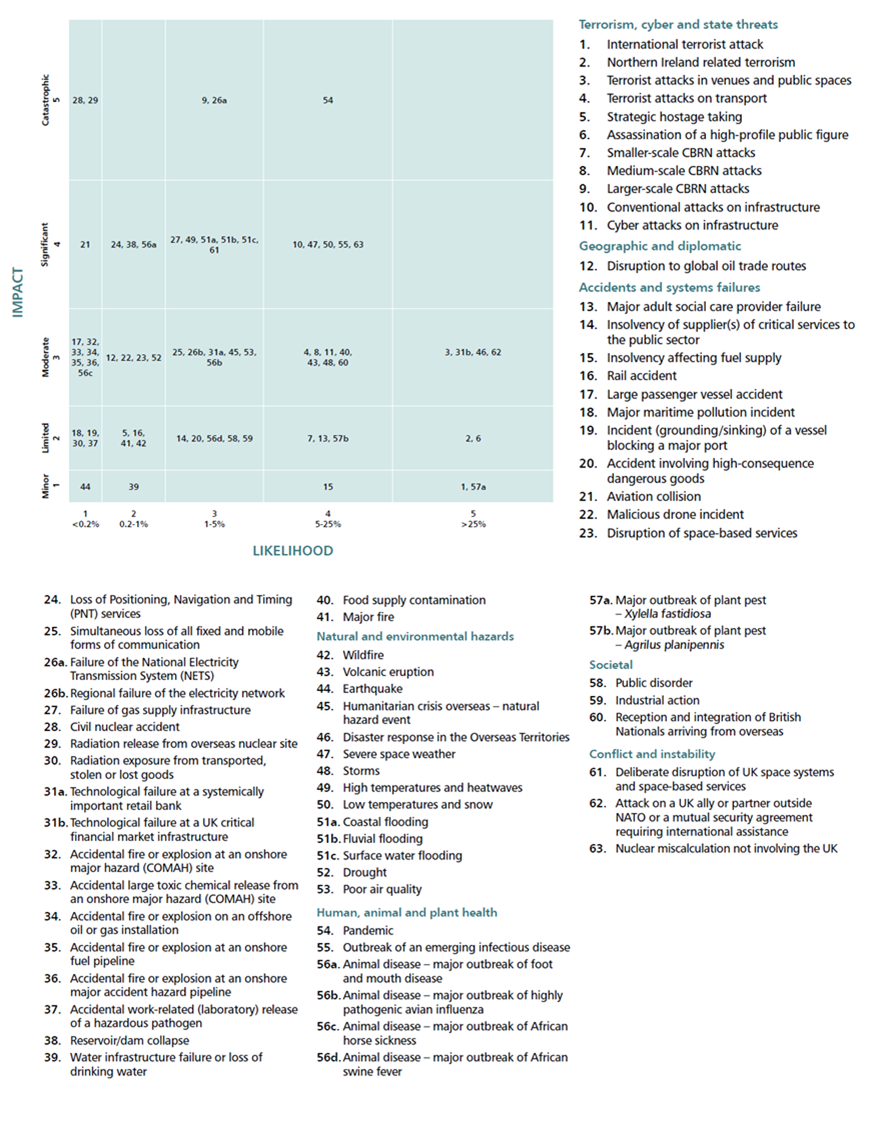
5 risks are identified as catastrophic, with likelihoods ranging from remote (0-5%) to highly unlikely (5-25%):
- 28. Civil nuclear accident
- 29. Radiation release from overseas nuclear site
- 9. Larger-scale Chemical, Biological, Radiological and Nuclear (CBRN) attacks
- 26a. Failure of the National Electricity Transmission System (NETS)
- 54. Pandemic
8 risks are identified the most likely, between Unlikely (25-35%) and Almost certain (95-100%), with impacts ranging from Minor (1) to Moderate: (62):
- 1. International terrorist attack
- 57a. Major outbreak of plant pest – Xylella fastidiosa
- 2. Northern Ireland related terrorism
- 6. Assassination of a high-profile public figure
- 3. Terrorist attacks in venues and public spaces
- 31b. Technological failure at a UK critical financial market infrastructure
- 46. Disaster response in the Overseas Territories
- 62. Attack on a UK ally or partner outside NATO or a mutual security agreement requiring international assistance
As Unamuno said, Truth before peace.
____________________
Featured Image: Microsoft Bing
 Mind the Post