
In 1970, Salvador Allende became president of Chile, and he began an ambitious effort to bring about socialist change through peaceful, democratic means. His commitment to changing Chile’s long-standing social and economic structures set the stage for a technological experiment.
A small team of people in the Chilean government believed that bringing Chile’s most important industries under state control could be addressed through the use of computer and communications technology. It was a huge challenge. By 1970, the Soviet Union had already tried and failed to build a national computer system for managing a planned economy. U.S. ARPANET, the predecessor of the Internet, was still in its infancy. Chile had approximately fifty computers installed in the government and the private sector, most of which were out of date, whereas approximately 48,000 general-purpose computers were installed in the United States at the time.
They set out to create a new system for industrial management in collaboration with a group of British technologists. In mid-1971, Fernando Flores, then a high-ranking member of the Chilean Production Development Corporation (CORFO), approached Stafford Beer, a British theorist, consultant and professor with some provocative cybernetic ideas, for advice on applying his cybernetic theories to the management of the state-run sector of the Chilean economy. From 1971 to 1973, the transnational team worked on the creation of a new technological system, which they called Project Cybersyn in English or Proyecto Synco in Spanish.
The system included a computerized economic simulator, which would give government policy makers an opportunity to test their economic ideas before implementation. In a little over a year the team built a prototype of the system and hoped that, once complete, it would help the government stay in power and improve the state of the Chilean economy. On 11 September 1973, the project ended with Pinochet’s coup d’état.
The rest is history which you can read in a fantastic text(1) compiled by Eden Medina and published in 2011.
Allende was not allowed to continue with his social and political experiment. Today, 50 years later, in the middle of our current AI frenzy (and geopolitical turmoil), the question is more urgent than ever: Can advances in computer technology ease central planning?
This is the question addressed by a paper(2) published by Vicente Moreno-Casas, Victor I. Espinosa, and William Wang, The Political Economy of Complexity: The Case of Cyber-Communism. Their answer is what you probably suspect: Complexity theory shows that central planning of the economy is impossible(3).
This article analyzes cyber-communism and the feasibility of central planning from complexity theory. It first introduces the most known definitions of complexity in economics, namely computational and dynamic complexity. This enables to construct a complexity political economy from which then deal with cyber-communism. This political economy highlights the notion of cultivation, as a natural selection approach to established successful institutions and rules. In contrast to cultivation, the article presents the notion of control, which corresponds to traditional political economy, as the belief in the effective alteration of economic variables by a group of planners or policymakers. This work emphasizes some problems central planning faces: self-reference, noncomputability of optimal points, reflexivity, and less adaptive capacity. It concludes that cyber-communism conflicts with a complexity political economy based on cultivation, and that cyber-communist planning is not realistic, ultimately meaning that technology cannot allow and effective socialist planning.
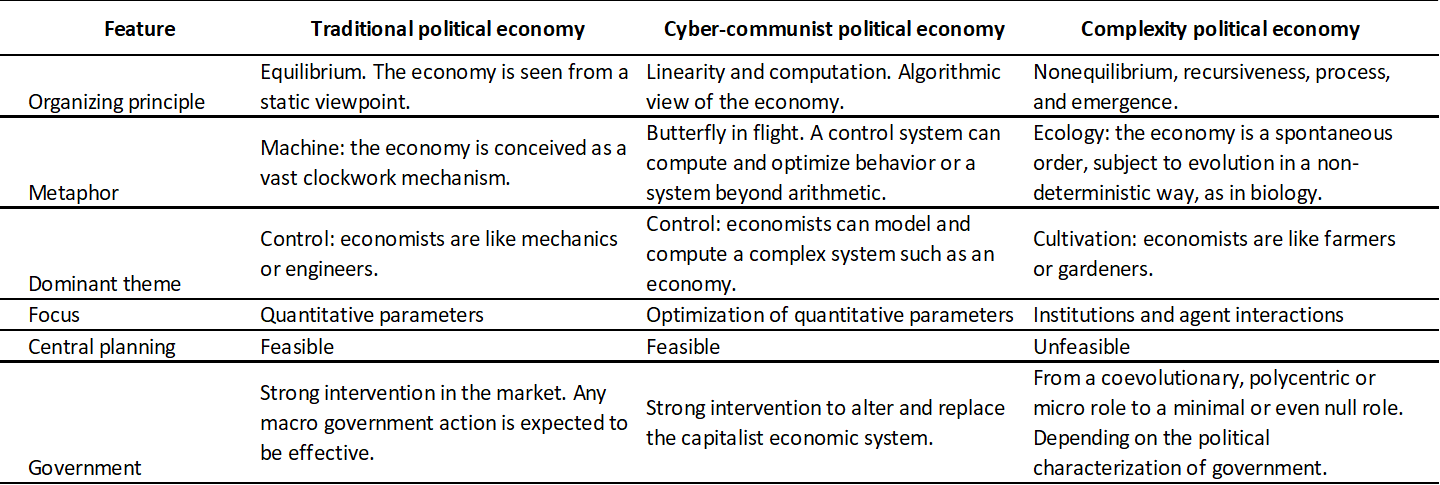
Given that control is incompatible with a complexity vision, Donald Lavoie proposes that political economy should be oriented toward cultivation. The term was first coined by Friedrich Hayek. He employed cultivation in the sense “in which the farmer or gardener cultivates plants, where he knows and can control only some of the determining circumstances.”
____________________
(1) Medina, Eden. Cybernetic Revolutionaries: Technology and Politics in Allende’s Chile. Mit Press, 2011. https://mitpress.mit.edu/9780262525961/cybernetic-revolutionaries/
(2) Moreno-Casas, Vicente, Victor I. Espinosa, and William Hongsong Wang. ‘The Political Economy of Complexity: The Case of Cyber-Communism’. Journal of Economic Behavior & Organization 204 (1 December 2022): 566–80. https://doi.org/10.1016/j.jebo.2022.10.042.
(3) The abstract in preprint is a little bit more “explicit:” This work emphasizes the impossibility of central planning of a complex system due to the noncomputability of a global optimum, a self-reference problem, and the existence of emergent dynamics
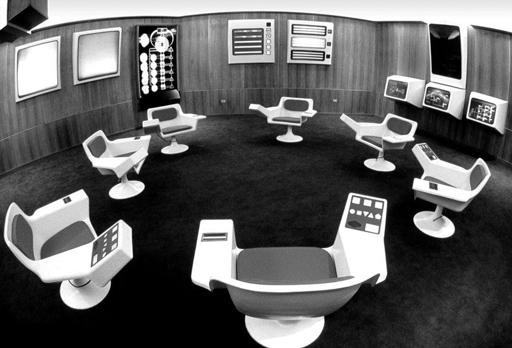
Featured Image: Computer-generated image of Project CyberSyn operations room.
 Mind the Post
[…] productivity and the elimination of identity. It is an idea recognized by all those who have argued in favour or against mechanization of […]