Here is my presentation at “Empowering Futures – Long-term Governance, Democracy and Futures Research,” the 23rd international Futures Conference – Futures Conference 2023 – organized by the Finland Futures Research Centre and the Finland Futures Academy, University of Turku, Finland, hosting the Helsinki Node of The Millennium Project.

🌍 Spain. A Country for the future?
Over the last 2+centuries technological innovation has played a fundamental role in economic development, wealth creation and social progress. Spain has not played and do not play today a leading role in the field. Since the advent of democracy in 1978, the country has undergone a remarkable economic and social transformation. However, it has not been enough to substantially reduce the income gap it maintains with the most advanced economies in the world. We wonder why and we briefly explore some historical clues.
Our objective is to understand the key forces driving change, and the most important factors and levers driving the evolving socio techno economic transition. We use our country, Spain, as a test and showcase, but our objective is to outline an holistic model inspired by scenario planning and game theory to study future adaptive strategies available to meaningful players/agents in the futures game over the next 25-50 years.
You can read the paper1 in which it is based.
And here are some of the key takeaways from the text, generated by Googlel’s AI Chatbot Bard (not a bad summary)
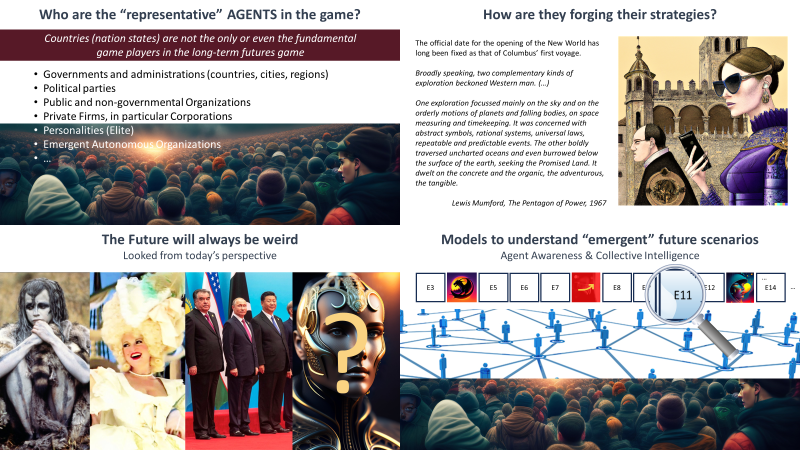
- The Futures Game is a simplified model that can be used to identify and evaluate options for the future.
- The model assumes that there are many different players who can influence the future of a country’s economy.
- The model also assumes that each player has a particular vision (image of the future), and that they will take actions to try to make that vision a reality.
- The aggregated actions of all the players will determine the emergent scenario.
- The authors believe that the model can be used to simulate the complex dynamics of multiple individual agents interacting in a competitive world.
- They also believe that the model can be used to help players make better decisions about the future.
I hope this summary is helpful. Let me know if you have any other questions.
(Bard dixit 😉
More on the motivation for the paper here. And here is also a video recorded at Sicómoro Club, where the authors we have the opportunity to present and discuss (in Spanish, of course) about the ideas in the paper, moderated by Fernando Garcia-Quismondo (Thanks Fernando!).
A Mini Report of the Turku Conference by Sirkka Heinonen, who invited me to participate (Thanks Sirkka!).
____________________
Jariego, Francisco J. and Peñuelas, Isabel F., Spain: A Country for The Future (May 8, 2023). SSRN: https://ssrn.com/abstract=4441432 or http://dx.doi.org/10.2139/ssrn.4441432
 Mind the Post
[…] Interestingly, John Burn-Murdoch have adapted and extended their analysis to include Spain, which was economically competitive with Britain well into the 17th century, but then fell behind. Why? […]
[…] feel alien to us. Or, in other words, weird. This is exactly the possibility we explore in our Futures Game. Usually under stressed or avoided in future studies, and mainly explored through dystopian science […]
[…] feel alien to us. Or, in other words, weird. This is exactly the possibility we explore in our Futures Game. Usually under stressed or avoided in future studies, and mainly explored through dystopian science […]